
Technische Daten
| Formel | C19H21ClN4 |
||||||
| Molekulargewicht | 340.85 | CAS-Nr. | 950455-15-9 | ||||
| Löslichkeit (25°C)* | In vitro | DMSO | 68 mg/mL (199.5 mM) | ||||
| Ethanol | 18 mg/mL (52.8 mM) | ||||||
| Water | Insoluble | ||||||
| In vivo (Lösungsmittel einzeln und der Reihe nach zum Produkt hinzufügen.) |
|
||||||
|
* <1 mg/ml bedeutet schwer löslich oder unlöslich. * Bitte beachten Sie, dass Selleck die Löslichkeit aller Verbindungen intern testet und die tatsächliche Löslichkeit geringfügig von veröffentlichten Werten abweichen kann. Dies ist normal und ist auf geringfügige Batch-zu-Batch-Variationen zurückzuführen. * Versand bei Raumtemperatur (Stabilitätstests zeigen, dass dieses Produkt ohne Kühlmaßnahmen versendet werden kann.) |
|||||||
Vorbereitung von Stammlösungen
Biologische Aktivität
| Beschreibung | Liproxstatin-1 ist ein potenter Ferroptosis-Inhibitor mit einer IC50 von 22 nM. | ||
|---|---|---|---|
| Ziele |
|
||
| In vitro | Liproxstatin-1 ist in der Lage, Ferroptose im niedrigen Nanomolarbereich zu hemmen und das Wachstum von Gpx4−/−-Zellen mit einer IC50 von 22 nM zu hemmen. Diese Verbindung (50 nM) verhindert vollständig die Lipidperoxidation in Gpx4−/−-Zellen. Es (200 nM) schützt in einer dosisabhängigen Weise vor FINs wie BSO (10 µM), Erastin (1 µM) und RSL3 (0,5 µM), während es den durch Staurosporin (0,2 µM) und H2O2 (200 µM) induzierten Zelltod nicht verhindern kann. | ||
| In vivo | Liproxstatin-1 verlängert die Überlebenszeit im Vergleich zur mit dem Vehikel behandelten Gruppe erheblich, verzögert die Ferroptose in Tubuluszellen und mildert Gewebeschäden bei ischämie-/reperfusionsbedingten Leberschäden. |
Protokoll (aus Referenz)
| Zell-Assay: |
|
|---|---|
| Tierstudie: |
|
Referenzen
|
Kundenproduktvalidierung
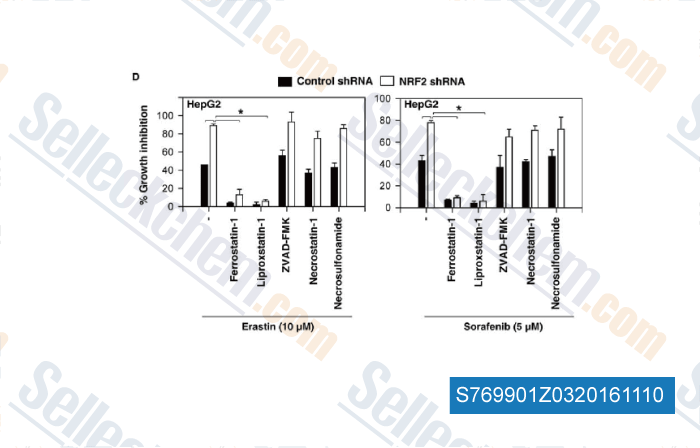
-
,
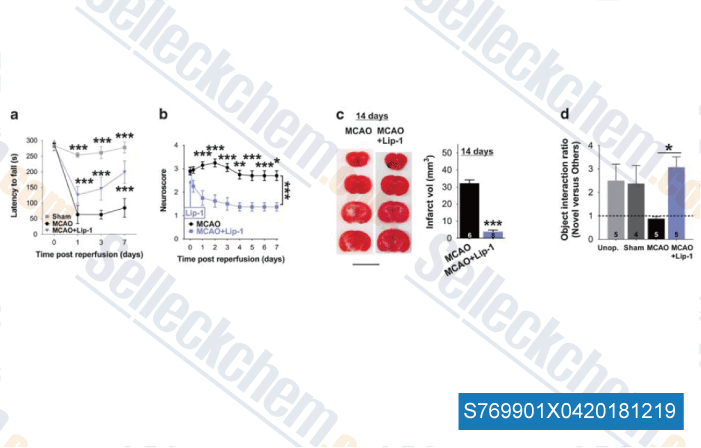
-
Daten von [ , , Mol Psychiatry, 2017, 22(11):1520-1530 ]
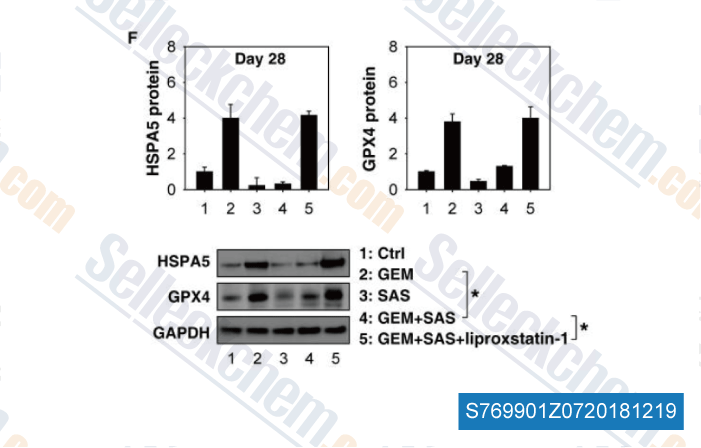
-
Daten von [ , , Cancer Res, 2017, 77(8):2064-2077 ]
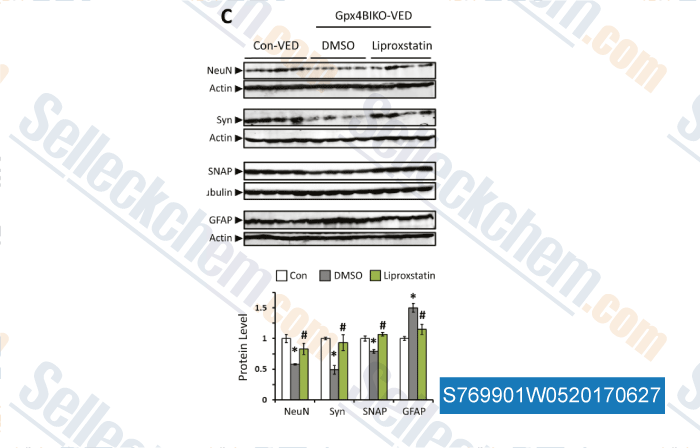
-
Daten von [ , , Redox Biol, 2017, 12:8-17 ]
Sellecks Liproxstatin-1 Wurde zitiert von 280 Publikationen
| Cytosolic cytochrome c represses ferroptosis [ Cell Metab, 2025, S1550-4131(25)00149-4] | PubMed: 40233758 |
| Endothelial but not systemic ferroptosis inhibition protects from antineutrophil cytoplasmic antibody-induced crescentic glomerulonephritis [ Kidney Int, 2025, 107(6):1037-1050] | PubMed: 40122342 |
| S100P is a ferroptosis suppressor to facilitate hepatocellular carcinoma development by rewiring lipid metabolism [ Nat Commun, 2025, 16(1):509] | PubMed: 39779666 |
| Simvastatin overcomes the pPCK1-pLDHA-SPRINGlac axis-mediated ferroptosis and chemo-immunotherapy resistance in AKT-hyperactivated intrahepatic cholangiocarcinoma [ Cancer Commun (Lond), 2025, 10.1002/cac2.70036] | PubMed: 40443016 |
| A transcriptional atlas of gut-innervating neurons reveals activation of interferon signaling and ferroptosis during intestinal inflammation [ Neuron, 2025, S0896-6273(25)00136-9] | PubMed: 40101721 |
| HIF-independent oxygen sensing via KDM6A regulates ferroptosis [ Mol Cell, 2025, 85(15):2973-2987.e6] | PubMed: 40712585 |
| Inhibition of Endoplasmic Reticulum Stress Cooperates with SLC7A11 to Promote Disulfidptosis and Suppress Tumor Growth upon Glucose Limitation [ Adv Sci (Weinh), 2025, 12(7):e2408789] | PubMed: 39739602 |
| Vorapaxar enhanced mitochondria-associated ferroptosis primes cancer immunotherapy via targeting FOXO1/HMOX1 axis [ Cell Rep Med, 2025, 6(10):102371] | PubMed: 41005298 |
| SLC25A1 and ACLY maintain cytosolic acetyl-CoA and regulate ferroptosis susceptibility via FSP1 acetylation [ EMBO J, 2025, 10.1038/s44318-025-00369-5] | PubMed: 39881208 |
| Cathepsin S regulates ferroptosis sensitivity in hepatocellular carcinoma through the KEAP1-NRF2 signaling pathway [ Redox Biol, 2025, 86:103815] | PubMed: 40784043 |
RÜCKGABERICHTLINIE
Die bedingungslose Rückgaberichtlinie von Selleck Chemical gewährleistet unseren Kunden ein reibungsloses Online-Einkaufserlebnis. Wenn Sie in irgendeiner Weise mit Ihrem Kauf unzufrieden sind, können Sie jeden Artikel innerhalb von 7 Tagen nach Erhalt zurückgeben. Im Falle von Produktqualitätsproblemen, sei es protokollbezogene oder produktbezogene Probleme, können Sie jeden Artikel innerhalb von 365 Tagen ab dem ursprünglichen Kaufdatum zurückgeben. Bitte befolgen Sie die nachstehenden Anweisungen, wenn Sie Produkte zurücksenden.
VERSAND UND LAGERUNG
Selleck-Produkte werden bei Raumtemperatur transportiert. Wenn Sie das Produkt bei Raumtemperatur erhalten, seien Sie versichert, dass die Qualitätskontrollabteilung von Selleck Experimente durchgeführt hat, um zu überprüfen, dass die normale Temperaturplatzierung von einem Monat die biologische Aktivität von Pulverprodukten nicht beeinträchtigt. Nach dem Sammeln lagern Sie das Produkt bitte gemäß den in der Datenblatt beschriebenen Anforderungen. Die meisten Selleck-Produkte sind unter den empfohlenen Bedingungen stabil.
NICHT FÜR DIE ANWENDUNG AM MENSCHEN, FÜR VETERINÄRMEDIZINISCHE DIAGNOSTIK ODER THERAPEUTISCHE ZWECKE.