
Technische Daten
| Formel | C23H29FN6O |
||||||
| Molekulargewicht | 424.51 | CAS-Nr. | 1454682-72-4 | ||||
| Löslichkeit (25°C)* | In vitro | DMSO | 20 mg/mL (47.11 mM) | ||||
| Water | Insoluble | ||||||
| Ethanol | Insoluble | ||||||
| In vivo (Lösungsmittel einzeln und der Reihe nach zum Produkt hinzufügen.) |
|
||||||
|
* <1 mg/ml bedeutet schwer löslich oder unlöslich. * Bitte beachten Sie, dass Selleck die Löslichkeit aller Verbindungen intern testet und die tatsächliche Löslichkeit geringfügig von veröffentlichten Werten abweichen kann. Dies ist normal und ist auf geringfügige Batch-zu-Batch-Variationen zurückzuführen. * Versand bei Raumtemperatur (Stabilitätstests zeigen, dass dieses Produkt ohne Kühlmaßnahmen versendet werden kann.) |
|||||||
Vorbereitung von Stammlösungen
Biologische Aktivität
| Beschreibung | LY3009120 (DP-4978) ist ein potenter Pan-Raf-Inhibitor mit einer IC50 von 44 nM, 31-47 nM und 42 nM für A-Raf, B-Raf und C-Raf in A375-Zellen. Diese Verbindung induziert Autophagy. Phase 1. | ||||||
|---|---|---|---|---|---|---|---|
| Ziele |
|
||||||
| In vitro | LY3009120 hemmt das Zellwachstum von A375- und HCT116-Zellen mit einer IC50 von 9,2 bzw. 220 μM. Diese Verbindung hemmt die Tyrosinkinase KDR mit einer IC50 von 3,9 μM. | ||||||
| In vivo | Bei Ratten mit BRAF V600E ST019VR PDX-Tumoren zeigt LY3009120 (15 oder 30 mg/kg, p.o.) eine dosisabhängige Tumorwachstumshemmung. Bei Nacktratten mit A375-Xenotransplantat zeigt die orale Einzeldosisbehandlung mit dieser Verbindung (3 bis 50 mg/kg, p.o.) eine dosisabhängige Hemmung von Phospho-ERK, mit einer Dosis für 50 % Hemmung von Phospho-ERK (EC50) von 4,36 mg/kg, wobei die Plasmakonzentration zur Erzielung einer 50 %igen Hemmung von Phospho-ERK (EC50) 68,9 ng/mL oder 165 nM beträgt. |
Protokoll (aus Referenz)
| Kinase-Assay:[2] |
|
|---|---|
| Zell-Assay:[1] |
|
| Tierstudie:[1] |
|
Referenzen
|
Kundenproduktvalidierung
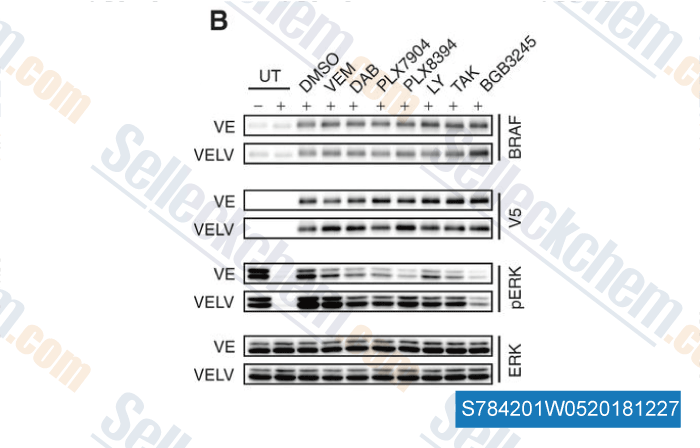
-
Daten von [ , , Cancer Discov, 2018, 8(9):1130-1141 ]
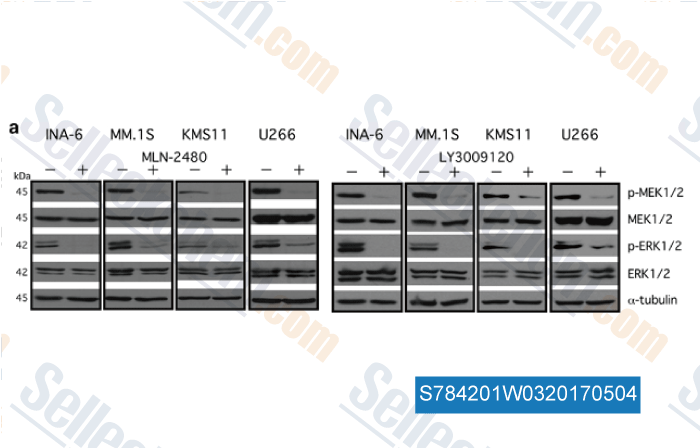
-
Daten von [ , , Leukemia, 2017, 31(4):922-933 ]
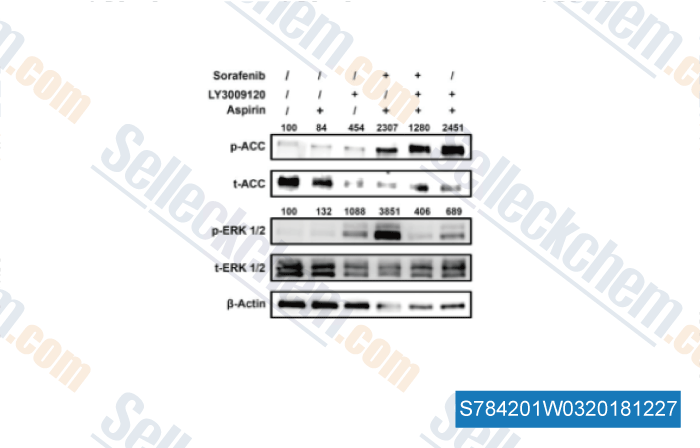
-
Daten von [ , , Clin Cancer Res, 2018, 24(5):1090-1102 ]
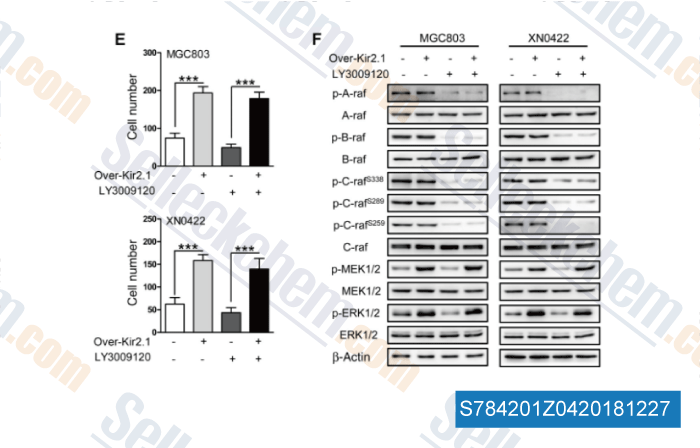
-
Daten von [ , , Cancer Res, 2018, 78(11):3041-3053 ]
Sellecks LY3009120 Wurde zitiert von 55 Publikationen
| RIT1 Drives Oncogenic Transformation and is an Actionable Target in Lung Adenocarcinoma [ Cancer Res, 2025, 10.1158/0008-5472.CAN-24-3819] | PubMed: 40644578 |
| Bioluminescence-based assays for quantifying endogenous protein interactions in live cells [ J Biol Chem, 2025, 301(8):110454] | PubMed: 40617353 |
| MED10 as a Novel Oncogenic Driver in HCC: Promoting Cell Cycle Progression and Proliferation Through RAF1 Activation [ Front Biosci (Landmark Ed), 2025, 30(8):39944] | PubMed: 40917057 |
| H3K4me3 remodeling induced acquired resistance through O-GlcNAc transferase [ Drug Resist Updat, 2023, 71:100993] | PubMed: 37639774 |
| The combination of osimertinib with Raf inhibitor overcomes osimertinib resistance induced by KRAS amplification in EGFR-mutated lung cancer cells [ Exp Cell Res, 2023, 430(1):113722] | PubMed: 37442265 |
| Targeting RAF Isoforms and Tumor Microenvironments in RAS or BRAF Mutant Colorectal Cancers with SJ-C1044 for Anti-Tumor Activity [ Curr Issues Mol Biol, 2023, 45(7):5865-5878] | PubMed: 37504287 |
| BRAFΔβ3-αC in-frame deletion mutants differ in their dimerization propensity, HSP90 dependence, and druggability [ Sci Adv, 2023, 9(35):eade7486] | PubMed: 37656784 |
| RAS-dependent RAF-MAPK hyperactivation by pathogenic RIT1 is a therapeutic target in Noonan syndrome-associated cardiac hypertrophy [ Sci Adv, 2023, 9(28):eadf4766] | PubMed: 37450595 |
| Mutations in ALK signaling pathways conferring resistance to ALK inhibitor treatment lead to collateral vulnerabilities in neuroblastoma cells [ Mol Cancer, 2022, 21(1):126] | PubMed: 35689207 |
| Glutamine deficiency in solid tumor cells confers resistance to ribosomal RNA synthesis inhibitors [ Nat Commun, 2022, 13(1):3706] | PubMed: 35764642 |
RÜCKGABERICHTLINIE
Die bedingungslose Rückgaberichtlinie von Selleck Chemical gewährleistet unseren Kunden ein reibungsloses Online-Einkaufserlebnis. Wenn Sie in irgendeiner Weise mit Ihrem Kauf unzufrieden sind, können Sie jeden Artikel innerhalb von 7 Tagen nach Erhalt zurückgeben. Im Falle von Produktqualitätsproblemen, sei es protokollbezogene oder produktbezogene Probleme, können Sie jeden Artikel innerhalb von 365 Tagen ab dem ursprünglichen Kaufdatum zurückgeben. Bitte befolgen Sie die nachstehenden Anweisungen, wenn Sie Produkte zurücksenden.
VERSAND UND LAGERUNG
Selleck-Produkte werden bei Raumtemperatur transportiert. Wenn Sie das Produkt bei Raumtemperatur erhalten, seien Sie versichert, dass die Qualitätskontrollabteilung von Selleck Experimente durchgeführt hat, um zu überprüfen, dass die normale Temperaturplatzierung von einem Monat die biologische Aktivität von Pulverprodukten nicht beeinträchtigt. Nach dem Sammeln lagern Sie das Produkt bitte gemäß den in der Datenblatt beschriebenen Anforderungen. Die meisten Selleck-Produkte sind unter den empfohlenen Bedingungen stabil.
NICHT FÜR DIE ANWENDUNG AM MENSCHEN, FÜR VETERINÄRMEDIZINISCHE DIAGNOSTIK ODER THERAPEUTISCHE ZWECKE.