
Technische Daten
| Formel | C17H15BrF2N4O3 |
||||||
| Molekulargewicht | 441.23 | CAS-Nr. | 606143-89-9 | ||||
| Löslichkeit (25°C)* | In vitro | DMSO | 88 mg/mL (199.44 mM) | ||||
| Water | Insoluble | ||||||
| Ethanol | Insoluble | ||||||
| In vivo (Lösungsmittel einzeln und der Reihe nach zum Produkt hinzufügen.) |
|
||||||
|
* <1 mg/ml bedeutet schwer löslich oder unlöslich. * Bitte beachten Sie, dass Selleck die Löslichkeit aller Verbindungen intern testet und die tatsächliche Löslichkeit geringfügig von veröffentlichten Werten abweichen kann. Dies ist normal und ist auf geringfügige Batch-zu-Batch-Variationen zurückzuführen. * Versand bei Raumtemperatur (Stabilitätstests zeigen, dass dieses Produkt ohne Kühlmaßnahmen versendet werden kann.) |
|||||||
Vorbereitung von Stammlösungen
Biologische Aktivität
| Beschreibung | Binimetinib (MEK162, ARRY-162, ARRY-438162) ist ein potenter Inhibitor von MEK1/2 mit einer IC50 von 12 nM in einem zellfreien Assay. Binimetinib induziert G1-Zellzyklusarrest und Apoptose in menschlichen NSCLC-Zelllinien und induziert Autophagy. Phase 3. | ||
|---|---|---|---|
| Ziele |
|
||
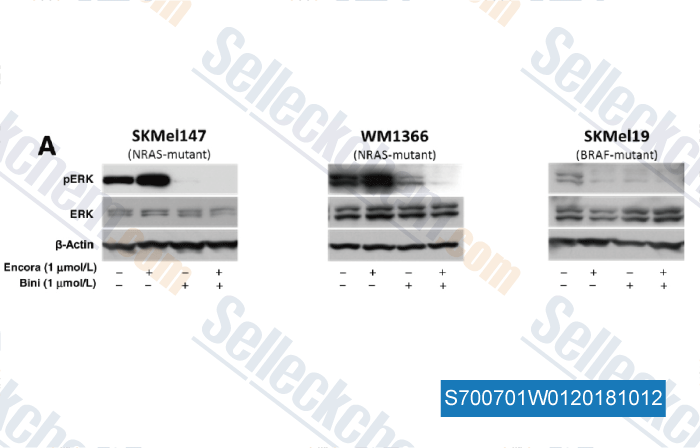
| In vitro | Binimetinib (MEK162) ist ein kürzlich entdeckter potenter und selektiver ATP-nicht-kompetitiver MEK1/2-Inhibitor, der pERK in Zellen mit einer IC50 von 11 nM hemmt. Diese Verbindung (625 nM) hemmt die In-vitro-Osteoklastendifferenzierung mit einer IC50 von 39 nM. Sie (10 μM) hemmt die In-vitro-Osteoklastenresorption mit einer IC50 von 625 nM. Sie (2 μM) beeinflusst die Osteoblastendifferenzierung schwach. Sie (1 μM) in Kombination mit MK-2206 (2 μM) kehrt die Resistenz von RSK-exprimierenden MCF7-Zellen vollständig um. |
||
| In vivo | Binimetinib (MEK162) zeigt eine dosisabhängige Hemmung der Knöchelschwellung in Rattenmodellen für Adjuvans-induzierte Arthritis (AIA), signifikant bei 10 mg/kg und 30 mg/kg im Vergleich zur Vehikelkontrolle. Diese Verbindung zeigt auch eine dosisabhängige Hemmung der Serum-IL-6-Konzentration in Rattenmodellen für Adjuvans-induzierte Arthritis (AIA), mit vollständiger Hemmung bei 10 mg/kg im Vergleich zur Vehikelkontrolle. Bei 30 mg/kg zeigt es eine dosisabhängige Hemmung der relativen Milzgewichte in Rattenmodellen für Adjuvans-induzierte Arthritis (AIA). Zusätzlich hemmt es signifikant die Knochenresorption und Entzündung bei verzögerter Dosierung im Vergleich zum Vehikel in Rattenmodellen für Adjuvans-induzierte Arthritis (AIA). ARRY-438162 (10 mg/kg, po, bid) reduziert die Krankheitsintensität dosisabhängig in Rattenmodellen für Kollagen-induzierte Arthritis (CIA) und Adjuvans-induzierte Arthritis (AIA). Es (po, bid) hemmt die Zunahme des Knöcheldurchmessers um 27% und 50% bei 1 mg/kg und 3 mg/kg im Rattenmodell für Kollagen-induzierte Arthritis (CIA), während Ibuprofen eine 46%ige Hemmung aufweist. ARRY-438162 (10 mg/kg, po, bid) hemmt signifikant Läsionen (Entzündung, Knorpelschaden, Pannusbildung und Knochenresorption) um 32% und 60% bei 1 mg/kg und 3 mg/kg im Rattenmodell für Kollagen-induzierte Arthritis (CIA). Es hemmt den AIA-Knöcheldurchmesser um 11% und 34% bei 3 mg/kg und 10 mg/kg in Rattenmodellen für Adjuvans-induzierte Arthritis (AIA). In Kombination mit BEZ235 (6 mg/kg, BID) führt es zu einer signifikanten Reduktion des Tumorwachstums in immundefizienten Mäusen, die mit MCF7-Zellen injiziert wurden. |
Protokoll (aus Referenz)
| Tierstudie: |
|
|---|
Referenzen
|
Kundenproduktvalidierung
-
Daten von [ , , Clin Cancer Res, 2017, 23(20):6203-6214 ]
![A875 and WM2664 cells were transfected with Myc-NRAS plasmid (2.5 ug, 24 h) and NRAS siRNA (10 nM, 48 h), respectively, then were treated with indicated inhibitor for 48 h. The activation of indicated molecules and NRAS were examined by Western Blotting (A and D). The relative phosphorylation levels of signalling mediators were quantified by measuring the relative intensity of phosphorylated bands to the corresponding total bands (BeC and EeF; presented as mean±standard deviation [SD] of three scans)](https://file.selleckchem.com/downloads/review/700px/Binimetinib-S700701W0220181019.gif)
-
Daten von [ , , Eur J Cancer, 2018, 89:90-101 ]
-
Daten von [ , , Oncotarget, 2016, 7(50):82185-82199 ]
-S700701W0520150923.gif)
-
Daten von [ , , Tumor Biol, 2015, 36: 5699-06 ]
Sellecks MEK162 (Binimetinib, ARRY-162) Wurde zitiert von 105 Publikationen
| Combined inhibition of focal adhesion kinase and RAF/MEK elicits synergistic inhibition of melanoma growth and reduces metastases [ Cell Rep Med, 2025, 6(2):101943] | PubMed: 39922199 |
| Geometric deep learning and multiple-instance learning for 3D cell-shape profiling [ Cell Syst, 2025, 16(3):101229] | PubMed: 40112779 |
| Basroparib overcomes acquired resistance to MEK inhibitors by inhibiting Wnt-mediated cancer stemness in KRAS-mutated colorectal cancer [ Biochem Pharmacol, 2025, 235:116842] | PubMed: 40024348 |
| Integration of focal adhesion morphogenesis and polarity by DOCK5 promotes YAP/TAZ-driven drug resistance in TNBC [ Mol Omics, 2025, 10.1039/d4mo00154k] | PubMed: 40353692 |
| Tumour-selective activity of RAS-GTP inhibition in pancreatic cancer [ Nature, 2024, 629(8013):927-936] | PubMed: 38588697 |
| MEK inhibition prevents CAR-T cell exhaustion and differentiation via downregulation of c-Fos and JunB [ Signal Transduct Target Ther, 2024, 9(1):293] | PubMed: 39438476 |
| Dual Inhibition of CDK4/6 and XPO1 Induces Senescence With Acquired Vulnerability to CRBN-Based PROTAC Drugs [ Gastroenterology, 2024, S0016-5085(24)00062-3] | PubMed: 38262581 |
| Nutritional vitamin B12 regulates RAS/MAPK-mediated cell fate decisions through one-carbon metabolism [ Nat Commun, 2024, 15(1):8178] | PubMed: 39289374 |
| EHMT2 promotes tumorigenesis in GNAQ/11-mutant uveal melanoma via ARHGAP29-mediated RhoA pathway [ Acta Pharm Sin B, 2024, 14(3):1187-1203] | PubMed: 38486999 |
| Patient-derived rhabdomyosarcoma cells recapitulate the genetic and transcriptomic landscapes of primary tumors [ iScience, 2024, 27(10):110862] | PubMed: 39319271 |
RÜCKGABERICHTLINIE
Die bedingungslose Rückgaberichtlinie von Selleck Chemical gewährleistet unseren Kunden ein reibungsloses Online-Einkaufserlebnis. Wenn Sie in irgendeiner Weise mit Ihrem Kauf unzufrieden sind, können Sie jeden Artikel innerhalb von 7 Tagen nach Erhalt zurückgeben. Im Falle von Produktqualitätsproblemen, sei es protokollbezogene oder produktbezogene Probleme, können Sie jeden Artikel innerhalb von 365 Tagen ab dem ursprünglichen Kaufdatum zurückgeben. Bitte befolgen Sie die nachstehenden Anweisungen, wenn Sie Produkte zurücksenden.
VERSAND UND LAGERUNG
Selleck-Produkte werden bei Raumtemperatur transportiert. Wenn Sie das Produkt bei Raumtemperatur erhalten, seien Sie versichert, dass die Qualitätskontrollabteilung von Selleck Experimente durchgeführt hat, um zu überprüfen, dass die normale Temperaturplatzierung von einem Monat die biologische Aktivität von Pulverprodukten nicht beeinträchtigt. Nach dem Sammeln lagern Sie das Produkt bitte gemäß den in der Datenblatt beschriebenen Anforderungen. Die meisten Selleck-Produkte sind unter den empfohlenen Bedingungen stabil.
NICHT FÜR DIE ANWENDUNG AM MENSCHEN, FÜR VETERINÄRMEDIZINISCHE DIAGNOSTIK ODER THERAPEUTISCHE ZWECKE.