
Technische Daten
| Formel | C26H41N3O5 |
||||||
| Molekulargewicht | 475.62 | CAS-Nr. | 1211877-36-9 | ||||
| Löslichkeit (25°C)* | In vitro | DMSO | 95 mg/mL (199.73 mM) | ||||
| Ethanol | 95 mg/mL (199.73 mM) | ||||||
| Water | Insoluble | ||||||
| In vivo (Lösungsmittel einzeln und der Reihe nach zum Produkt hinzufügen.) |
|
||||||
|
* <1 mg/ml bedeutet schwer löslich oder unlöslich. * Bitte beachten Sie, dass Selleck die Löslichkeit aller Verbindungen intern testet und die tatsächliche Löslichkeit geringfügig von veröffentlichten Werten abweichen kann. Dies ist normal und ist auf geringfügige Batch-zu-Batch-Variationen zurückzuführen. * Versand bei Raumtemperatur (Stabilitätstests zeigen, dass dieses Produkt ohne Kühlmaßnahmen versendet werden kann.) |
|||||||
Vorbereitung von Stammlösungen
Biologische Aktivität
| Beschreibung | MG132 ((S,R,S)-(-)-MG132, Z-Leu-D-Leu-Leu-al) ist ein potenter proteasome (ChTL, TL, and PGPH) Inhibitor. Diese Verbindung hemmt auch Calpain (IC50=1,2 μM). Es kann verwendet werden, um Tiermodelle der Parkinson-Krankheit zu induzieren. | ||
|---|---|---|---|
| Ziele |
|
||
| In vitro | MG-132 zeigt eine >1000-fach höhere Aktivität als ZLLal bei der Hemmung der ZLLL-MCA-abbauenden Aktivität des 20S proteasome mit einer IC50 von 100 nM gegenüber 110 μM. Diese Verbindung hemmt auch Calpain mit einer IC50 von 1,2 μM. Diese Chemikalie induziert Neuritenwachstum in PC12-Zellen bei einer optimalen Konzentration von 20 nM und zeigt eine 500-fach höhere Wirksamkeit als ZLLal. Diese Verbindung (10 μM) hemmt potent die TNF-α-induzierte NF-κB-Aktivierung, die Interleukin-8 (IL-8)-Gengtranskription und die IL-8-Proteinfreisetzung in A549-Zellen durch Hemmung des proteasome-vermittelten IκBα-Abbaus. Diese chemische Behandlung induziert potent eine p53-abhängige Apoptose in KIM-2-Zellen durch 26S proteasome-Hemmung. Im Gegensatz zu BzLLLCOCHO oder PS-341 führt die Behandlung mit dieser Verbindung zu einer schwachen Hemmung der Chymotrypsin-ähnlichen (CT-L) und Peptidylglutamyl-Peptid-hydrolysierenden (PGPH)-Aktivitäten des 26S proteasome, während multiple Myelomzellen (U266 und OPM-2) empfindlicher auf die Induktion der Apoptose durch diese Chemikalie reagieren als auf BzLLLCOCHO. Diese Verbindung (1 μM) sensibilisiert TRAIL-resistente Prostatakrebszellen durch Aktivierung der AP-1-Familienmitglieder c-Fos und c-Jun, die wiederum das antiapoptotische Molekül c-FLIP(L) unterdrücken. Diese Chemikalie verstärkt signifikant die Fähigkeit von Inositolhexakisphosphat (IP6), die zelluläre Stoffwechselaktivität in PC3- und DU145-Androgen-unabhängigen Prostatakrebs (AIPCa)-Zelllinien zu reduzieren. |
||
| In vivo | Die Verabreichung von MG-132 rettet effektiv die Expressionslevel und die Plasmamembranlokalisation von Dystrophin, β-Dystroglykan, α-bdystroglykan und α-Sarcoglykan in Skelettmuskelfasern von mdx-Mäusen, reduziert Muskelfaserschäden und lindert die histopathologischen Anzeichen der Muskeldystrophie. Die Behandlung mit dieser Verbindung reduziert signifikant die immobilisationsinduzierte Skelettmuskelatrophie bei Mäusen, indem sie die muskelspezifischen Ubiquitinligasen Atrogin-1/MAFbx und MuRF-1 mRNA herunterreguliert. |
Protokoll (aus Referenz)
| Kinase-Assay: |
|
|---|---|
| Zell-Assay: |
|
| Tierstudie: |
|
Referenzen
|
Kundenproduktvalidierung
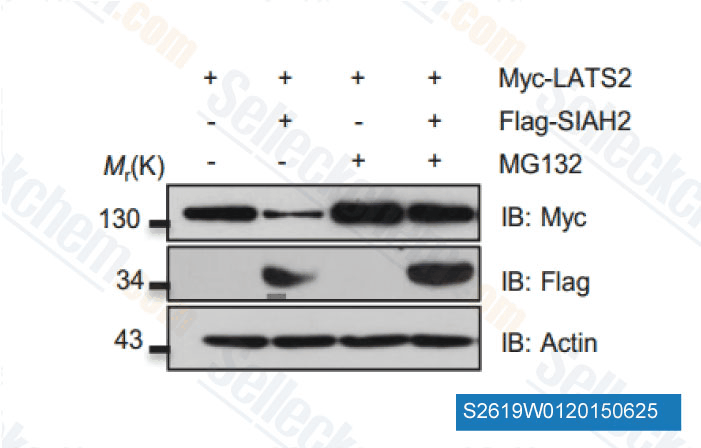
-
Daten von [ Nat Cell Biol , 2015 , 17(1), 95-103 ]

-
Daten von [ Cell Rep , 2015 , 11(9), 1458-73 ]
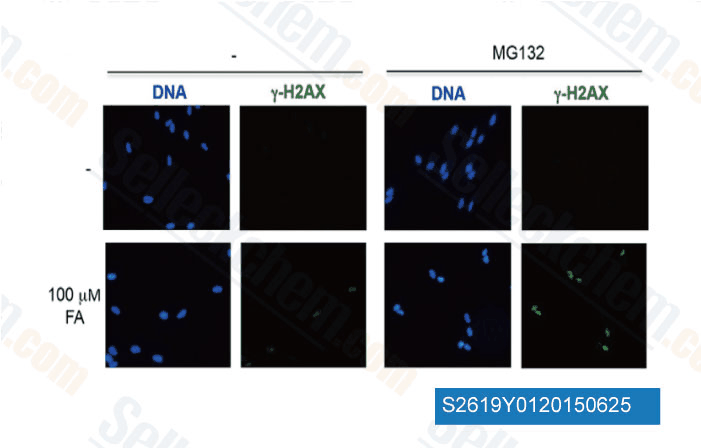
-
Daten von [ Toxicol Appl Pharmacol , 2015 , 286(2), 135-41 ]
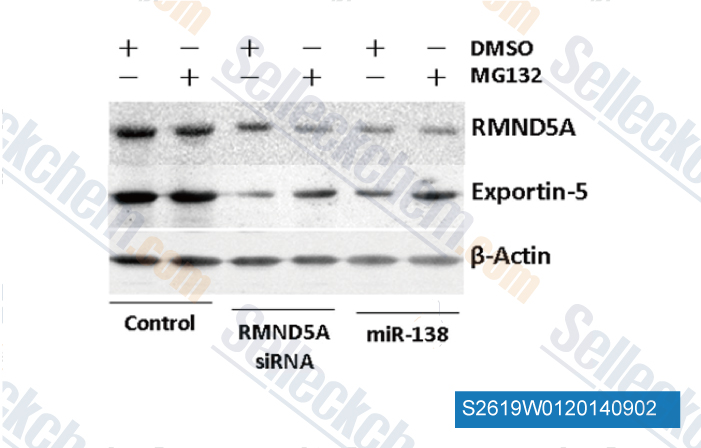
-
Daten von [ Nucleic Acids Res , 2014 , 42(1), 458-74 ]
Sellecks MG132 Wurde zitiert von 2478 Publikationen
| Anisomelic acid promotes proteasomal degradation of HPV16 E6 via E3 ligase recruitment: A mass spectrometry-based interactome study [ J Proteomics, 2026, 322:105536] | PubMed: 40967472 |
| Lymph node environment drives FSP1 targetability in metastasizing melanoma [ Nature, 2025, 10.1038/s41586-025-09709-1] | PubMed: 41193799 |
| VCP downstream metabolite glycerol-3-phosphate (G3P) inhibits CD8+T cells function in the HCC microenvironment [ Signal Transduct Target Ther, 2025, 10(1):26] | PubMed: 39848960 |
| NAP1L1 degradation by FBXW7 reduces the deubiquitination of HDGF-p62 signaling to stimulate autophagy and induce primary cisplatin chemosensitivity in nasopharyngeal carcinoma [ Mol Cancer, 2025, 24(1):152] | PubMed: 40414865 |
| LZTR1 regulates epithelial MHC-I expression via NF-κB1 to modulate CD8+ T cells activation [ Cell Discov, 2025, 11(1):84] | PubMed: 41162356 |
| MAPK13 phosphorylates PHGDH and promotes its degradation via chaperone-mediated autophagy during liver injury [ Cell Discov, 2025, 11(1):15] | PubMed: 39962071 |
| Alterations in PD-L1 succinylation shape anti-tumor immune responses in melanoma [ Nat Genet, 2025, 57(3):680-693] | PubMed: 40069506 |
| Transcriptional repressor Capicua is a gatekeeper of cell-intrinsic interferon responses [ Cell Host Microbe, 2025, 33(4):512-528.e7] | PubMed: 40132591 |
| A heterotrimeric protein complex assembles the metazoan V-ATPase upon dissipation of proton gradients [ Nat Struct Mol Biol, 2025, 10.1038/s41594-025-01610-9] | PubMed: 40646309 |
| Harnessing the FGFR2/NF2/YAP signaling-dependent necroptosis to develop an FGFR2/IL-8 dual blockade therapeutic strategy [ Nat Commun, 2025, 16(1):4128] | PubMed: 40319089 |
RÜCKGABERICHTLINIE
Die bedingungslose Rückgaberichtlinie von Selleck Chemical gewährleistet unseren Kunden ein reibungsloses Online-Einkaufserlebnis. Wenn Sie in irgendeiner Weise mit Ihrem Kauf unzufrieden sind, können Sie jeden Artikel innerhalb von 7 Tagen nach Erhalt zurückgeben. Im Falle von Produktqualitätsproblemen, sei es protokollbezogene oder produktbezogene Probleme, können Sie jeden Artikel innerhalb von 365 Tagen ab dem ursprünglichen Kaufdatum zurückgeben. Bitte befolgen Sie die nachstehenden Anweisungen, wenn Sie Produkte zurücksenden.
VERSAND UND LAGERUNG
Selleck-Produkte werden bei Raumtemperatur transportiert. Wenn Sie das Produkt bei Raumtemperatur erhalten, seien Sie versichert, dass die Qualitätskontrollabteilung von Selleck Experimente durchgeführt hat, um zu überprüfen, dass die normale Temperaturplatzierung von einem Monat die biologische Aktivität von Pulverprodukten nicht beeinträchtigt. Nach dem Sammeln lagern Sie das Produkt bitte gemäß den in der Datenblatt beschriebenen Anforderungen. Die meisten Selleck-Produkte sind unter den empfohlenen Bedingungen stabil.
NICHT FÜR DIE ANWENDUNG AM MENSCHEN, FÜR VETERINÄRMEDIZINISCHE DIAGNOSTIK ODER THERAPEUTISCHE ZWECKE.