
Technische Daten
| Formel | C25H21N5O.2HCl |
||||||
| Molekulargewicht | 480.39 | CAS-Nr. | 1032350-13-2 | ||||
| Löslichkeit (25°C)* | In vitro | DMSO | 30 mg/mL (62.44 mM) | ||||
| Water | Insoluble | ||||||
| Ethanol | Insoluble | ||||||
| In vivo (Lösungsmittel einzeln und der Reihe nach zum Produkt hinzufügen.) |
|
||||||
|
* <1 mg/ml bedeutet schwer löslich oder unlöslich. * Bitte beachten Sie, dass Selleck die Löslichkeit aller Verbindungen intern testet und die tatsächliche Löslichkeit geringfügig von veröffentlichten Werten abweichen kann. Dies ist normal und ist auf geringfügige Batch-zu-Batch-Variationen zurückzuführen. * Versand bei Raumtemperatur (Stabilitätstests zeigen, dass dieses Produkt ohne Kühlmaßnahmen versendet werden kann.) |
|||||||
Vorbereitung von Stammlösungen
Biologische Aktivität
| Beschreibung | MK-2206 2HCl ist ein hochselektiver Inhibitor von Akt1/2/3 mit einer IC50 von 8 nM/12 nM/65 nM in zellfreien Assays; keine hemmenden Aktivitäten gegen 250 andere Proteinkinasen beobachtet. Diese Verbindung induziert Autophagy und Apoptosis in Krebszellen. Phase 2. | ||||||
|---|---|---|---|---|---|---|---|
| Ziele |
|
||||||
| In vitro | MK-2206 2HCl ist ein allosterischer Inhibitor und wird durch die Pleckstrin-Homologie-Domäne aktiviert. Diese Verbindung hemmt die Autophosphorylierung von Akt T308 und S473. Es verhindert auch die Akt-vermittelte Phosphorylierung nachgeschalteter Signalmoleküle, einschließlich TSC2, PRAS40 und ribosomaler S6-Proteine. Diese Chemikalie hemmt Ras-Wildtyp (WT)-Zelllinien (A431, HCC827 und NCI-H292) stärker im Vergleich zu Ras-mutierten Zelllinien (NCI-H358, NCI-H23, NCI-H1299 und Calu-6). Es zeigt auch synergistische Reaktionen in Kombination mit zytotoxischen Mitteln in Lungen-NCI-H460- oder Ovarial-A2780-Tumorzellen. MK-2206 oder siRNA-vermittelte Akt-Hemmung aktiviert stark die Autophagy in menschlichen Gliomzellen. Die Stilllegung des eukaryotischen Elongationsfaktors-2 (eEF-2) unterdrückt jedoch diese durch die Verbindung induzierte Autophagy, mit einer Förderung des apoptotischen Zelltods. |
||||||
| In vivo | MK-2206 2HCl zeigt bei einer Dosis von 240 mg/kg 60 % TGI und hemmt mehr als 70 % von Phospho-Akt1/2 (T308 und S473) in A2780-Ovarialkrebs-Xenografts. Diese Verbindung zeigt in Kombination eine signifikante Antitumoraktivität im NCI-H292-Xenograft. |
||||||
| Merkmale | Der erste allosterische niedermolekulare Inhibitor von Akt, der in die klinische Entwicklung gelangte. |
Protokoll (aus Referenz)
| Kinase-Assay: |
|
|---|---|
| Zell-Assay: |
|
| Tierstudie: |
|
Referenzen
|
Kundenproduktvalidierung
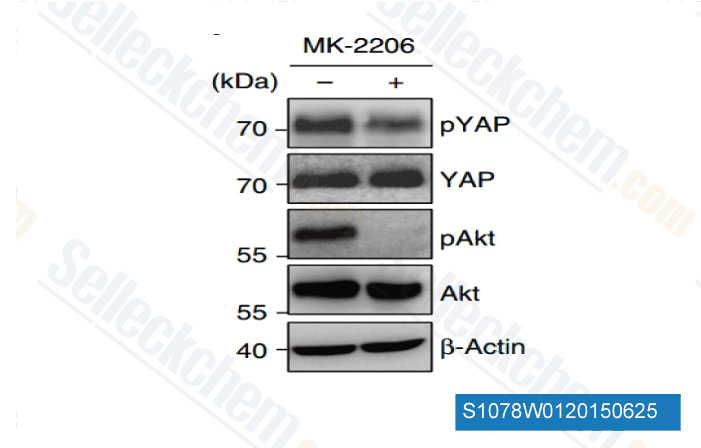
-
Daten von [ Nat Commun , 2015 , 6:6943 ]
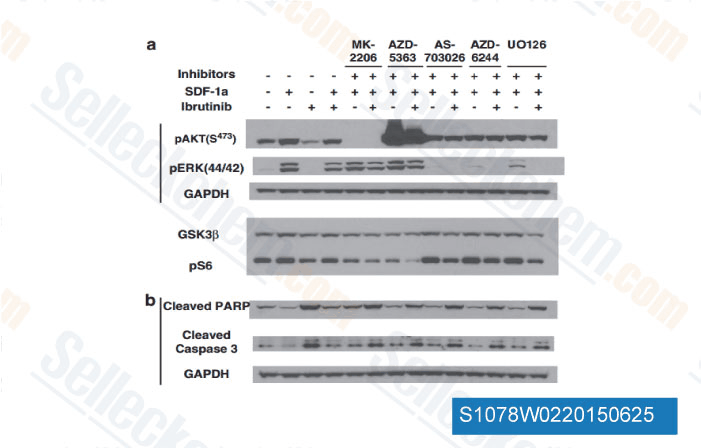
-
Daten von [ Leukemia , 2015 , 29(1), 169-76 ]
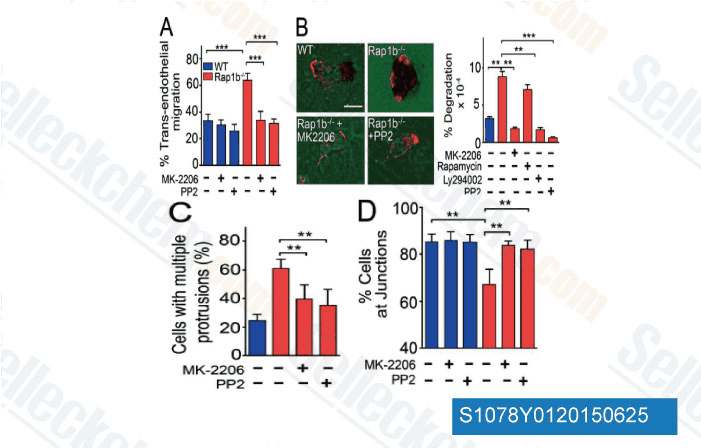
-
Daten von [ J Exp Med , 2014 , 211(9), 1741-58 ]
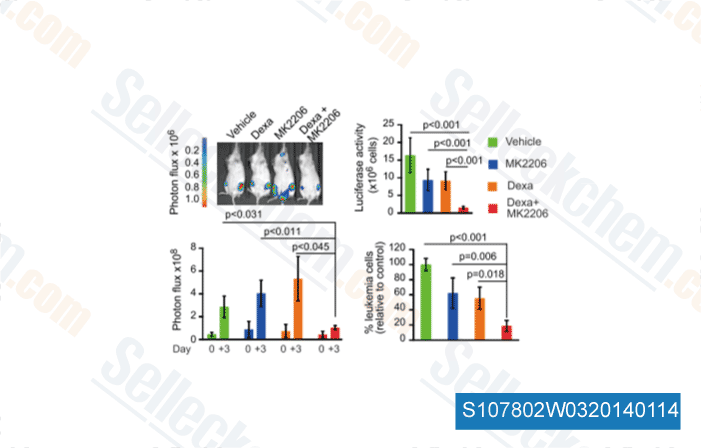
-
Daten von [ Cancer Cell , 2013 , 24, 766-76 ]
Sellecks MK-2206 Dihydrochloride Wurde zitiert von 1974 Publikationen
| Lysosomal EGFR acts as a Rheb-GEF independent of its kinase activity to activate mTORC1 [ Cell Res, 2025, 10.1038/s41422-025-01110-x] | PubMed: 40259053 |
| Oncogenic RAS induces a distinctive form of non-canonical autophagy mediated by the P38-ULK1-PI4KB axis [ Cell Res, 2025, 10.1038/s41422-025-01085-9] | PubMed: 40055523 |
| IFITM3-MET interaction drives osimertinib resistance through AKT pathway activation in EGFR-mutant non-small cell lung cancer [ Mol Cancer, 2025, 24(1):272] | PubMed: 41152910 |
| APOBEC3 mutagenesis drives therapy resistance in breast cancer [ Nat Genet, 2025, 57(6):1452-1462] | PubMed: 40379787 |
| Chromosome mis-segregation triggers cell cycle arrest through a mechanosensitive nuclear envelope checkpoint [ Nat Cell Biol, 2025, 27(1):73-86] | PubMed: 39779939 |
| Nucleus-translocated glucokinase functions as a protein kinase to phosphorylate TAZ and promote tumour growth [ Nat Commun, 2025, 16(1):7156] | PubMed: 40759645 |
| RIOK3 mediates the degradation of 40S ribosomes [ Mol Cell, 2025, 85(4):802-814.e12] | PubMed: 39947183 |
| CD24 Regulates the Formation of Ectosomes in B Lymphocytes [ J Extracell Vesicles, 2025, 14(5):e70093] | PubMed: 40415253 |
| PIP5K1A Suppresses Ferroptosis and Induces Sorafenib Resistance by Stabilizing NRF2 in Hepatocellular Carcinoma [ Adv Sci (Weinh), 2025, 12(30):e04372] | PubMed: 40405713 |
| EGFR TKIs suppress MUC1 glycosylation through the PI3K/AKT/SP1/C1GALT1 pathway to enhance TnMUC1 CAR-T efficacy in EGFR-mutant NSCLC [ Cell Rep Med, 2025, S2666-3791(25)00272-1] | PubMed: 40562040 |
RÜCKGABERICHTLINIE
Die bedingungslose Rückgaberichtlinie von Selleck Chemical gewährleistet unseren Kunden ein reibungsloses Online-Einkaufserlebnis. Wenn Sie in irgendeiner Weise mit Ihrem Kauf unzufrieden sind, können Sie jeden Artikel innerhalb von 7 Tagen nach Erhalt zurückgeben. Im Falle von Produktqualitätsproblemen, sei es protokollbezogene oder produktbezogene Probleme, können Sie jeden Artikel innerhalb von 365 Tagen ab dem ursprünglichen Kaufdatum zurückgeben. Bitte befolgen Sie die nachstehenden Anweisungen, wenn Sie Produkte zurücksenden.
VERSAND UND LAGERUNG
Selleck-Produkte werden bei Raumtemperatur transportiert. Wenn Sie das Produkt bei Raumtemperatur erhalten, seien Sie versichert, dass die Qualitätskontrollabteilung von Selleck Experimente durchgeführt hat, um zu überprüfen, dass die normale Temperaturplatzierung von einem Monat die biologische Aktivität von Pulverprodukten nicht beeinträchtigt. Nach dem Sammeln lagern Sie das Produkt bitte gemäß den in der Datenblatt beschriebenen Anforderungen. Die meisten Selleck-Produkte sind unter den empfohlenen Bedingungen stabil.
NICHT FÜR DIE ANWENDUNG AM MENSCHEN, FÜR VETERINÄRMEDIZINISCHE DIAGNOSTIK ODER THERAPEUTISCHE ZWECKE.