
Technische Daten
| Formel | C25H34N6O·xHCl |
||||||
| Molekulargewicht | 434.58 (free base) | CAS-Nr. | 2070014-87-6 | ||||
| Löslichkeit (25°C)* | In vitro | DMSO | 10 mg/mL | ||||
| Water | Insoluble | ||||||
| Ethanol | Insoluble | ||||||
| In vivo (Lösungsmittel einzeln und der Reihe nach zum Produkt hinzufügen.) |
|
||||||
|
* <1 mg/ml bedeutet schwer löslich oder unlöslich. * Bitte beachten Sie, dass Selleck die Löslichkeit aller Verbindungen intern testet und die tatsächliche Löslichkeit geringfügig von veröffentlichten Werten abweichen kann. Dies ist normal und ist auf geringfügige Batch-zu-Batch-Variationen zurückzuführen. * Versand bei Raumtemperatur (Stabilitätstests zeigen, dass dieses Produkt ohne Kühlmaßnahmen versendet werden kann.) |
|||||||
Vorbereitung von Stammlösungen
Biologische Aktivität
| Beschreibung | MRT68921 ist ein potenter dualer Autophagy-Kinase-ULK1/2-Inhibitor mit IC50-Werten von 2,9 nM bzw. 1,1 nM. | ||||
|---|---|---|---|---|---|
| Ziele |
|
||||
| In vitro | MRT68921 stört spezifisch die Reifung von Autophagosomen und blockiert somit den Autophagy-Fluss durch ULK1-Hemmung. |
||||
| In vivo | MRT68921 ist ein potenter dualer Autophagy-Kinase ULK1/2 Inhibitor. |
Protokoll (aus Referenz)
| Kinase-Assay: |
|
|---|---|
| Zell-Assay: |
|
| Tierstudie: |
|
Referenzen
|
Kundenproduktvalidierung

-
, , Methods Enzymol. 2017, 587:391-404
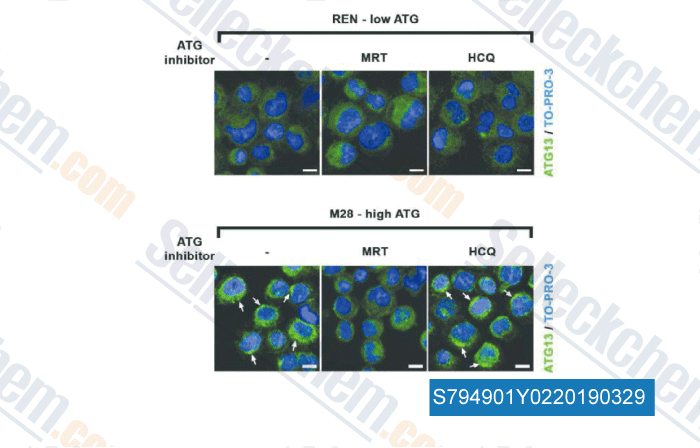
-
Daten von [ , , Mol Carcinog, 2018, 57(3):319-332 ]
Sellecks MRT68921 HCl Wurde zitiert von 46 Publikationen
| Excessive autophagic degradation of MYLK3 causes sunitinib-induced cardiotoxicity [ Autophagy, 2025, 1-20.] | PubMed: 40568844 |
| Inhibiting autophagy selectively prunes dysfunctional tumor vessels and optimizes the tumor immune microenvironment [ Theranostics, 2025, 15(1):258-276] | PubMed: 39744218 |
| Defective chaperone-mediated autophagy in the retinal pigment epithelium of age-related macular degeneration patients [ EMBO Mol Med, 2025, 17(12):3472-3495] | PubMed: 41168502 |
| Image-based temporal profiling of autophagy-related phenotypes [ Autophagy Rep, 2025, 4(1)2484835] | PubMed: 40291494 |
| Exposure of the inner mitochondrial membrane triggers apoptotic mitophagy [ Cell Death Differ, 2024, 10.1038/s41418-024-01260-2] | PubMed: 38396150 |
| Synthetic lethality of combined ULK1 defection and p53 restoration induce pyroptosis by directly upregulating GSDME transcription and cleavage activation through ROS/NLRP3 signaling [ J Exp Clin Cancer Res, 2024, 43(1):248] | PubMed: 39215364 |
| Starvation-induced phosphorylation activates gasdermin A to initiate pyroptosis [ Cell Rep, 2024, 43(9):114728] | PubMed: 39264808 |
| Chronic hypoxia stabilizes 3βHSD1 via autophagy suppression [ Cell Rep, 2024, 43(1):113575] | PubMed: 38181788 |
| ATG7/GAPLINC/IRF3 axis plays a critical role in regulating pathogenesis of influenza A virus [ PLoS Pathog, 2024, 20(1):e1011958] | PubMed: 38227600 |
| ULK2 Is a Key Pro-Autophagy Protein That Contributes to the High Chemoresistance and Disease Relapse in FLT3-Mutated Acute Myeloid Leukemia [ Int J Mol Sci, 2024, 25(1)646] | PubMed: 38203816 |
RÜCKGABERICHTLINIE
Die bedingungslose Rückgaberichtlinie von Selleck Chemical gewährleistet unseren Kunden ein reibungsloses Online-Einkaufserlebnis. Wenn Sie in irgendeiner Weise mit Ihrem Kauf unzufrieden sind, können Sie jeden Artikel innerhalb von 7 Tagen nach Erhalt zurückgeben. Im Falle von Produktqualitätsproblemen, sei es protokollbezogene oder produktbezogene Probleme, können Sie jeden Artikel innerhalb von 365 Tagen ab dem ursprünglichen Kaufdatum zurückgeben. Bitte befolgen Sie die nachstehenden Anweisungen, wenn Sie Produkte zurücksenden.
VERSAND UND LAGERUNG
Selleck-Produkte werden bei Raumtemperatur transportiert. Wenn Sie das Produkt bei Raumtemperatur erhalten, seien Sie versichert, dass die Qualitätskontrollabteilung von Selleck Experimente durchgeführt hat, um zu überprüfen, dass die normale Temperaturplatzierung von einem Monat die biologische Aktivität von Pulverprodukten nicht beeinträchtigt. Nach dem Sammeln lagern Sie das Produkt bitte gemäß den in der Datenblatt beschriebenen Anforderungen. Die meisten Selleck-Produkte sind unter den empfohlenen Bedingungen stabil.
NICHT FÜR DIE ANWENDUNG AM MENSCHEN, FÜR VETERINÄRMEDIZINISCHE DIAGNOSTIK ODER THERAPEUTISCHE ZWECKE.