
Technische Daten
| Formel | C31H33N5O4 |
||||||||||
| Molekulargewicht | 539.62 | CAS-Nr. | 656247-17-5 | ||||||||
| Löslichkeit (25°C)* | In vitro | DMSO | 10 mg/mL (18.53 mM) | ||||||||
| Water | Insoluble | ||||||||||
| Ethanol | Insoluble | ||||||||||
| In vivo (Lösungsmittel einzeln und der Reihe nach zum Produkt hinzufügen.) |
|
||||||||||
|
* <1 mg/ml bedeutet schwer löslich oder unlöslich. * Bitte beachten Sie, dass Selleck die Löslichkeit aller Verbindungen intern testet und die tatsächliche Löslichkeit geringfügig von veröffentlichten Werten abweichen kann. Dies ist normal und ist auf geringfügige Batch-zu-Batch-Variationen zurückzuführen. * Versand bei Raumtemperatur (Stabilitätstests zeigen, dass dieses Produkt ohne Kühlmaßnahmen versendet werden kann.) |
|||||||||||
Vorbereitung von Stammlösungen
Biologische Aktivität
| Beschreibung | Nintedanib ist ein potenter dreifacher Angiokinase-Inhibitor für VEGFR1/2/3, FGFR1/2/3 und PDGFRα/β mit IC50-Werten von 34 nM/13 nM/13 nM, 69 nM/37 nM/108 nM und 59 nM/65 nM in zellfreien Assays. Phase 3. | |||||||||||
|---|---|---|---|---|---|---|---|---|---|---|---|---|
| Ziele |
|
|||||||||||
| In vitro | BIBF1120 hemmt die PDGFR-Kinaseaktivität der PDGFR-alpha- und PDGFR-beta-Typen mit IC50-Werten von 59 nM bzw. 65 nM. Darüber hinaus unterdrückt BIBF1120 die FGFR-Subtypen mit IC50-Werten von 60 nM, 37 nM und 108 nM für FGFR1, FGFR2 bzw. FGFR3. BIBF1120 bindet an die ATP-Bindungsstelle in der Spalte zwischen den Amino- und Carboxy-terminalen Lappen der Kinasedomäne. Das Indolinon-Gerüst bildet zwei Wasserstoffbrückenbindungen mit dem Rückgratstickstoff von Cys919 und dem Rückgratcarbonylsauerstoff von Glu917 in der Scharnierregion. BIBF 1120 hemmt die Proliferation von PDGF-BB-stimulierten BRPs mit einer EC50 von 79 nM in Zellassays. BIBF1120 in Konzentrationen von nur 100 nM blockiert die Aktivierung von MAPK nach Stimulation mit 5% Serum plus PDGF-BB. In Kulturen humaner vaskulärer glatter Muskelzellen (HUASMC) verhindert BIBF1120 die PDGF-BB-stimulierte Proliferation mit einer EC50 von 69 nM. |
|||||||||||
| In vivo | In allen bisher getesteten Tumormodellen, einschließlich menschlicher Tumor-Xenografts, die in Nacktmäusen wachsen, und einem syngenen Ratten-Tumormodell, ist BIBF1120 bei gut verträglichen Dosen (25-100 mg/kg täglich p.o.) hochaktiv. Dies zeigt sich in der Magnetresonanztomographie der Tumordurchblutung nach 3 Tagen, der Reduzierung der Gefäßdichte und Gefäßintegrität nach 5 Tagen und einer ausgeprägten Wachstumshemmung. |
Protokoll (aus Referenz)
| Kinase-Assay: |
|
|---|---|
| Zell-Assay: |
|
| Tierstudie: |
|
Referenzen
|
Kundenproduktvalidierung
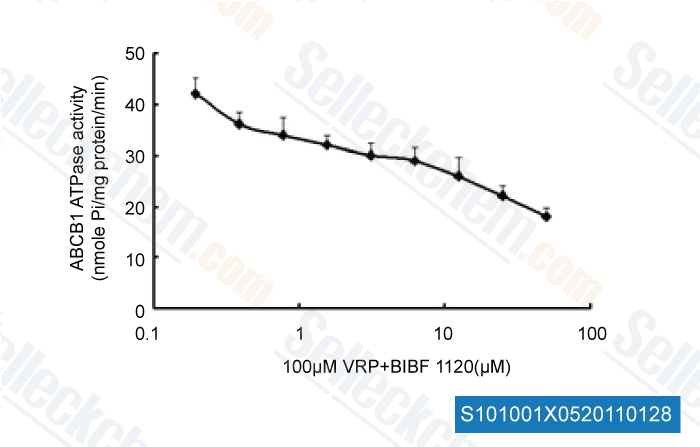
-
Daten von [ Cell Oncol , 2011 , 34, 33–44 ]
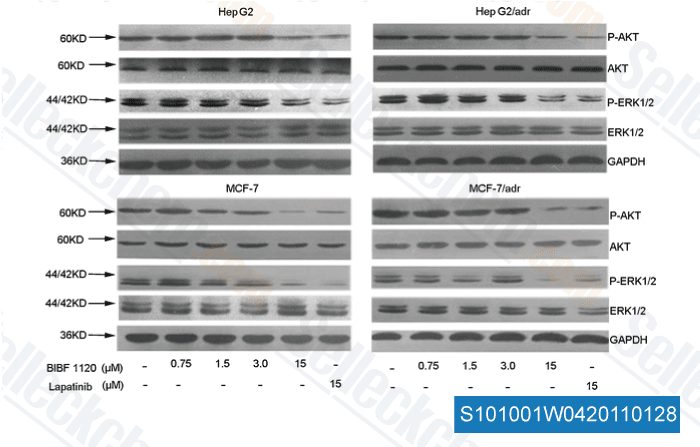
-
Daten von [ Cell Oncol , 2011 , 34, 33–44 ]
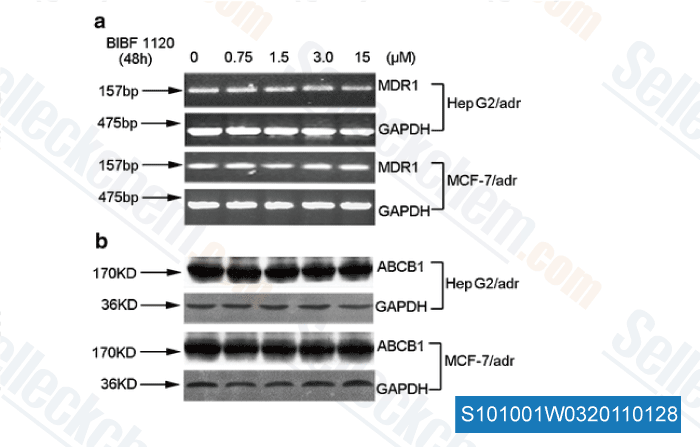
-
Daten von [ Cell Oncol , 2011 , 34, 33–44 ]
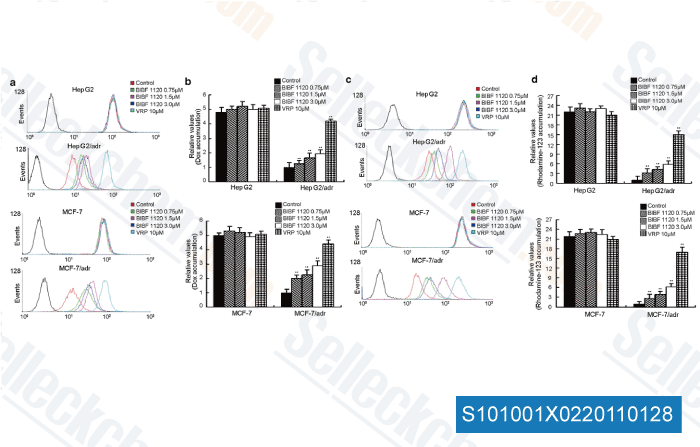
-
Daten von [ Cell Oncol , 2011 , 34, 33–44 ]
Sellecks BIBF 1120 (Nintedanib) Wurde zitiert von 152 Publikationen
| Endothelial-secreted Endocan activates PDGFRA and regulates vascularity and spatial phenotype in glioblastoma [ Nat Commun, 2025, 16(1):471] | PubMed: 39773984 |
| Inhibition of 11β-hydroxysteroid dehydrogenase 1 alleviates pulmonary fibrosis through inhibition of endothelial-to-mesenchymal transition and M2 macrophage polarization by upregulating heme oxygenase-1 [ Cell Death Dis, 2025, 16(1):196] | PubMed: 40118823 |
| Repurposing flavopiridol as an inhaled therapeutic for pulmonary fibrosis [ Eur J Pharmacol, 2025, 1005:178058] | PubMed: 40816528 |
| Nintedanib inhibits neovascularization and subretinal fibrosis in a laser-induced choroidal neovascularization mouse model [ Biochem Biophys Res Commun, 2025, 775:152169] | PubMed: 40499495 |
| Targeting PDGF signaling of cancer-associated fibroblasts blocks feedback activation of HIF-1α and tumor progression of clear cell ovarian cancer [ Cell Rep Med, 2024, S2666-3791(24)00201-5] | PubMed: 38670097 |
| Nintedanib Mitigates Radiation-Induced Pulmonary Fibrosis by Suppressing Epithelial Cell Inflammatory Response and Inhibiting Fibroblast-to-Myofibroblast Transition [ Int J Biol Sci, 2024, 20(9):3353-3371] | PubMed: 38993568 |
| KRASG 12C-inhibitor-based combination therapies for pancreatic cancer: insights from drug screening [ Mol Oncol, 2024, 10.1002/1878-0261.13725] | PubMed: 39253995 |
| Hypoxia Promotes Invadosome Formation by Lung Fibroblasts [ Cells, 2024, 13(13)1152] | PubMed: 38995003 |
| Impact of Nintedanib and Anti-Angiogenic Agents on Uveal Melanoma Cell Behavior [ Invest Ophthalmol Vis Sci, 2024, 65(2):30] | PubMed: 38381412 |
| Identification of aryl hydrocarbon receptor allosteric antagonists from clinically approved drugs [ Drug Dev Res, 2024, 85(5):e22232] | PubMed: 38992915 |
RÜCKGABERICHTLINIE
Die bedingungslose Rückgaberichtlinie von Selleck Chemical gewährleistet unseren Kunden ein reibungsloses Online-Einkaufserlebnis. Wenn Sie in irgendeiner Weise mit Ihrem Kauf unzufrieden sind, können Sie jeden Artikel innerhalb von 7 Tagen nach Erhalt zurückgeben. Im Falle von Produktqualitätsproblemen, sei es protokollbezogene oder produktbezogene Probleme, können Sie jeden Artikel innerhalb von 365 Tagen ab dem ursprünglichen Kaufdatum zurückgeben. Bitte befolgen Sie die nachstehenden Anweisungen, wenn Sie Produkte zurücksenden.
VERSAND UND LAGERUNG
Selleck-Produkte werden bei Raumtemperatur transportiert. Wenn Sie das Produkt bei Raumtemperatur erhalten, seien Sie versichert, dass die Qualitätskontrollabteilung von Selleck Experimente durchgeführt hat, um zu überprüfen, dass die normale Temperaturplatzierung von einem Monat die biologische Aktivität von Pulverprodukten nicht beeinträchtigt. Nach dem Sammeln lagern Sie das Produkt bitte gemäß den in der Datenblatt beschriebenen Anforderungen. Die meisten Selleck-Produkte sind unter den empfohlenen Bedingungen stabil.
NICHT FÜR DIE ANWENDUNG AM MENSCHEN, FÜR VETERINÄRMEDIZINISCHE DIAGNOSTIK ODER THERAPEUTISCHE ZWECKE.