
Technische Daten
| Formel | C25H19NO3S |
||||||
| Molekulargewicht | 413.49 | CAS-Nr. | 503468-95-9 | ||||
| Löslichkeit (25°C)* | In vitro | DMSO | 3 mg/mL (7.25 mM) | ||||
| Water | Insoluble | ||||||
| Ethanol | Insoluble | ||||||
| In vivo (Lösungsmittel einzeln und der Reihe nach zum Produkt hinzufügen.) |
|
||||||
|
* <1 mg/ml bedeutet schwer löslich oder unlöslich. * Bitte beachten Sie, dass Selleck die Löslichkeit aller Verbindungen intern testet und die tatsächliche Löslichkeit geringfügig von veröffentlichten Werten abweichen kann. Dies ist normal und ist auf geringfügige Batch-zu-Batch-Variationen zurückzuführen. * Versand bei Raumtemperatur (Stabilitätstests zeigen, dass dieses Produkt ohne Kühlmaßnahmen versendet werden kann.) |
|||||||
Vorbereitung von Stammlösungen
Biologische Aktivität
| Beschreibung | NU7441 (KU-57788) ist ein hochwirksamer und selektiver DNA-PK-Inhibitor mit einer IC50 von 14 nM. Er hemmt auch mTOR und PI3K mit einer IC50 von 1,7 μM bzw. 5 μM in zellfreien Assays und reduziert die Häufigkeit von NHEJ, während die Rate der HDR nach Cas9-vermittelter DNA-Spaltung erhöht wird. | ||||||
|---|---|---|---|---|---|---|---|
| Ziele |
|
||||||
| In vitro | NU7441 (KU-57788) erhöht die Persistenz von γH2AX-Foci nach durch ionisierende Strahlung induzierten DNA-Schäden. Es (0,5 μM oder 1 μM) erhöht die durch ionisierende Strahlung und Doxorubicin induzierte G2-M-Akkumulation in SW620- und LoVo-Zellen merklich. Diese Verbindung bewirkt die Persistenz von Doxorubicin- und ionisierender Strahlung-induzierten DNA-Doppelstrangbrüchen und verringert auch leicht die homologe Rekombinationsaktivität in DNA-PK-profizienten M059-Fus-1- und DNA-PK-defizienten M059 J-menschlichen Tumorzellen. Es hemmt die UV-induzierte RPA p34-Hyperphosphorylierung dosisabhängig sowohl in Zellen ohne als auch in Zellen mit Expression der Polymerase η. NU7441 erhöht die Spiegel von -induzierten γH2AX-Foci und verringert entsprechend den -induzierten Zelltod in chronischen lymphatischen Leukämiezellen. Es hemmt auch die -induzierte DNA-PKcs-Autophosphorylierung und -Reparatur in chronischen lymphatischen Leukämiezellen. Diese Verbindung reduziert die Häufigkeit von NHEJ, während sie die Rate von HDR nach Cas9-vermittelter DNA-Spaltung erhöht. |
||||||
| In vivo | NU7441 (KU-57788), intraperitoneal in einer Dosis von 10 mg/kg verabreicht, bleibt für mindestens 4 Stunden im Körper, zeigt keine Toxizität und erhöht die induzierte Tumorwachstumsverzögerung um das 2-fache bei Mäusen mit SW620-Xenografts. |
Protokoll (aus Referenz)
| Zell-Assay: |
|
|---|---|
| Tierstudie: |
|
Referenzen
|
Kundenproduktvalidierung
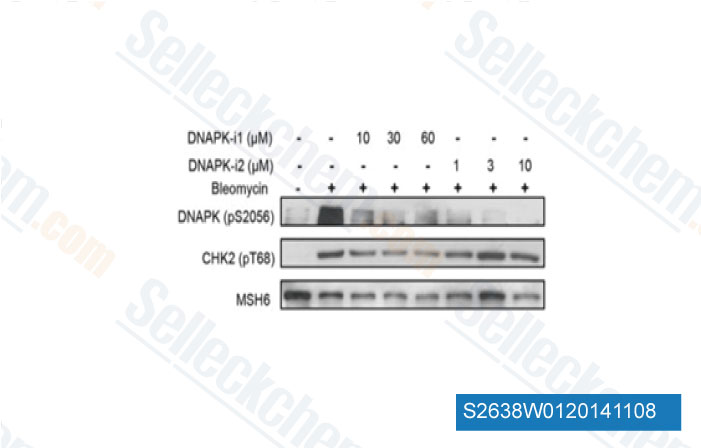
-
Daten von [ Toxicol Sci , 2014 , 10.1093/toxsci/kfu207 ]
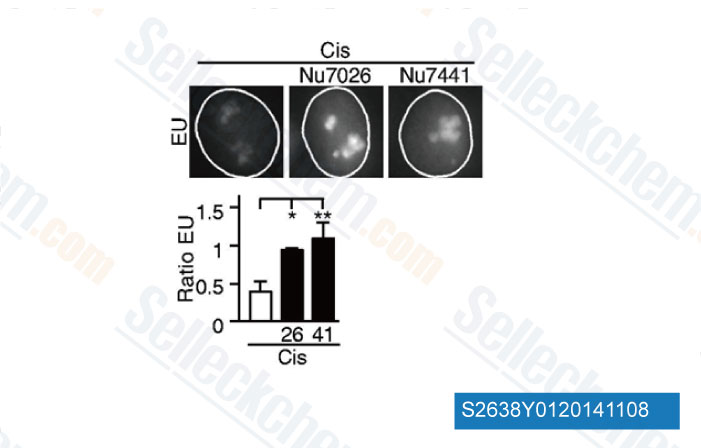
-
Daten von [ Nucleic Acids Res , 2013 , 41(15), 7378-86 ]
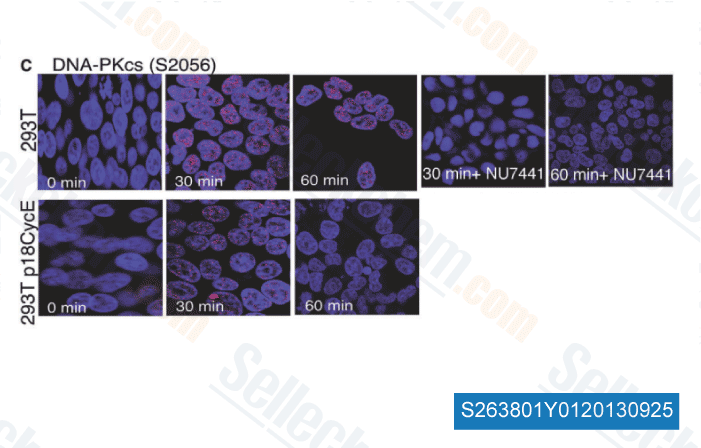
-
Daten von [ Nucleic Acids Res , 2013 , 41, 10157-69 ]
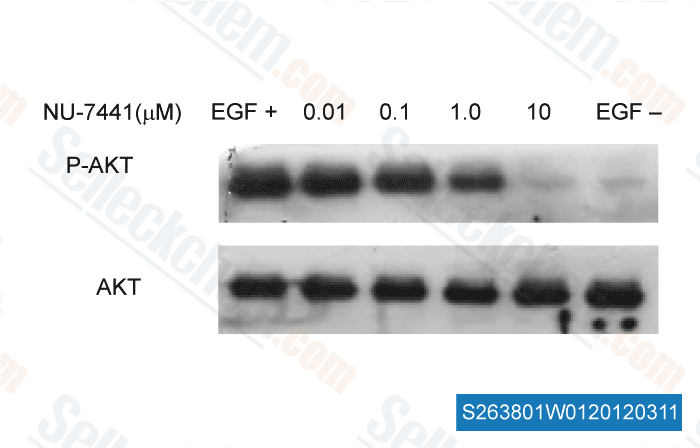
-
, , Dr. Zhang of Tianjin Medical University
Sellecks NU7441 (KU-57788) Wurde zitiert von 309 Publikationen
| Homologous recombination promotes non-immunogenic mitotic cell death upon DNA damage [ Nat Cell Biol, 2025, 27(1):59-72] | PubMed: 39805921 |
| Highly efficient prime editors for mammalian genome editing based on porcine retrovirus reverse transcriptase [ Trends Biotechnol, 2025, S0167-7799(25)00314-2] | PubMed: 40885667 |
| Phosphorylation-dependent WRN-RPA interaction promotes recovery of stalled forks at secondary DNA structure [ Nat Commun, 2025, 16(1):997] | PubMed: 39870632 |
| Autophosphorylation of the Tousled-like kinases TLK1 and TLK2 regulates recruitment to damaged chromatin via PCNA interaction [ Nucleic Acids Res, 2025, 53(4)gkae1279] | PubMed: 39727191 |
| Homeodomain protein PRRX1 anchors the Ku heterodimers at DNA double-strand breaks to promote nonhomologous end-joining [ Nucleic Acids Res, 2025, 53(6)gkaf200] | PubMed: 40114375 |
| ONE-STEP tagging: a versatile method for rapid site-specific integration by simultaneous reagent delivery [ Nucleic Acids Res, 2025, 53(15)gkaf809] | PubMed: 40823809 |
| The inflammasome sensor NLRP3 interacts with REV7 to maintain genome integrity through homologous recombination [ Nucleic Acids Res, 2025, 53(12)gkaf554] | PubMed: 40613708 |
| Nuclear damage-induced DNA damage response coupled with IFI16-driven ECM remodeling underlies dilated cardiomyopathy [ Theranostics, 2025, 15(12):5998-6021] | PubMed: 40365289 |
| Cross-species analysis of the nuclease Artemis highlights its evolving function in domesticating RAG-like transposons and residues that are crucial for activity [ PLoS Biol, 2025, 23(4):e3003056] | PubMed: 40245028 |
| DSCC1 restrains 53BP1/RIF1 signaling at DNA double-strand breaks to promote homologous recombination repair [ Cell Rep, 2025, 44(4):115452] | PubMed: 40117291 |
RÜCKGABERICHTLINIE
Die bedingungslose Rückgaberichtlinie von Selleck Chemical gewährleistet unseren Kunden ein reibungsloses Online-Einkaufserlebnis. Wenn Sie in irgendeiner Weise mit Ihrem Kauf unzufrieden sind, können Sie jeden Artikel innerhalb von 7 Tagen nach Erhalt zurückgeben. Im Falle von Produktqualitätsproblemen, sei es protokollbezogene oder produktbezogene Probleme, können Sie jeden Artikel innerhalb von 365 Tagen ab dem ursprünglichen Kaufdatum zurückgeben. Bitte befolgen Sie die nachstehenden Anweisungen, wenn Sie Produkte zurücksenden.
VERSAND UND LAGERUNG
Selleck-Produkte werden bei Raumtemperatur transportiert. Wenn Sie das Produkt bei Raumtemperatur erhalten, seien Sie versichert, dass die Qualitätskontrollabteilung von Selleck Experimente durchgeführt hat, um zu überprüfen, dass die normale Temperaturplatzierung von einem Monat die biologische Aktivität von Pulverprodukten nicht beeinträchtigt. Nach dem Sammeln lagern Sie das Produkt bitte gemäß den in der Datenblatt beschriebenen Anforderungen. Die meisten Selleck-Produkte sind unter den empfohlenen Bedingungen stabil.
NICHT FÜR DIE ANWENDUNG AM MENSCHEN, FÜR VETERINÄRMEDIZINISCHE DIAGNOSTIK ODER THERAPEUTISCHE ZWECKE.