
Technische Daten
| Formel | C8H14N2O4Pt |
|||
| Molekulargewicht | 397.29 | CAS-Nr. | 61825-94-3 | |
| Löslichkeit (25°C)* | In vitro | Water | 2 mg/mL (5.03 mM) | |
| Ethanol | Insoluble | |||
|
* <1 mg/ml bedeutet schwer löslich oder unlöslich. * Bitte beachten Sie, dass Selleck die Löslichkeit aller Verbindungen intern testet und die tatsächliche Löslichkeit geringfügig von veröffentlichten Werten abweichen kann. Dies ist normal und ist auf geringfügige Batch-zu-Batch-Variationen zurückzuführen. * Versand bei Raumtemperatur (Stabilitätstests zeigen, dass dieses Produkt ohne Kühlmaßnahmen versendet werden kann.) |
||||
Vorbereitung von Stammlösungen
Biologische Aktivität
| Beschreibung | Oxaliplatin ist ein DNA alkylating agent, der Autophagy aktiviert. Oxaliplatin hemmt die DNA synthesis, indem es DNA adducts in RT4-, TCCSUP-, A2780-, HT-29-, U-373MG-, U-87MG-, SK-MEL-2- und HT-144-Zellen bildet.Lösungen sind instabil und sollten frisch zubereitet werden. DMSO wird nicht zur Auflösung platinbasierter Medikamente empfohlen, da dies leicht zur Inaktivierung des Medikaments führen kann. | |
|---|---|---|
| Ziele |
|
|
| In vitro | Der Hauptwirkmechanismus von Oxaliplatin wird durch die Bildung von DNA-Addukten vermittelt. Diese Verbindung induziert primäre und sekundäre DNA lesions, die zur Zellapoptose führen. Es ist wirksam gegen menschliche Melanomzelllinien C32 und G361 mit IC50-Werten von 0,98 mM bzw. 0,14 mM. Diese Chemikalie hemmt effektiv Blasenkarzinomzelllinien RT4 und TCCSUP, die Ovarialkarzinomzelllinie A2780, die Darmkarzinomzelllinie HT-29, Glioblastomzelllinien U-373MG und U-87MG sowie Melanomzelllinien SK-MEL-2 und HT-144 mit IC50-Werten von 11 μM, 15 μM, 0,17 μM, 0,97 μM, 2,95 μM, 17,6 μM, 30,9 μM bzw. 7,85 μM. |
|
| In vivo | Eine wöchentliche i.p.-Injektion von Oxaliplatin mit 10 mg/kg bei Nacktmäusen mit hepatozellulären HCCLM3-Tumoren reduziert signifikant das Tumorvolumen und den apoptotischen Index. Diese Verbindung (5 mg/kg, i.v. an den Tagen 1, 5 und 9) ist aktiv gegen T-Leukämie-Lymphome L40 AKR mit einem T/C-Wert von 1,77. Es ist auch wirksam bei intrazerebral transplantierten L1210-Leukämien, MA 16-C-Xenotransplantaten, B16-Melanom-Xenotransplantaten, Lewis-Lungen-Xenotransplantaten und C26-Kolonkarzinom-Xenotransplantaten. Diese Chemikalie induziert eine Beeinträchtigung des retrograden neuronalen Transports bei Mäusen. |
|
| Merkmale | Es wird nicht empfohlen, dieses Produkt in Dimethylsulfoxid (DMSO) zu lösen. |
Protokoll (aus Referenz)
| Zell-Assay: |
|
|---|---|
| Tierstudie: |
|
Referenzen
|
Kundenproduktvalidierung
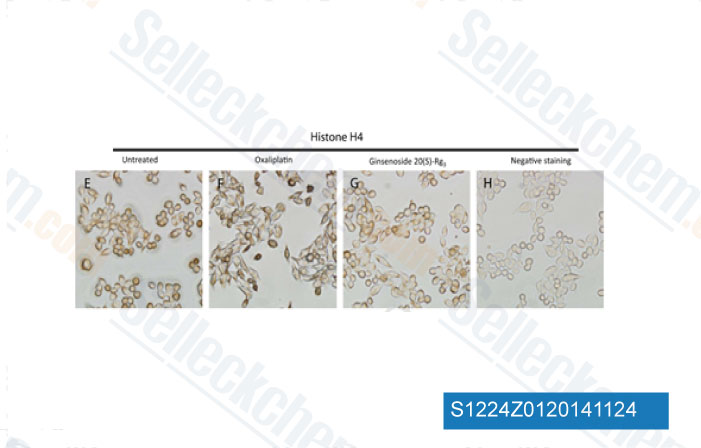
-
Daten von [ J Proteomics , 2014 , 10.1016/j.jprot.2014.10.009 ]
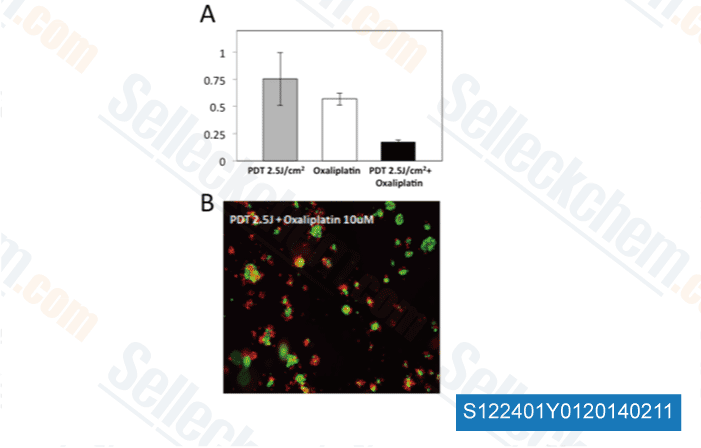
-
Daten von [ Optical Methods for Tumor Treatment and Detection , 2013 , 10.1117/12.2010730 ]
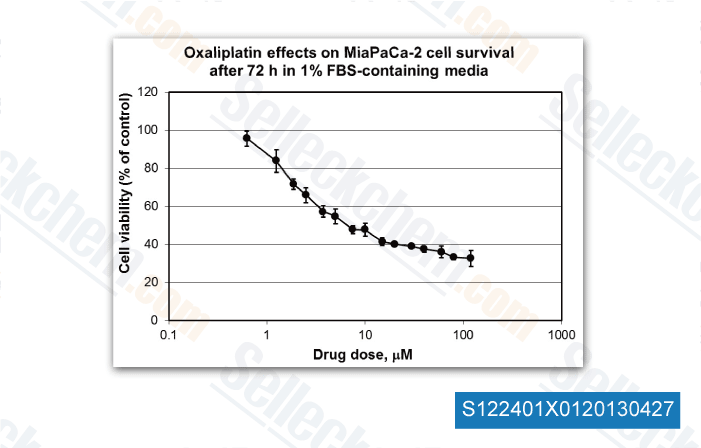
-
, 2013 , Dr. Edita Aksamitiene from Thomas Jefferson University
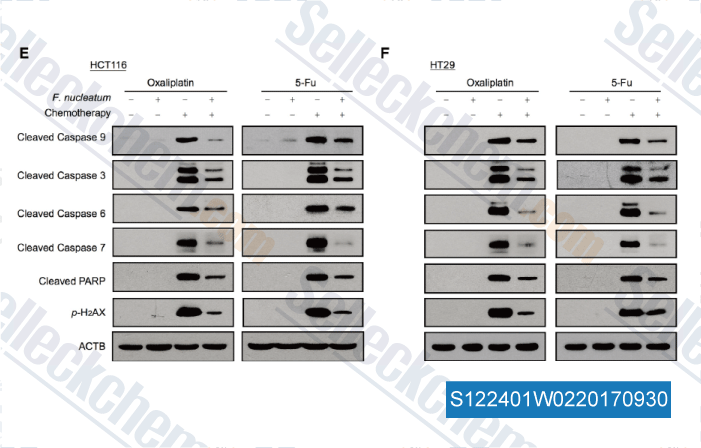
-
Daten von [ , , Cell, 2017, 170(3):548-563.e16 ]
Sellecks Oxaliplatin Wurde zitiert von 282 Publikationen
| Activation of lysosomal iron triggers ferroptosis in cancer [ Nature, 2025, 10.1038/s41586-025-08974-4] | PubMed: 40335696 |
| Cisplatin and temozolomide combinatorial treatment triggers hypermutability and immune surveillance in experimental cancer models [ Cancer Cell, 2025, S1535-6108(25)00223-5] | PubMed: 40513578 |
| The noncanonical function of liver-type phosphofructokinase potentiates the efficacy of HDAC inhibitors in cancer [ Signal Transduct Target Ther, 2025, 10(1):341] | PubMed: 41083431 |
| A pancreatic cancer organoid biobank links multi-omics signatures to therapeutic response and clinical evaluation of statin combination therapy [ Cell Stem Cell, 2025, S1934-5909(25)00265-6] | PubMed: 40812300 |
| Prediction of Patient Drug Response via 3D Bioprinted Gastric Cancer Model Utilized Patient-Derived Tissue Laden Tissue-Specific Bioink [ Adv Sci (Weinh), 2025, 12(10):e2411769] | PubMed: 39748450 |
| Targeting of the G9a, DNMT1 and UHRF1 epigenetic complex as an effective strategy against pancreatic ductal adenocarcinoma [ J Exp Clin Cancer Res, 2025, 44(1):13] | PubMed: 39810240 |
| Unveiling radiobiological traits and therapeutic responses of BRAFV600E-mutant colorectal cancer via patient-derived organoids [ J Exp Clin Cancer Res, 2025, 44(1):92] | PubMed: 40069844 |
| Gemcitabine and ATR inhibitors synergize to kill PDAC cells by blocking DNA damage response [ Mol Syst Biol, 2025, 21(3):231-253] | PubMed: 39838187 |
| Monitoring Response to Combinatorial Immunotherapies by Tracking both T Cells and Natural Killer Cells In Vivo via ImmunoPET-Raman Multimodal Gold Nanostars [ ACS Appl Mater Interfaces, 2025, 10.1021/acsami.5c11312] | PubMed: 41099635 |
| CBX3 promotes multidrug resistance by suppressing ferroptosis in colorectal carcinoma via the CUL3/NRF2/GPX2 axis [ Oncogene, 2025, 10.1038/s41388-025-03337-9] | PubMed: 40089640 |
RÜCKGABERICHTLINIE
Die bedingungslose Rückgaberichtlinie von Selleck Chemical gewährleistet unseren Kunden ein reibungsloses Online-Einkaufserlebnis. Wenn Sie in irgendeiner Weise mit Ihrem Kauf unzufrieden sind, können Sie jeden Artikel innerhalb von 7 Tagen nach Erhalt zurückgeben. Im Falle von Produktqualitätsproblemen, sei es protokollbezogene oder produktbezogene Probleme, können Sie jeden Artikel innerhalb von 365 Tagen ab dem ursprünglichen Kaufdatum zurückgeben. Bitte befolgen Sie die nachstehenden Anweisungen, wenn Sie Produkte zurücksenden.
VERSAND UND LAGERUNG
Selleck-Produkte werden bei Raumtemperatur transportiert. Wenn Sie das Produkt bei Raumtemperatur erhalten, seien Sie versichert, dass die Qualitätskontrollabteilung von Selleck Experimente durchgeführt hat, um zu überprüfen, dass die normale Temperaturplatzierung von einem Monat die biologische Aktivität von Pulverprodukten nicht beeinträchtigt. Nach dem Sammeln lagern Sie das Produkt bitte gemäß den in der Datenblatt beschriebenen Anforderungen. Die meisten Selleck-Produkte sind unter den empfohlenen Bedingungen stabil.
NICHT FÜR DIE ANWENDUNG AM MENSCHEN, FÜR VETERINÄRMEDIZINISCHE DIAGNOSTIK ODER THERAPEUTISCHE ZWECKE.