
Technische Daten
| Formel | C12H7Cl2NO3S2 |
||||||||||
| Molekulargewicht | 348.22 | CAS-Nr. | 882257-11-6 | ||||||||
| Löslichkeit (25°C)* | In vitro | DMSO | 35 mg/mL (100.51 mM) | ||||||||
| Water | Insoluble | ||||||||||
| Ethanol | Insoluble | ||||||||||
| In vivo (Lösungsmittel einzeln und der Reihe nach zum Produkt hinzufügen.) |
|
||||||||||
|
* <1 mg/ml bedeutet schwer löslich oder unlöslich. * Bitte beachten Sie, dass Selleck die Löslichkeit aller Verbindungen intern testet und die tatsächliche Löslichkeit geringfügig von veröffentlichten Werten abweichen kann. Dies ist normal und ist auf geringfügige Batch-zu-Batch-Variationen zurückzuführen. * Versand bei Raumtemperatur (Stabilitätstests zeigen, dass dieses Produkt ohne Kühlmaßnahmen versendet werden kann.) |
|||||||||||
Vorbereitung von Stammlösungen
Biologische Aktivität
| Beschreibung | P5091 ist ein selektiver und potenter Inhibitor der Ubiquitin-spezifischen Protease 7 (USP7) mit einer EC50 von 4,2 μM und der eng verwandten USP47. | ||||
|---|---|---|---|---|---|
| Ziele |
|
||||
| In vitro | P5091 ist ein trisubstituiertes Thiophen mit Dichlorphenylthio-, Nitro- und Acetyl-Substituenten, die die Anti-USP7-Aktivität vermitteln. Diese Verbindung zeigt eine potente, spezifische und selektive Deubiquitinierungsaktivität gegen USP7. Im Gegensatz dazu hemmt sie keine anderen DUBs oder andere getestete Familien von Cysteinproteasen (EC50 > 100 mM). Diese Chemikalie hemmt die Markierung von USP7 mit HA-UbVME in einer konzentrationsabhängigen Weise. Die USP7-vermittelte Spaltung von hochmolekularen Polyubiquitinketten wird durch diese Verbindung dosisabhängig gehemmt. Darüber hinaus hemmt sie die USP7-, aber nicht die USP2- oder USP8-vermittelte Spaltung von Poly-K48-verknüpften Ubiquitinketten. Die USP7-Hemmung durch diese Verbindung induziert die Polyubiquitinierung von HDM2 und beschleunigt den Abbau von HDM2. Sie hemmt die USP7-Deubiquitinierungsaktivität, ohne die Proteasomaktivität in MM-Zellen zu blockieren. Diese Chemikalie induziert einen dosisabhängigen Rückgang der Lebensfähigkeit verschiedener MM-Zelllinien. Sie überwindet das durch Knochenmark-Stromazellen induzierte Wachstum von MM-Zellen. Diese Verbindung verringerte HDM2 und HDMX sowie erhöhte p53- und p21-Spiegel. Insgesamt wird die durch diese Verbindung induzierte Zytotoxizität teilweise über die HDM2-p21-Signalachse vermittelt, und obwohl p53 als Reaktion auf diese chemische Behandlung hochreguliert wird, ist die zytotoxische Aktivität davon nicht p53-abhängig. |
||||
| In vivo | In Tiermodellstudien für Tumore wird P5091 gut vertragen, hemmt das Tumorwachstum und verlängert das Überleben. Die Kombination dieser Verbindung mit dem HDAC-Inhibitor SAHA löst eine synergistische Anti-MM-Aktivität aus. |
Protokoll (aus Referenz)
| Kinase-Assay: |
|
|---|---|
| Zell-Assay: |
|
| Tierstudie: |
|
Referenzen
|
Kundenproduktvalidierung
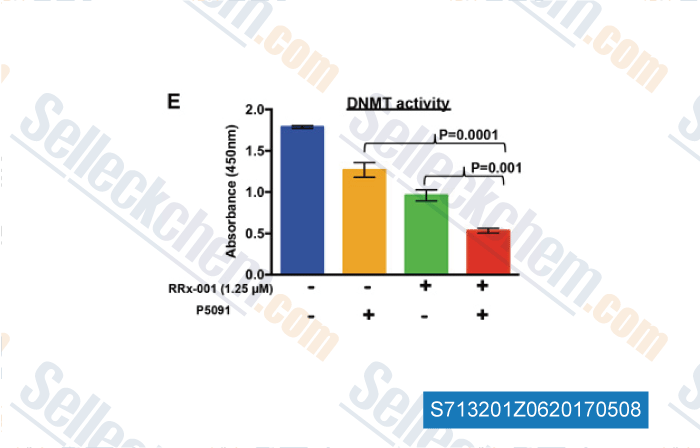
-
Daten von [ , , Leukemia, 2016, 30(11):2187-2197 ]
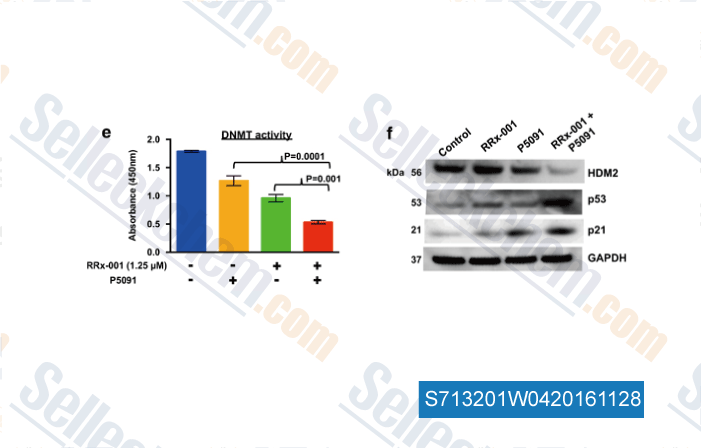
-
Daten von [ , , Leukemia, 2016, 30(11):2187-2197. ]

-
Daten von [ , , Cell Physiol Biochem, 2017, 43(5):1755-1766 ]
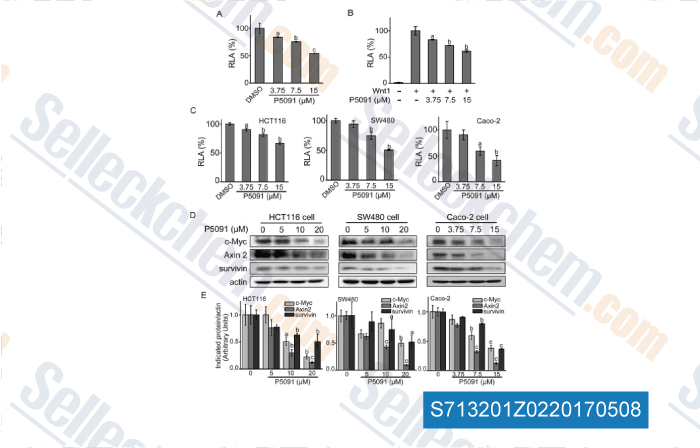
-
Daten von [ , , Biochem Pharmacol, 2017, 131:29-39 ]
Sellecks P5091 Wurde zitiert von 57 Publikationen
| ACC1 is a dual metabolic-epigenetic regulator of Treg stability and immune tolerance [ Mol Metab, 2025, 94:102111] | PubMed: 39929287 |
| The deubiquitinase USP7 stabilizes HER2 expression and promotes breast cancer progression [ Neoplasia, 2025, 66:101192] | PubMed: 40472738 |
| Stabilization of KPNB1 by deubiquitinase USP7 promotes glioblastoma progression through the YBX1-NLGN3 axis [ J Exp Clin Cancer Res, 2024, 43(1):28] | PubMed: 38254206 |
| ER Stress-Activated HSF1 Governs Cancer Cell Resistance to USP7 Inhibitor-Based Chemotherapy through the PERK Pathway [ Int J Mol Sci, 2024, 25(5)2768] | PubMed: 38474017 |
| USP7/Maged1-mediated H2A monoubiquitination in the paraventricular thalamus: an epigenetic mechanism involved in cocaine use disorder [ Nat Commun, 2023, 14(1):8481] | PubMed: 38123574 |
| Engineered Microparticles for Treatment of Murine Brain Metastasis by Reprograming Tumor Microenvironment and Inhibiting MAPK Pathway [ Adv Sci (Weinh), 2023, 10(8):e2206212] | PubMed: 36698296 |
| USP7 promotes non-small-cell lung cancer cell glycolysis and survival by stabilizing and activating c-Abl [ Clin Transl Med, 2023, 13(12):e1509] | PubMed: 38082439 |
| De-ubiquitination of SAMHD1 by USP7 promotes DNA damage repair to overcome oncogenic stress and affect chemotherapy sensitivity [ Oncogene, 2023, 42(22):1843-1856] | PubMed: 37081042 |
| Suppression of USP7 negatively regulates the stability of ETS proto-oncogene 2 protein [ Biomed Pharmacother, 2023, 162:114700] | PubMed: 37062218 |
| USP7 Inhibits Osteoclastogenesis via Dual Effects of Attenuating TRAF6/TAK1 Axis and Stimulating STING Signaling [ Aging Dis, 2023, 14(6):2267-2283] | PubMed: 37199589 |
RÜCKGABERICHTLINIE
Die bedingungslose Rückgaberichtlinie von Selleck Chemical gewährleistet unseren Kunden ein reibungsloses Online-Einkaufserlebnis. Wenn Sie in irgendeiner Weise mit Ihrem Kauf unzufrieden sind, können Sie jeden Artikel innerhalb von 7 Tagen nach Erhalt zurückgeben. Im Falle von Produktqualitätsproblemen, sei es protokollbezogene oder produktbezogene Probleme, können Sie jeden Artikel innerhalb von 365 Tagen ab dem ursprünglichen Kaufdatum zurückgeben. Bitte befolgen Sie die nachstehenden Anweisungen, wenn Sie Produkte zurücksenden.
VERSAND UND LAGERUNG
Selleck-Produkte werden bei Raumtemperatur transportiert. Wenn Sie das Produkt bei Raumtemperatur erhalten, seien Sie versichert, dass die Qualitätskontrollabteilung von Selleck Experimente durchgeführt hat, um zu überprüfen, dass die normale Temperaturplatzierung von einem Monat die biologische Aktivität von Pulverprodukten nicht beeinträchtigt. Nach dem Sammeln lagern Sie das Produkt bitte gemäß den in der Datenblatt beschriebenen Anforderungen. Die meisten Selleck-Produkte sind unter den empfohlenen Bedingungen stabil.
NICHT FÜR DIE ANWENDUNG AM MENSCHEN, FÜR VETERINÄRMEDIZINISCHE DIAGNOSTIK ODER THERAPEUTISCHE ZWECKE.