
Technische Daten
| Formel | C22H27N5O4 |
|||
| Molekulargewicht | 425.48 | CAS-Nr. | 1013101-36-4 | |
| Löslichkeit (25°C)* | In vitro | 5%TFA | 6.06 mg/mL (14.24 mM) | |
| DMSO | Insoluble | |||
| Water | Insoluble | |||
|
* <1 mg/ml bedeutet schwer löslich oder unlöslich. * Bitte beachten Sie, dass Selleck die Löslichkeit aller Verbindungen intern testet und die tatsächliche Löslichkeit geringfügig von veröffentlichten Werten abweichen kann. Dies ist normal und ist auf geringfügige Batch-zu-Batch-Variationen zurückzuführen. * Versand bei Raumtemperatur (Stabilitätstests zeigen, dass dieses Produkt ohne Kühlmaßnahmen versendet werden kann.) |
||||
Vorbereitung von Stammlösungen
Biologische Aktivität
| Beschreibung | PF-04691502 (PF4691502) ist ein ATP-kompetitiver PI3K(α/β/δ/γ)/mTOR-Doppelinhibitor mit einem Ki von 1,8 nM/2,1 nM/1,6 nM/1,9 nM und 16 nM in zellfreien Assays, mit geringer Aktivität gegen Vps34, AKT, PDK1, p70S6K, MEK, ERK, p38 oder JNK. Diese Verbindung induziert Apoptose. Phase 2. | |||||||||||
|---|---|---|---|---|---|---|---|---|---|---|---|---|
| Ziele |
|
|||||||||||
| In vitro | PF-04691502 hemmt potent rekombinante Klasse-I-PI3K und mTOR in biochemischen Assays und unterdrückt die Transformation von aviären Fibroblasten, die durch Wildtyp-PI3K γ, δ oder mutierte PI3Kα vermittelt wird. In PIK3CA-mutierten und PTEN-delektierten Krebszelllinien reduziert diese Verbindung die Phosphorylierung von AKT T308 und AKT S473 (IC(50) von 7,5-47 nM bzw. 3,8-20 nM) und hemmt die Zellproliferation (IC(50) von 179-313 nM). Es hemmt die mTORC1-Aktivität in Zellen, gemessen durch einen PI3K-unabhängigen Nährstoff-stimulierten Assay, mit einem IC(50) von 32 nM und hemmt die Aktivierung von PI3K- und mTOR-nachgeschalteten Effektoren, einschließlich AKT, FKHRL1, PRAS40, p70S6K, 4EBP1 und S6RP. Eine kurzzeitige Exposition gegenüber dieser Chemikalie hemmt hauptsächlich PI3K, während die mTOR-Hemmung 24 bis 48 Stunden anhält. Diese Verbindung induziert einen G(1)-Arrest des Zellzyklus, einhergehend mit einer Hochregulation von p27 Kip1 und einer Reduktion von Rb. |
|||||||||||
| In vivo | Antitumoraktivität von PF-04691502 wird in U87 (PTEN-null), SKOV3 (PIK3CA-Mutation) und nicht-kleinzelligen Lungenkarzinom-Xenotransplantaten beobachtet. Diese Verbindung hemmt das Tumorwachstum nach 7 Tagen um 72 %. Die FDG-PET-Bildgebung zeigte, dass sie den Glukosestoffwechsel dramatisch reduziert. Gewebsbiomarker der PI3K/mTOR-Signalwegaktivität, p-AKT (S473) und p-RPS6 (S240/244), werden nach ihrer Behandlung ebenfalls dramatisch gehemmt. |
Protokoll (aus Referenz)
| Kinase-Assay: |
|
|---|---|
| Zell-Assay: |
|
| Tierstudie: |
|
Referenzen
|
Kundenproduktvalidierung
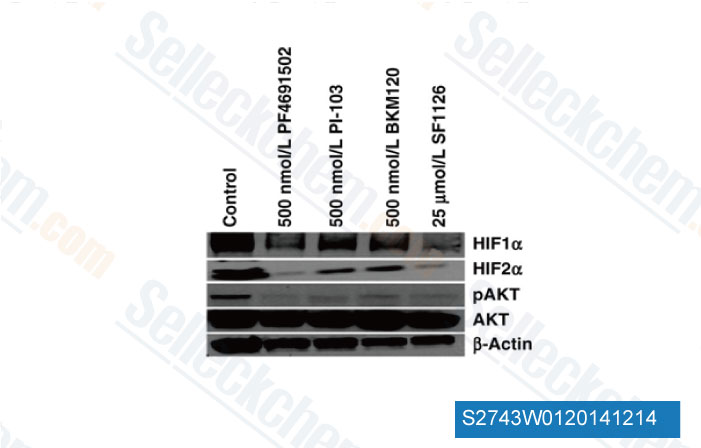
-
Daten von [ Mol Cancer Res , 2014 , 12(10), 1520-31 ]
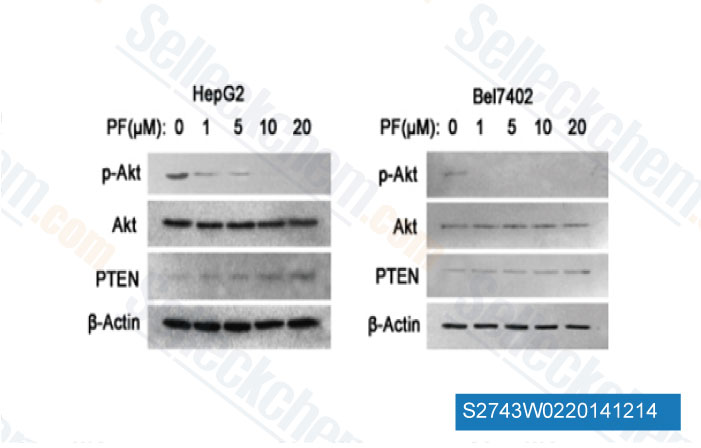
-
Daten von [ Toxicol Lett , 2013 , 220(2), 150-6 ]
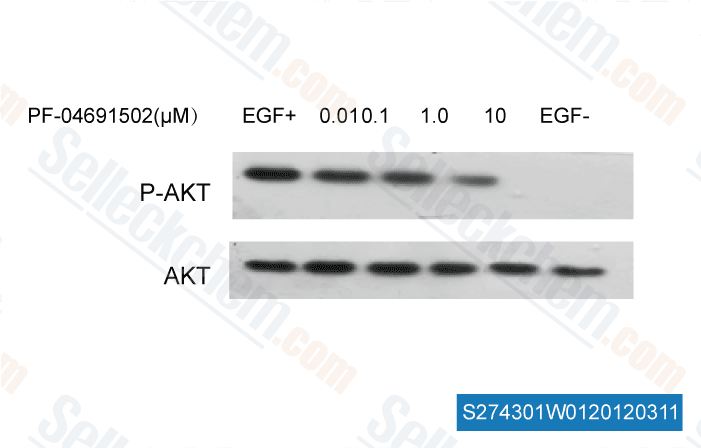
-
, , Dr. Zhang of Tianjin Medical University
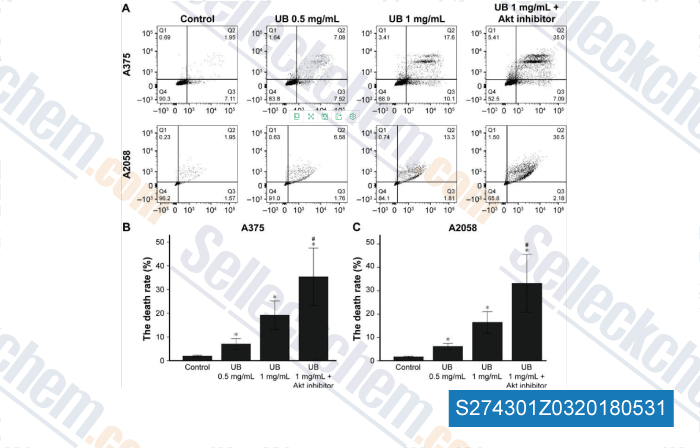
-
Daten von [ , , Onco Targets Ther, 2018, 11:943-953 ]
Sellecks PF-04691502 Wurde zitiert von 52 Publikationen
| ERK1-mediated GLYCTK2 phosphorylation promotes fructolysis to sustain glioblastoma survival under glucose deprivation [ Cell Death Discov, 2025, 11(1):266] | PubMed: 40467571 |
| Inhibitor PF-04691502 works as a senolytic to regulate cellular senescence [ Exp Gerontol, 2024, 186:112359] | PubMed: 38184267 |
| Zebrafish functional xenograft vasculature platform identifies PF-502 as a durable vasculature normalization drug [ iScience, 2023, 26(9):107734] | PubMed: 37680473 |
| Functional restoration of lysosomes and mitochondria through modulation of AKT activity ameliorates senescence [ Exp Gerontol, 2023, 173:112091] | PubMed: 36657533 |
| Glucose metabolic upregulation via phosphorylation of S6 ribosomal protein affects tumor progression in distal cholangiocarcinoma [ BMC Gastroenterol, 2023, 23(1):157] | PubMed: 37193984 |
| RNF43G659fs is an oncogenic colorectal cancer mutation and sensitizes tumor cells to PI3K/mTOR inhibition [ Nature Communications, 2022, 3181-2022)] | PubMed: None |
| RNF43 G659fs is an oncogenic colorectal cancer mutation and sensitizes tumor cells to PI3K/mTOR inhibition [ Nat Commun, 2022, 13(1):3181] | PubMed: 35676246 |
| A novel PI3K inhibitor XH30 suppresses orthotopic glioblastoma and brain metastasis in mice models [ Acta Pharm Sin B, 2022, 12(2):774-786] | PubMed: 35256946 |
| Leveraging patient derived models of FGFR2 fusion positive intrahepatic cholangiocarcinoma to identify synergistic therapies [ NPJ Precis Oncol, 2022, 6(1):75] | PubMed: 36274097 |
| Identification of New Vulnerabilities in Conjunctival Melanoma Using Image-Based High Content Drug Screening [ Cancers (Basel), 2022, 14(6)1575] | PubMed: 35326726 |
RÜCKGABERICHTLINIE
Die bedingungslose Rückgaberichtlinie von Selleck Chemical gewährleistet unseren Kunden ein reibungsloses Online-Einkaufserlebnis. Wenn Sie in irgendeiner Weise mit Ihrem Kauf unzufrieden sind, können Sie jeden Artikel innerhalb von 7 Tagen nach Erhalt zurückgeben. Im Falle von Produktqualitätsproblemen, sei es protokollbezogene oder produktbezogene Probleme, können Sie jeden Artikel innerhalb von 365 Tagen ab dem ursprünglichen Kaufdatum zurückgeben. Bitte befolgen Sie die nachstehenden Anweisungen, wenn Sie Produkte zurücksenden.
VERSAND UND LAGERUNG
Selleck-Produkte werden bei Raumtemperatur transportiert. Wenn Sie das Produkt bei Raumtemperatur erhalten, seien Sie versichert, dass die Qualitätskontrollabteilung von Selleck Experimente durchgeführt hat, um zu überprüfen, dass die normale Temperaturplatzierung von einem Monat die biologische Aktivität von Pulverprodukten nicht beeinträchtigt. Nach dem Sammeln lagern Sie das Produkt bitte gemäß den in der Datenblatt beschriebenen Anforderungen. Die meisten Selleck-Produkte sind unter den empfohlenen Bedingungen stabil.
NICHT FÜR DIE ANWENDUNG AM MENSCHEN, FÜR VETERINÄRMEDIZINISCHE DIAGNOSTIK ODER THERAPEUTISCHE ZWECKE.