
Technische Daten
| Formel | C14H12O4 |
||||||
| Molekulargewicht | 244.24 | CAS-Nr. | 10083-24-6 | ||||
| Löslichkeit (25°C)* | In vitro | DMSO | 48 mg/mL (196.52 mM) | ||||
| Ethanol | 48 mg/mL (196.52 mM) | ||||||
| Water | Insoluble | ||||||
| In vivo (Lösungsmittel einzeln und der Reihe nach zum Produkt hinzufügen.) |
|
||||||
|
* <1 mg/ml bedeutet schwer löslich oder unlöslich. * Bitte beachten Sie, dass Selleck die Löslichkeit aller Verbindungen intern testet und die tatsächliche Löslichkeit geringfügig von veröffentlichten Werten abweichen kann. Dies ist normal und ist auf geringfügige Batch-zu-Batch-Variationen zurückzuführen. * Versand bei Raumtemperatur (Stabilitätstests zeigen, dass dieses Produkt ohne Kühlmaßnahmen versendet werden kann.) |
|||||||
Vorbereitung von Stammlösungen
Biologische Aktivität
| Beschreibung | Piceatannol, ein natürliches Stilben, ist ein selektiver Syk-Inhibitor mit einer ~10-fachen Selektivität gegenüber Lyn. | |||||||||||
|---|---|---|---|---|---|---|---|---|---|---|---|---|
| Ziele |
|
|||||||||||
| In vitro | Piceatannol zeigt eine etwa 10-fache Selektivität für Syk gegenüber Lyn. Diese Verbindung hemmt in RBL-2H3-Zellen die antigenstimulierte Phosphorylierung von Syk und der meisten anderen zellulären Proteine, jedoch nicht die des Rezeptor-β- oder γ-Untereinheit, dosisabhängig. Es ist auch ein potenter Inhibitor der Histaminfreisetzung in Mastzellen. Die selektive Hemmung von Syk durch diese Chemikalie blockiert rezeptorvermittelte nachgeschaltete zelluläre Reaktionen in Mastzellen, einschließlich der Verhinderung der 1,4,5-IP3-Synthese, Sekretion sowie Membranruffe und Ausbreitung. Diese Verbindung hemmt auch potent PKA, PKC, MLCK und CDPK mit IC50-Werten von 3 μM, 8 μM, 12 μM bzw. 19 μM. Es verhindert selektiv die IFNα-induzierte Tyrosinphosphorylierung von STAT3 und -5, jedoch nicht von STAT1 und -2, parallel zum Verlust der Jak1- und IFNAR1-Tyrosinphosphorylierung, jedoch nicht von Tyk2 und IFNAR2. Diese Chemikalie induziert potent apoptotischen Zelltod in BJAB Burkitt-ähnlichen Lymphomzellen mit einer ED50 von 25 μM, durch die Aktivierung von Caspase-3 und die mitochondriale Permeabilitätsübergangs-unabhängig vom CD95/Fas-Signalweg. Es hemmt die durch TNF, H2O2, PMA, LPS, Okadainsäure und Ceramid induzierte NF-κB-Aktivierung. Diese Verbindung unterdrückt die Expression des TNF-induzierten NF-κB-abhängigen Reportergens und von Matrix-Metalloprotease-9, Cyclooxygenase-2 und Cyclin D1 unabhängig von der Syk-Kinase, indem sie die TNF-induzierte IκBα-Phosphorylierung, p65-Phosphorylierung, p65-Kernverlagerung und IκBα-Kinase-Aktivierung blockiert. Es bindet direkt an PI3K in einer ATP-kompetitiven Weise und unterdrückt die PI3K-Aktivität mit antiatherosklerotischen Wirkungen effektiver als Resveratrol. Diese Chemikalie hemmt die Androgen-abhängige (AD) und Androgen-unabhängige (AI) CaP-Zellproliferation, was mit einer reduzierten Expression von mTOR und seinen Schlüssel-Effektoren AKT und eIF4EBP-1 einhergeht. | |||||||||||
| In vivo | Die orale Verabreichung von Piceatannol führt zu einer bemerkenswerten Verbesserung der Störung der Darmarchitektur, einer signifikanten Reduktion der kolischen Myeloperoxidase (MPO)-Aktivität und einer Abnahme der Produktion entzündlicher Mediatoren wie Stickoxid (NO), Prostaglandin (PG) E2 und proinflammatorischer Zytokine in BALB/c-Mäusen mit Dextransulfat-Natrium (DSS)-induzierter Kolitis. Diese Verbindungsbehandlung hemmt den Anstieg des Blutzuckerspiegels in frühen Stadien und verbessert die gestörte Glukosetoleranz in späten Stadien bei db/db-Mäusen, einem Typ-2-Diabetes-Modell. |
Protokoll (aus Referenz)
| Kinase-Assay: |
|
|---|---|
| Zell-Assay: |
|
| Tierstudie: |
|
Referenzen
|
Kundenproduktvalidierung
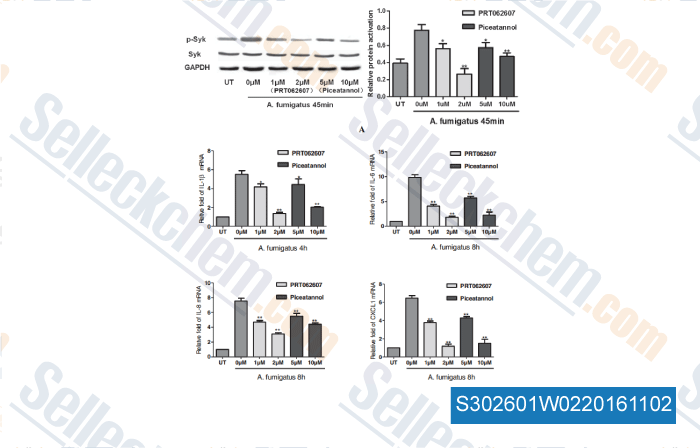
-
, , BMC Ophthalmol, 2014, 15:56.
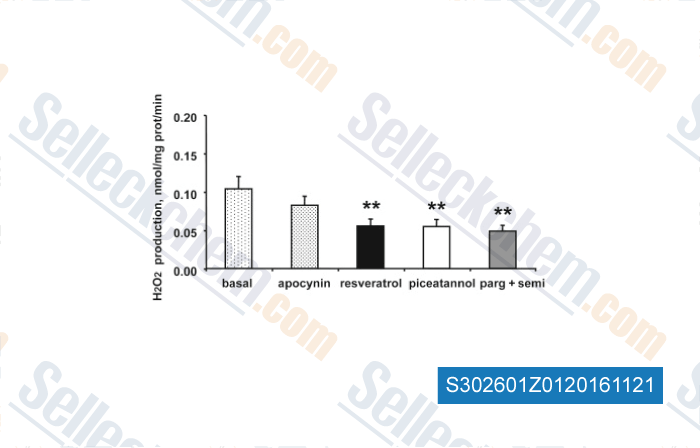
-
Daten von [ , , Chem Biol Interact, 2016, 258:115-25. ]
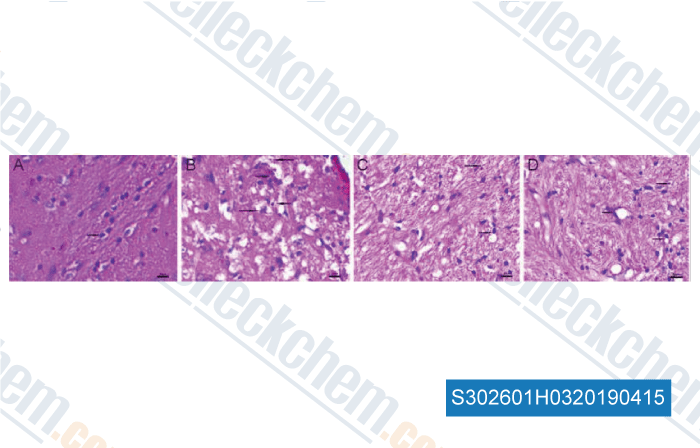
-
Daten von [ , , Neural Regen Res, 2018, 13(8):1425-1432 ]
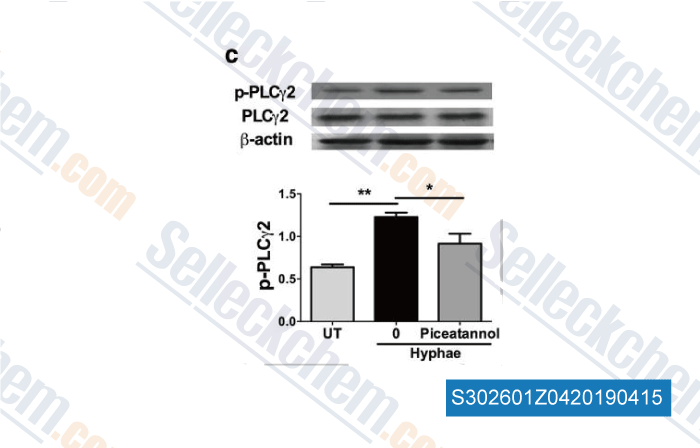
-
Daten von [ , , BMC Ophthalmol, 2018, 18(1):170 ]
Sellecks Piceatannol Wurde zitiert von 36 Publikationen
| R406 and its structural analogs reduce SNCA/α-synuclein levels via autophagic degradation [ Autophagy, 2025, 1-17.] | PubMed: 40143425 |
| Selective Senolysis of 5FU-Induced CRC Senescent Cells by Piceatannol Through Mitochondrial Depolarization and AIF-Dependent Apoptosis [ Int J Mol Sci, 2025, 26(18)9134] | PubMed: 41009697 |
| Polyaniline-Based Glyco-Condensation on Au Nanoparticles Enhances Immunotherapy in Lung Cancer [ ACS Appl Mater Interfaces, 2022, 14(21):24144-24159] | PubMed: 35579575 |
| Piceatannol enhances Beclin-1 activity to suppress tumor progression and its combination therapy strategy with everolimus in gastric cancer [ Sci China Life Sci, 2022, 10.1007/s11427-022-2185-9] | PubMed: 36271983 |
| Global post-translational modification profiling of HIV-1-infected cells reveals mechanisms of host cellular pathway remodeling [ Cell Rep, 2022, 38(13):110567] | PubMed: 35354044 |
| Main Determinants Affecting the Antiproliferative Activity of Stilbenes and Their Gut Microbiota Metabolites in Colon Cancer Cells: A Structure-Activity Relationship Study [ Int J Mol Sci, 2022, 23(23)15102] | PubMed: 36499424 |
| Orientia tsutsugamushi Infection Stimulates Syk-Dependent Responses and Innate Cytosolic Defenses in Macrophages [ Pathogens, 2022, 12(1)53] | PubMed: 36678402 |
| CCL4-mediated targeting of spleen tyrosine kinase (Syk) inhibitor using nanoparticles alleviates inflammatory bowel disease [ Clin Transl Med, 2021, 11(2):e339] | PubMed: 33634985 |
| TREM1 Regulates Neuroinflammatory Injury by Modulate Proinflammatory Subtype Transition of Microglia and Formation of Neutrophil Extracellular Traps via Interaction With SYK in Experimental Subarachnoid Hemorrhage [ Front Immunol, 2021, 12:766178] | PubMed: 34721438 |
| Inhibition of Dectin-1 Ameliorates Neuroinflammation by Regulating Microglia/Macrophage Phenotype After Intracerebral Hemorrhage in Mice [ Transl Stroke Res, 2021, 10.1007/s12975-021-00889-2] | PubMed: 33539006 |
RÜCKGABERICHTLINIE
Die bedingungslose Rückgaberichtlinie von Selleck Chemical gewährleistet unseren Kunden ein reibungsloses Online-Einkaufserlebnis. Wenn Sie in irgendeiner Weise mit Ihrem Kauf unzufrieden sind, können Sie jeden Artikel innerhalb von 7 Tagen nach Erhalt zurückgeben. Im Falle von Produktqualitätsproblemen, sei es protokollbezogene oder produktbezogene Probleme, können Sie jeden Artikel innerhalb von 365 Tagen ab dem ursprünglichen Kaufdatum zurückgeben. Bitte befolgen Sie die nachstehenden Anweisungen, wenn Sie Produkte zurücksenden.
VERSAND UND LAGERUNG
Selleck-Produkte werden bei Raumtemperatur transportiert. Wenn Sie das Produkt bei Raumtemperatur erhalten, seien Sie versichert, dass die Qualitätskontrollabteilung von Selleck Experimente durchgeführt hat, um zu überprüfen, dass die normale Temperaturplatzierung von einem Monat die biologische Aktivität von Pulverprodukten nicht beeinträchtigt. Nach dem Sammeln lagern Sie das Produkt bitte gemäß den in der Datenblatt beschriebenen Anforderungen. Die meisten Selleck-Produkte sind unter den empfohlenen Bedingungen stabil.
NICHT FÜR DIE ANWENDUNG AM MENSCHEN, FÜR VETERINÄRMEDIZINISCHE DIAGNOSTIK ODER THERAPEUTISCHE ZWECKE.