
Technische Daten
| Formel | C28H54N8.8HCl |
|||
| Molekulargewicht | 794.47 | CAS-Nr. | 155148-31-5 | |
| Löslichkeit (25°C)* | In vitro | Water | 100 mg/mL (125.87 mM) | |
| DMSO | Insoluble | |||
| Ethanol | Insoluble | |||
|
* <1 mg/ml bedeutet schwer löslich oder unlöslich. * Bitte beachten Sie, dass Selleck die Löslichkeit aller Verbindungen intern testet und die tatsächliche Löslichkeit geringfügig von veröffentlichten Werten abweichen kann. Dies ist normal und ist auf geringfügige Batch-zu-Batch-Variationen zurückzuführen. * Versand bei Raumtemperatur (Stabilitätstests zeigen, dass dieses Produkt ohne Kühlmaßnahmen versendet werden kann.) |
||||
Vorbereitung von Stammlösungen
Biologische Aktivität
| Beschreibung | Plerixafor (AMD3100, JM 3100, Plerixafor Octahydrochlorid, AMD3100 Octahydrochlorid, SID791 Octahydrochlorid) 8HCl ist das Hydrochlorid von Plerixafor, einem Chemokinrezeptor-Antagonisten für CXCR4 und CXCL12-vermittelte Chemotaxis mit IC50 von 44 nM bzw. 5,7 nM in zellfreien Assays. Plerixafor kann als Anti-HIV-Mittel eingesetzt werden. | ||||
|---|---|---|---|---|---|
| Ziele |
|
||||
| In vitro | Plerixafor hemmt die CXCL12-vermittelte Chemotaxis mit einer leicht besseren Potenz als seine Affinität für CXCR4. Plerixafor antagonisiert auch die SDF-1/CXCL12-Ligandenbindung mit einem IC50 von 651 nM. Plerixafor hemmt die SDF-1-vermittelte GTP-Bindung, den SDF-1-vermittelten Kalziumfluss und die SDF-1-stimulierte Chemotaxis mit IC50-Werten von 27 nM, 572 nM bzw. 51 nM. Plerixafor hemmt den Kalziumfluss nicht bei Zellen, die CXCR3, CCR1, CCR2b, CCR4, CCR5 oder CCR7 exprimieren, wenn sie mit ihren kognaten Liganden stimuliert werden, noch hemmt Plerixafor die Rezeptorbindung von LTB4. Plerixafor induziert von sich aus keinen Kalziumfluss in den CCRF–CEM-Zellen, die mehrere GPCRs, einschließlich CXCR4, CCR4 und CCR7, exprimieren. |
||||
| In vivo | Eine einzige topische Anwendung von Plerixafor fördert die Wundheilung bei diabetischen Mäusen, indem sie die Zytokinproduktion erhöht, EPCs aus dem Knochenmark mobilisiert und die Aktivität von Fibroblasten und Monozyten/Makrophagen steigert, wodurch sowohl Angiogenese als auch Vaskulogenese zunehmen. Kohorten von Mäusen werden fünf aufeinanderfolgende Tage mit PBS, IGF1, PDGF, SCF oder VEGF und am 5. Tag mit Plerixafor behandelt. Die Anzahl und Größe der Kolonien sind bei Mäusen, die mit IGF1 plus Plerixafor injiziert wurden, am höchsten im Vergleich zu den mit PDGF, SCF und VEGF behandelten Gruppen in Kombination mit Plerixafor. |
Protokoll (aus Referenz)
| Tierstudie: |
|
|---|
Referenzen
|
Kundenproduktvalidierung
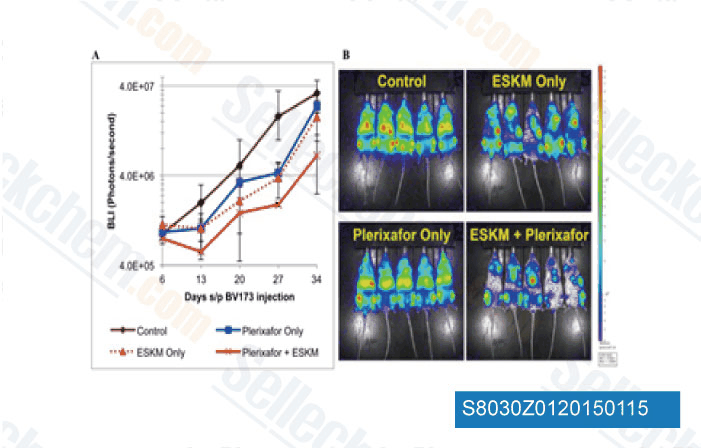
-
Daten von [ Blood , 2014 , 123(21), 3296-304 ]
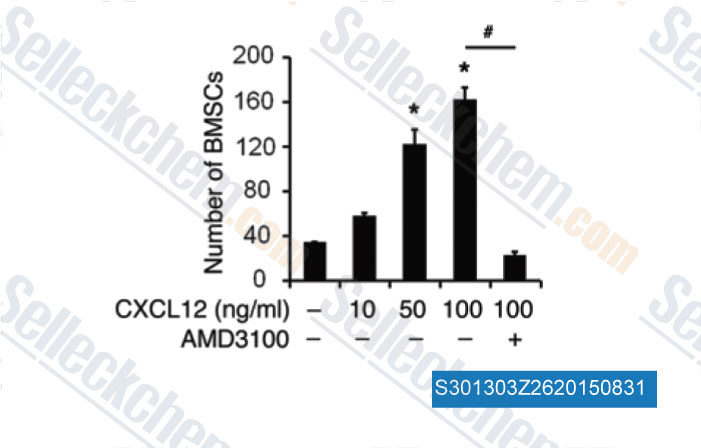
-
Daten von [ , , J Clin Invest, 2015, 125(8): 3226-40 ]
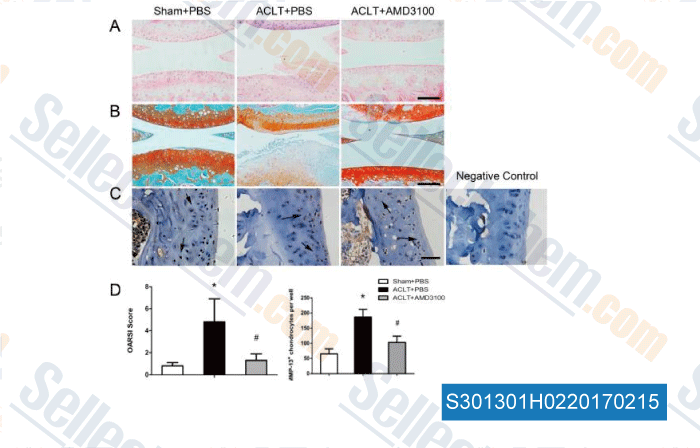
-
Daten von [ , , Int J Mol Sci, 2016, 17(6): 943. ]
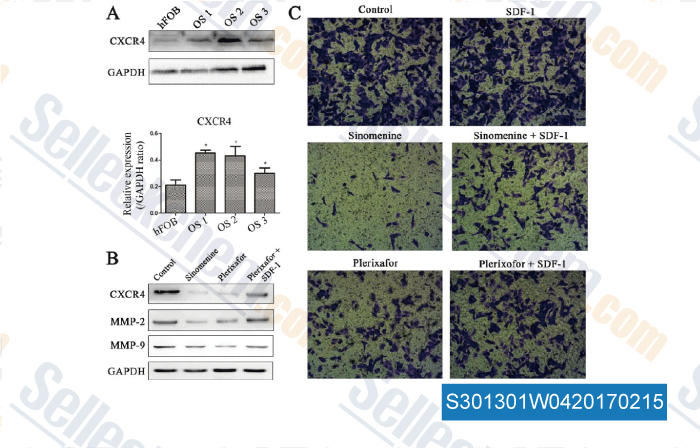
-
Daten von [ , , Int J Oncol, 2016, 48(5):2098-112. ]
Sellecks Plerixafor (AMD3100) 8HCl Wurde zitiert von 50 Publikationen
| SDF-1α mRNA therapy in peripheral artery disease [ Angiogenesis, 2025, 28(3):26] | PubMed: 40314870 |
| BMP9 regulates the endothelial secretome to drive pulmonary hypertension [ bioRxiv, 2025, 2025.08.29.673113] | PubMed: 40950088 |
| PAMD-Ch17, a Polymeric Analog of Plerixafor, Induces Mitochondrial Dysfunction in T-ALL Cells Independent of CXCR4 [ bioRxiv, 2025, 2025.05.28.656643] | PubMed: 40501752 |
| CXCL17 is an allosteric inhibitor of CXCR4 through a mechanism of action involving glycosaminoglycans [ Sci Signal, 2024, 17(828):eabl3758] | PubMed: 38502733 |
| Patient-derived rhabdomyosarcoma cells recapitulate the genetic and transcriptomic landscapes of primary tumors [ iScience, 2024, 27(10):110862] | PubMed: 39319271 |
| Metformin potentiates nephrotoxicity by promoting NETosis in response to renal ferroptosis [ Cell Discov, 2023, 9(1):104] | PubMed: 37848438 |
| Vascular regeneration and skeletal muscle repair induced by long-term exposure to SDF-1α derived from engineered mesenchymal stem cells after hindlimb ischemia [ Exp Mol Med, 2023, 10.1038/s12276-023-01096-9] | PubMed: 37779148 |
| PDGF-BB is involved in HIF-1α/CXCR4/CXCR7 axis promoting capillarization of hepatic sinusoidal endothelial cells [ Heliyon, 2023, 9(1):e12715] | PubMed: 36685431 |
| Targeting CXCR4 abrogates resistance to trastuzumab by blocking cell cycle progression and synergizes with docetaxel in breast cancer treatment [ Res Sq, 2023, rs.3.rs-2388864] | PubMed: 36824840 |
| Targeting vasoactive intestinal peptide-mediated signaling enhances response to immune checkpoint therapy in pancreatic ductal adenocarcinoma [ Nat Commun, 2022, 13(1):6418] | PubMed: 36302761 |
RÜCKGABERICHTLINIE
Die bedingungslose Rückgaberichtlinie von Selleck Chemical gewährleistet unseren Kunden ein reibungsloses Online-Einkaufserlebnis. Wenn Sie in irgendeiner Weise mit Ihrem Kauf unzufrieden sind, können Sie jeden Artikel innerhalb von 7 Tagen nach Erhalt zurückgeben. Im Falle von Produktqualitätsproblemen, sei es protokollbezogene oder produktbezogene Probleme, können Sie jeden Artikel innerhalb von 365 Tagen ab dem ursprünglichen Kaufdatum zurückgeben. Bitte befolgen Sie die nachstehenden Anweisungen, wenn Sie Produkte zurücksenden.
VERSAND UND LAGERUNG
Selleck-Produkte werden bei Raumtemperatur transportiert. Wenn Sie das Produkt bei Raumtemperatur erhalten, seien Sie versichert, dass die Qualitätskontrollabteilung von Selleck Experimente durchgeführt hat, um zu überprüfen, dass die normale Temperaturplatzierung von einem Monat die biologische Aktivität von Pulverprodukten nicht beeinträchtigt. Nach dem Sammeln lagern Sie das Produkt bitte gemäß den in der Datenblatt beschriebenen Anforderungen. Die meisten Selleck-Produkte sind unter den empfohlenen Bedingungen stabil.
NICHT FÜR DIE ANWENDUNG AM MENSCHEN, FÜR VETERINÄRMEDIZINISCHE DIAGNOSTIK ODER THERAPEUTISCHE ZWECKE.