
Technische Daten
| Formel | C7H5N5S2 |
||||||
| Molekulargewicht | 223.28 | CAS-Nr. | 2645-32-1 | ||||
| Löslichkeit (25°C)* | In vitro | DMSO | 4 mg/mL (17.91 mM) | ||||
| Water | Insoluble | ||||||
| Ethanol | Insoluble | ||||||
| In vivo (Lösungsmittel einzeln und der Reihe nach zum Produkt hinzufügen.) |
|
||||||
|
* <1 mg/ml bedeutet schwer löslich oder unlöslich. * Bitte beachten Sie, dass Selleck die Löslichkeit aller Verbindungen intern testet und die tatsächliche Löslichkeit geringfügig von veröffentlichten Werten abweichen kann. Dies ist normal und ist auf geringfügige Batch-zu-Batch-Variationen zurückzuführen. * Versand bei Raumtemperatur (Stabilitätstests zeigen, dass dieses Produkt ohne Kühlmaßnahmen versendet werden kann.) |
|||||||
Vorbereitung von Stammlösungen
Biologische Aktivität
| Beschreibung | PR-619 ist ein nicht-selektiver, reversibler Inhibitor der Deubiquitinylierungsenzyme (DUBs) mit einem EC50 von 1-20 μM in einem zellfreien Assay. Diese Verbindung aktiviert die Autophagy. | |||||||||||
|---|---|---|---|---|---|---|---|---|---|---|---|---|
| Ziele |
|
|||||||||||
| In vitro | PR-619 ist ein zellgängiger Pyridinamin-Klasse-Breitspektrum-DUB-Inhibitor, dessen bekannte Ziele ATXN3, BAP1, JOSD2, OTUD5, UCH-L1, UCH-L3, UCH-L5/UCH37, USP1, 2, 4, 5, 7, 8, 9X, 10, 14, 15, 16, 19, 20, 22, 24, 28, 47, 48, VCIP135, YOD1, sowie die deISGylase PLpro, deNEDDylase DEN1 und deSUMOlyase SENP6 umfassen. Diese Verbindung erhöht die Gesamtprotein-Polyubiquitinierung in HEK293T-Zellen dosis- und zeitabhängig (20 bis 150 μM, 0,5 bis 20 h). Die Behandlung mit dieser Chemikalie führt zu einer Hochregulierung von sowohl K48- als auch K63-verknüpften PolyUb-Ketten. Sie induziert den HCT116-Zelltod mit EC50-Werten von 6,3 μM. |
|||||||||||
| In vivo | PR-619 verstärkt die Antitumorwirkung auf UC-Xenotransplantate von Nacktmäusen. |
Protokoll (aus Referenz)
| Kinase-Assay: |
|
|---|---|
| Zell-Assay: |
|
Referenzen
|
Kundenproduktvalidierung
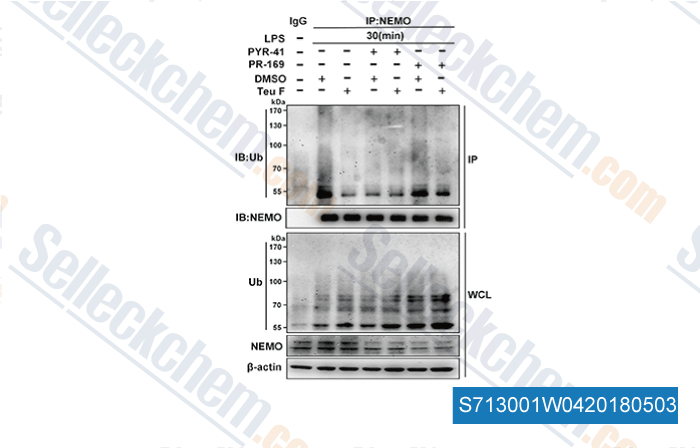
-
Daten von [ , , Front Pharmacol, 2017, https://doi.org/10.3389/fphar.2017.00565 ]
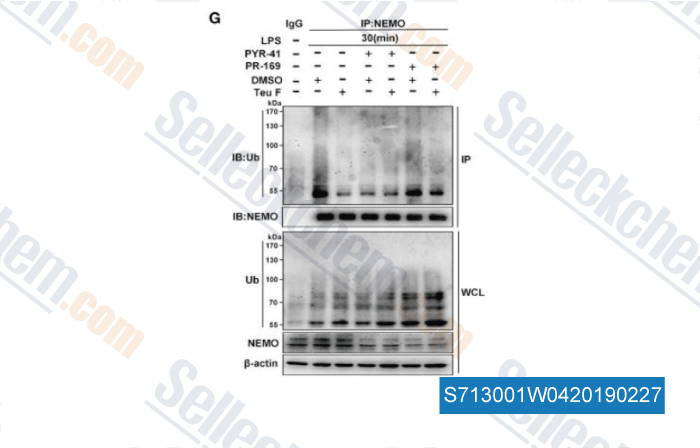
-
Daten von [ , , Front Pharmacol, 2018, 8:565 ]
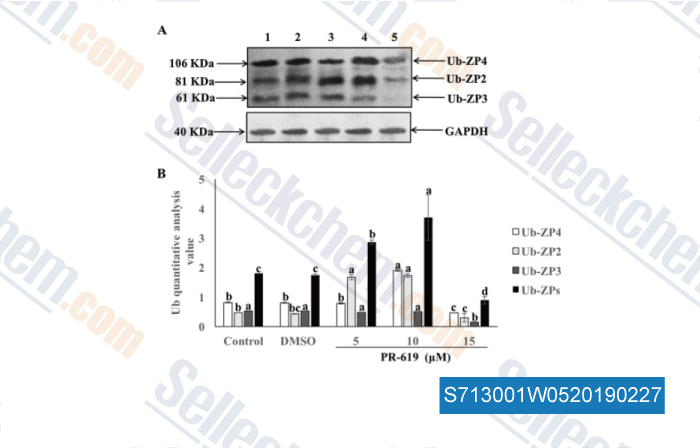
-
Daten von [ , , Anim Reprod Sci, 2017, 187:64-73 ]
Sellecks PR-619 Wurde zitiert von 65 Publikationen
| USP15 Facilitates Colorectal Cancer Immune Evasion through SMYD3/CCL2-Dependent Myeloid-Derived Suppressor Cell Recruitment [ Cancer Immunol Res, 2025, 10.1158/2326-6066.CIR-24-1194] | PubMed: 40323348 |
| A novel mechanism in regulating drug sensitivity, growth, and apoptosis of bortezomib-resistant multiple myeloma cells: the USP4/KLF2/HMGA2 cascade [ J Orthop Surg Res, 2025, 20(1):220] | PubMed: 40022160 |
| Linear ubiquitination prevents lipodystrophy and obesity-associated metabolic syndrome [ Sci Adv, 2025, 11(38):eadw2539] | PubMed: 40961178 |
| Noncanonical function of folate through folate receptor 1 during neural tube formation [ Nat Commun, 2024, 15(1):1642] | PubMed: 38388461 |
| Sugar-mediated non-canonical ubiquitination impairs Nrf1/NFE2L1 activation [ Mol Cell, 2024, 84(16):3115-3127.e11] | PubMed: 39116872 |
| Increased CSN5 expression enhances the sensitivity to lenalidomide in multiple myeloma cells [ iScience, 2024, 27(12):111399] | PubMed: 39687025 |
| MAPK-dependent control of mitotic progression in S. pombe [ BMC Biol, 2024, 22(1):71] | PubMed: 38523261 |
| DNA polymerase η is regulated by mutually exclusive mono-ubiquitination and mono-NEDDylation [ bioRxiv, 2024, 2024.10.12.618026] | PubMed: 39416117 |
| Precise pancreatic cancer therapy through targeted degradation of mutant p53 protein by cerium oxide nanoparticles [ J Nanobiotechnology, 2023, 21(1):117] | PubMed: 37005668 |
| Comparative proteomic and phosphoproteomic analysis reveals differential heat response mechanism in two congeneric oyster species [ Ecotoxicol Environ Saf, 2023, 263:115197] | PubMed: 37451098 |
RÜCKGABERICHTLINIE
Die bedingungslose Rückgaberichtlinie von Selleck Chemical gewährleistet unseren Kunden ein reibungsloses Online-Einkaufserlebnis. Wenn Sie in irgendeiner Weise mit Ihrem Kauf unzufrieden sind, können Sie jeden Artikel innerhalb von 7 Tagen nach Erhalt zurückgeben. Im Falle von Produktqualitätsproblemen, sei es protokollbezogene oder produktbezogene Probleme, können Sie jeden Artikel innerhalb von 365 Tagen ab dem ursprünglichen Kaufdatum zurückgeben. Bitte befolgen Sie die nachstehenden Anweisungen, wenn Sie Produkte zurücksenden.
VERSAND UND LAGERUNG
Selleck-Produkte werden bei Raumtemperatur transportiert. Wenn Sie das Produkt bei Raumtemperatur erhalten, seien Sie versichert, dass die Qualitätskontrollabteilung von Selleck Experimente durchgeführt hat, um zu überprüfen, dass die normale Temperaturplatzierung von einem Monat die biologische Aktivität von Pulverprodukten nicht beeinträchtigt. Nach dem Sammeln lagern Sie das Produkt bitte gemäß den in der Datenblatt beschriebenen Anforderungen. Die meisten Selleck-Produkte sind unter den empfohlenen Bedingungen stabil.
NICHT FÜR DIE ANWENDUNG AM MENSCHEN, FÜR VETERINÄRMEDIZINISCHE DIAGNOSTIK ODER THERAPEUTISCHE ZWECKE.