
Technische Daten
| Formel | C22H29FN3O9P |
||||||
| Molekulargewicht | 529.45 | CAS-Nr. | 1190307-88-0 | ||||
| Löslichkeit (25°C)* | In vitro | DMSO | 100 mg/mL (188.87 mM) | ||||
| Ethanol | 100 mg/mL (188.87 mM) | ||||||
| Water | 13 mg/mL (24.55 mM) | ||||||
| In vivo (Lösungsmittel einzeln und der Reihe nach zum Produkt hinzufügen.) |
|
||||||
|
* <1 mg/ml bedeutet schwer löslich oder unlöslich. * Bitte beachten Sie, dass Selleck die Löslichkeit aller Verbindungen intern testet und die tatsächliche Löslichkeit geringfügig von veröffentlichten Werten abweichen kann. Dies ist normal und ist auf geringfügige Batch-zu-Batch-Variationen zurückzuführen. * Versand bei Raumtemperatur (Stabilitätstests zeigen, dass dieses Produkt ohne Kühlmaßnahmen versendet werden kann.) |
|||||||
Vorbereitung von Stammlösungen
Biologische Aktivität
| Beschreibung | Sofosbuvir ist ein HCV NS5B-Polymerase-Inhibitor zur Behandlung der chronischen Hepatitis-C-Virus-(HCV)-Infektion. | |
|---|---|---|
| Ziele |
|
|
| In vitro | Als HCV NS5B Polymeraseinhibitor zeigt PSI-7977 eine potentere hemmende Aktivität gegen die HCV-RNA-Replikation als PSI-7976 mit einer EC50 von 92 nM gegenüber 1,07 μM und einer EC90 von 0,29 μM gegenüber 2,99 μM, was damit übereinstimmt, dass die Inkubation von Klon-A-Zellen mit PSI-7977 zu einer höheren Konzentration von PSI-7409 führt als bei Klon-A-Zellen, die mit PSI-7976 inkubiert wurden. PSI-7977 ist ein effektives Substrat für CatA, um PSI-352707 mit 18-30-fach höherer Potenz im Vergleich zu PSI-7976 zu bilden. Im Gegensatz zu GS-7976 schreitet die CES1-vermittelte Hydrolyse von PSI-7977 jedoch nicht zeitabhängig fort. Die S282T NS5B-Polymerase-Mutation, aber nicht die S96T-Mutation, verleiht Resistenz gegen PSI-7977, wobei die EC90 von 0,42 μM auf 7,8 μM ansteigt. Bei einer 8-tägigen Zytotoxizitätsstudie zeigt PSI-7977 keine Zytotoxizität gegen Huh7-, HepG2-, BxPC3- und CEM-Zellen, selbst bei Konzentrationen bis zu 100 μM. Eine 14-tägige Behandlung mit PSI-7977 zeigt eine IC90 von 72,1 μM und 68,6 μM für die Hemmung von mtDNA bzw. rDNA in HepG2-Zellen. PSI-7977 zeigt eine potente Aktivität gegen Genotyp (GT) 1a, 1b und 2a (Stamm JFH-1) Replikons und chimäre Replikons, die GT 2a (Stamm J6), 2b und 3a NS5B Polymerase enthalten. Die Sequenzanalyse der JFH-1 NS5B-Region zeigt, dass zusätzliche Aminosäureänderungen, einschließlich T179A, M289L, I293L, M434T und H479P, sowohl vor als auch nach dem Auftreten von S282T selektiert werden, welche erforderlich sind, um Resistenz gegen PSI-7977 zu verleihen. |
Protokoll (aus Referenz)
| Zell-Assay:[2] |
|
|---|
Referenzen
|
Kundenproduktvalidierung
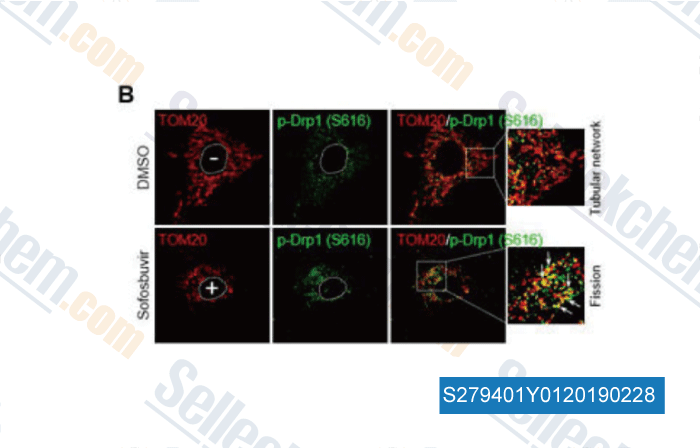
-
Daten von [ , , Hepatology, 2017, 66(3):758-771 ]
![Inhibition of hepatitis C virus by sofosbuvir. (A) Determination of 50% cytotoxic concentration (CC50). Huh-7.5 reporter cells (1.3×10<sup>4</sup>) were incubated with the indicated concentration of sofosbuvir (SOF) during 72 h at 37°C, and the numbers of viable cells were counted using MTT [3-(4,5-dimethylthiazol-2-yl)-2,5-diphenyltetrazolium bromide]. (B) Determination of the drug concentration required for 50% inhibition (IC50) of infectious HCV yield. Huh-7.5 reporter cells (1.0×10<sup>5</sup>) were infected with 3 103 TCID50 of HCV p0 in the presence of the indicated concentrations of SOF. Virus titers were determined in the cell culture supernatants at 72 h postinfection. Viral titers are given as the percentages of the titers obtained in the infection in the absence of SOF. (C) Progeny production in the course of three serial passages of HCV p0 in the presence of increasing concentrations of SOF, as indicated. Infection conditions are those explained in the description of panel B. Procedures are detailed in Materials and Methods.](https://file.selleckchem.com/downloads/review/700px/Sofosbuvir-S279401X0120170116.gif)
-
Daten von [ , , Antimicrob Agents Chemother, 2016, 60(6):3786-3793. ]
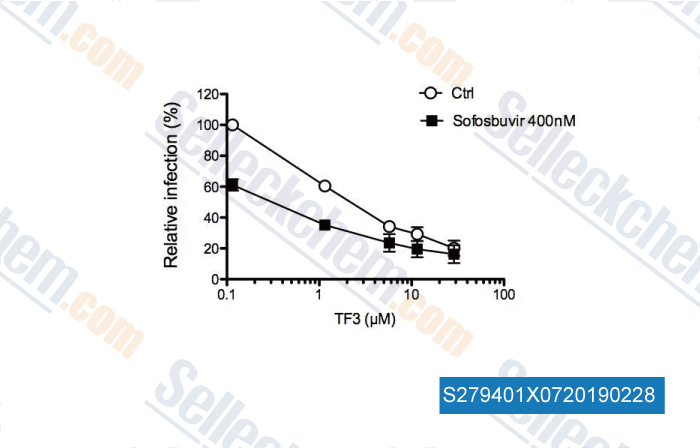
-
Daten von [ , , PLoS One, 2018, 13(11):e0198226 ]
Sellecks Sofosbuvir Wurde zitiert von 45 Publikationen
| Rapid hepatitis C virus replication machinery removal after antiviral treatment with DAA monitored by multimodal imaging [ Structure, 2025, S0969-2126(25)00193-5] | PubMed: 40553718 |
| Hepatitis C virus-induced differential transcriptional traits in host cells after persistent infection elimination by direct-acting antivirals in cell culture [ J Med Virol, 2024, 96(7):e29787] | PubMed: 38988177 |
| Immortalized hepatocyte-like cells: A competent hepatocyte model for studying clinical HCV isolate infection [ PLoS One, 2024, 19(5):e0303265] | PubMed: 38739590 |
| Hepatitis C virus infects and perturbs liver stem cells [ mBio, 2023, 10.1128/mbio.01318-23] | PubMed: 37938000 |
| Activation of the urotensin-II receptor by remdesivir induces cardiomyocyte dysfunction [ Commun Biol, 2023, 6(1):511] | PubMed: 37173432 |
| Fitness-Dependent, Mild Mutagenic Activity of Sofosbuvir for Hepatitis C Virus [ Antimicrob Agents Chemother, 2023, 67(7):e0039423] | PubMed: 37367486 |
| ヒト iPS 細胞由来心筋細胞を用いた慢性収縮毒性評価法の開発 [ Okayama University, 2023 , 10.18926/65391] | PubMed: none |
| An anti-influenza A virus microbial metabolite acts by degrading viral endonuclease PA [ Nat Commun, 2022, 13(1):2079] | PubMed: 35440123 |
| Therapeutic targeting of organelles for inhibition of Zika virus replication in neurons [ Antiviral Res, 2022, S0166-3542(22)00233-9] | PubMed: 36396026 |
| Processing and Subcellular Localization of the Hepatitis E Virus Replicase: Identification of Candidate Viral Factories [ Front Microbiol, 2022, 13:828636] | PubMed: 35283856 |
RÜCKGABERICHTLINIE
Die bedingungslose Rückgaberichtlinie von Selleck Chemical gewährleistet unseren Kunden ein reibungsloses Online-Einkaufserlebnis. Wenn Sie in irgendeiner Weise mit Ihrem Kauf unzufrieden sind, können Sie jeden Artikel innerhalb von 7 Tagen nach Erhalt zurückgeben. Im Falle von Produktqualitätsproblemen, sei es protokollbezogene oder produktbezogene Probleme, können Sie jeden Artikel innerhalb von 365 Tagen ab dem ursprünglichen Kaufdatum zurückgeben. Bitte befolgen Sie die nachstehenden Anweisungen, wenn Sie Produkte zurücksenden.
VERSAND UND LAGERUNG
Selleck-Produkte werden bei Raumtemperatur transportiert. Wenn Sie das Produkt bei Raumtemperatur erhalten, seien Sie versichert, dass die Qualitätskontrollabteilung von Selleck Experimente durchgeführt hat, um zu überprüfen, dass die normale Temperaturplatzierung von einem Monat die biologische Aktivität von Pulverprodukten nicht beeinträchtigt. Nach dem Sammeln lagern Sie das Produkt bitte gemäß den in der Datenblatt beschriebenen Anforderungen. Die meisten Selleck-Produkte sind unter den empfohlenen Bedingungen stabil.
NICHT FÜR DIE ANWENDUNG AM MENSCHEN, FÜR VETERINÄRMEDIZINISCHE DIAGNOSTIK ODER THERAPEUTISCHE ZWECKE.