
Technische Daten
| Formel | C17H13N3O7 |
||||||||||
| Molekulargewicht | 371.3 | CAS-Nr. | 418805-02-4 | ||||||||
| Löslichkeit (25°C)* | In vitro | DMSO | 74 mg/mL (199.29 mM) | ||||||||
| Water | Insoluble | ||||||||||
| Ethanol | Insoluble | ||||||||||
| In vivo (Lösungsmittel einzeln und der Reihe nach zum Produkt hinzufügen.) |
|
||||||||||
|
* <1 mg/ml bedeutet schwer löslich oder unlöslich. * Bitte beachten Sie, dass Selleck die Löslichkeit aller Verbindungen intern testet und die tatsächliche Löslichkeit geringfügig von veröffentlichten Werten abweichen kann. Dies ist normal und ist auf geringfügige Batch-zu-Batch-Variationen zurückzuführen. * Versand bei Raumtemperatur (Stabilitätstests zeigen, dass dieses Produkt ohne Kühlmaßnahmen versendet werden kann.) |
|||||||||||
Vorbereitung von Stammlösungen
Biologische Aktivität
| Beschreibung | PYR-41 ist der erste zellpermeable Inhibitor des Ubiquitin-aktivierenden Enzyms E1, ohne Aktivität bei E2. Diese Verbindung induziert Apoptose. | ||
|---|---|---|---|
| Ziele |
|
||
| In vitro | PYR-41 (50 μM) hemmt die Aktivität des Ubiquitin-aktivierenden Enzyms E1 um über 90%. Diese Verbindung könnte ein Ziel für nukleophilen Angriff sein und potenziell mit dem aktiven Zentrum-Cystein von E1 reagieren. Es blockiert effizient den Cyclin E-Abbau. Diese Chemikalie senkt den Spiegel von E1fUb-Thioestern in Zellen mit einer IC50 zwischen 10 und 25 μM und verhindert die durch Proteasom-Inhibitoren induzierte Akkumulation ubiquitylierter Proteine. Es erhöht die Gesamt-Sumoylierung in Zellen und in Zellen, die temperaturempfindliches E1 enthalten. Es ist in der Lage, sowohl Proteasom-abhängige als auch Proteasom-unabhängige Aktivitäten der Ubiquitylierung zu hemmen. Diese Verbindung (50 μM) schwächt die 1 ng/mL IL-1α-vermittelte Aktivierung des nukleären Faktors-κB um >60% ab, indem sie die nachgeschaltete Ubiquitylierung und den proteasomalen Abbau von IκBα verhindert. Es hemmt den Abbau von p53 und aktiviert die transkriptionelle Aktivität von p53, was es ermöglicht, transformierte p53-exprimierende Zellen differenziell abzutöten. Es blockiert Ubiquitinierungsreaktionen, führt aber paradoxerweise zur Akkumulation von hochmolekularen ubiquitinierten Proteinen. Diese Verbindung hat auch eine gleiche oder größere hemmende Aktivität gegen mehrere Deubiquitinasen (DUBs) in intakten Zellen und gereinigtem USP5 in vitro. Es vermittelt auch die Quervernetzung spezifischer Proteinkinasen (Bcr-Abl, Jak2), um deren Signalaktivität zu hemmen. |
Protokoll (aus Referenz)
Referenzen
|
Kundenproduktvalidierung
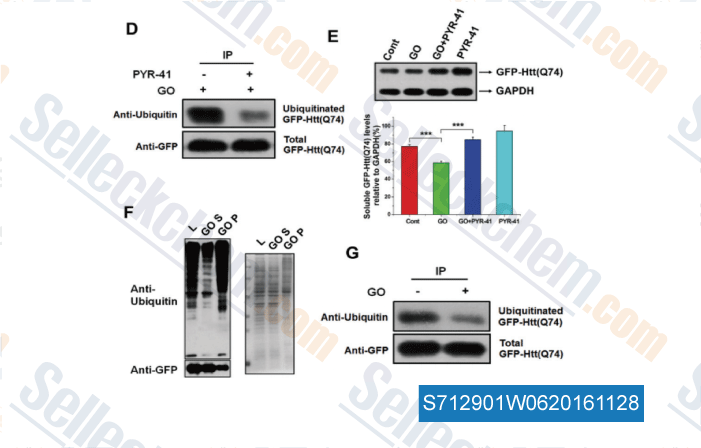
-
Daten von [ , , Nanoscale, 2016, 8: 18740-18750 ]
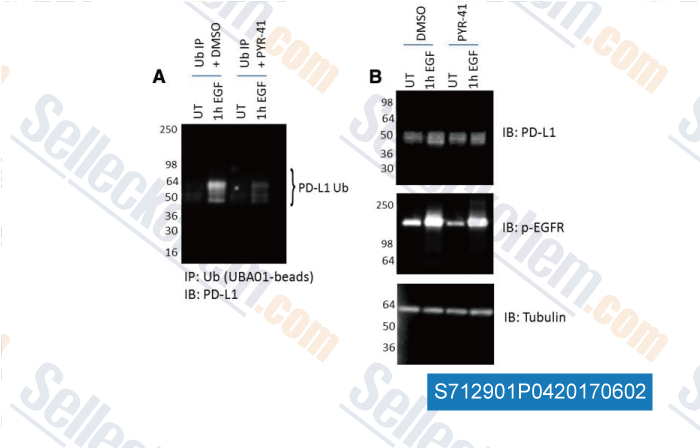
-
Daten von [ , , Neoplasia, 2017, 19(4):346-353 ]
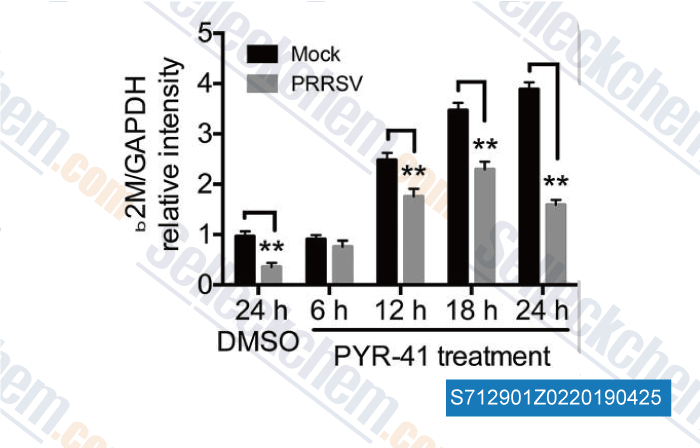
-
Daten von [ , , J Virol, 2017, 91(5) ]
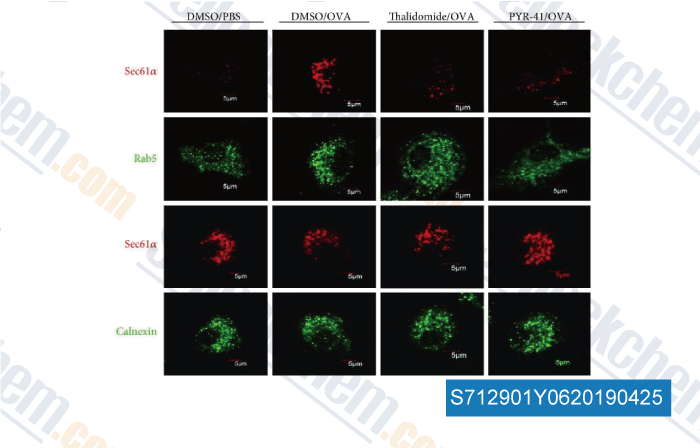
-
Daten von [ , , J Immunol Res, 2018, 2018:5070573 ]
Sellecks PYR-41 Wurde zitiert von 35 Publikationen
| SAMD9 senses cytosolic double-stranded nucleic acids in epithelial and mesenchymal cells to induce antiviral immunity [ Nat Commun, 2025, 16(1):3756] | PubMed: 40263291 |
| Glutathione reductase underlies the stability of mutant p53 by antagonizing protein glutathionylation [ Redox Biol, 2025, 81:103522] | PubMed: 39983342 |
| TLR4 endocytosis and endosomal TLR4 signaling are distinct and independent outcomes of TLR4 activation [ EMBO Rep, 2025, 10.1038/s44319-025-00444-2] | PubMed: 40204912 |
| Engineered a dual-targeting HA-TPP/A nanoparticle for combination therapy against KRAS-TP53 co-mutation in gastrointestinal cancers [ Bioact Mater, 2024, 32:277-291] | PubMed: 37876556 |
| ER Stress-Activated HSF1 Governs Cancer Cell Resistance to USP7 Inhibitor-Based Chemotherapy through the PERK Pathway [ Int J Mol Sci, 2024, 25(5)2768] | PubMed: 38474017 |
| IE1 of Human Cytomegalovirus Inhibits Necroptotic Cell Death via Direct and Indirect Modulation of the Necrosome Complex [ Viruses, 2024, 16(2)290] | PubMed: 38400065 |
| Precise pancreatic cancer therapy through targeted degradation of mutant p53 protein by cerium oxide nanoparticles [ J Nanobiotechnology, 2023, 21(1):117] | PubMed: 37005668 |
| The Ubiquitin-Proteasome System Facilitates Membrane Fusion and Uncoating during Coronavirus Entry [ Viruses, 2023, 15(10)2001] | PubMed: 37896778 |
| Proteasomal and autophagy-mediated degradation of mutp53 proteins through mitochondria-targeting aggregation-induced-emission materials [ Acta Biomater, 2022, S1742-7061(22)00458-5] | PubMed: 35931280 |
| Small Molecules Promote Selective Denaturation and Degradation of Tubulin Heterodimers through a Low-Barrier Hydrogen Bond [ J Med Chem, 2022, 65(13):9159-9173] | PubMed: 35762925 |
RÜCKGABERICHTLINIE
Die bedingungslose Rückgaberichtlinie von Selleck Chemical gewährleistet unseren Kunden ein reibungsloses Online-Einkaufserlebnis. Wenn Sie in irgendeiner Weise mit Ihrem Kauf unzufrieden sind, können Sie jeden Artikel innerhalb von 7 Tagen nach Erhalt zurückgeben. Im Falle von Produktqualitätsproblemen, sei es protokollbezogene oder produktbezogene Probleme, können Sie jeden Artikel innerhalb von 365 Tagen ab dem ursprünglichen Kaufdatum zurückgeben. Bitte befolgen Sie die nachstehenden Anweisungen, wenn Sie Produkte zurücksenden.
VERSAND UND LAGERUNG
Selleck-Produkte werden bei Raumtemperatur transportiert. Wenn Sie das Produkt bei Raumtemperatur erhalten, seien Sie versichert, dass die Qualitätskontrollabteilung von Selleck Experimente durchgeführt hat, um zu überprüfen, dass die normale Temperaturplatzierung von einem Monat die biologische Aktivität von Pulverprodukten nicht beeinträchtigt. Nach dem Sammeln lagern Sie das Produkt bitte gemäß den in der Datenblatt beschriebenen Anforderungen. Die meisten Selleck-Produkte sind unter den empfohlenen Bedingungen stabil.
NICHT FÜR DIE ANWENDUNG AM MENSCHEN, FÜR VETERINÄRMEDIZINISCHE DIAGNOSTIK ODER THERAPEUTISCHE ZWECKE.