
Technische Daten
| Formel | C26H25F2N3O6
|
||||||||||||||
| Molekulargewicht | 513.49 | CAS-Nr. | 1135695-98-5 | ||||||||||||
| Löslichkeit (25°C)* | In vitro | DMSO | 100 mg/mL (194.74 mM) | ||||||||||||
| Ethanol | 100 mg/mL (194.74 mM) | ||||||||||||||
| Water | Insoluble | ||||||||||||||
| In vivo (Lösungsmittel einzeln und der Reihe nach zum Produkt hinzufügen.) |
|
||||||||||||||
|
* <1 mg/ml bedeutet schwer löslich oder unlöslich. * Bitte beachten Sie, dass Selleck die Löslichkeit aller Verbindungen intern testet und die tatsächliche Löslichkeit geringfügig von veröffentlichten Werten abweichen kann. Dies ist normal und ist auf geringfügige Batch-zu-Batch-Variationen zurückzuführen. * Versand bei Raumtemperatur (Stabilitätstests zeigen, dass dieses Produkt ohne Kühlmaßnahmen versendet werden kann.) |
|||||||||||||||
Vorbereitung von Stammlösungen
Biologische Aktivität
| Beschreibung | Q-VD-Oph (Chinolin-Val-Asp-Difluorophenoxymethylketon) ist ein potenter Pan-Caspase-Inhibitor mit einer IC50 von 25 bis 400 nM für Caspasen 1, 3, 8 und 9. Q-VD-OPh kann die HIV-Infektion hemmen. | ||||||||
|---|---|---|---|---|---|---|---|---|---|
| Ziele |
|
||||||||
| In vitro | Q-VD-Oph (5–100 μM) hemmt wirksam die durch Actinomycin D induzierte DNA-Ladderbildung und die anschließende Apoptosis mit minimaler Toxizität in WEHI-231-Zellen. Q-VD-Oph verhindert die Caspase-vermittelte Spaltung von PARP und die Aktivierung der wichtigsten Initiator- und Effektor-Caspasen.Q-VD-Oph schützt Herzmuskelzellen in vitro vor virusinduzierter Apoptosis. | ||||||||
| In vivo | Q-VD-Oph hemmt die Caspase-1-Aktivität, die IL-18-Proteinexpression und die Neutrophileninfiltration während einer ischämischen ARF bei Mäusen.In vivo schützt die Caspase-Hemmung durch Q-VD-Oph vor virusinduzierten Myokardschäden, wobei die Caspase-3-Aktivität signifikant reduziert wird. Bei TgCRND8-Mäusen hemmt Q-VD-Oph die Caspase-7-Aktivierung und begrenzt die mit Tau verbundenen pathologischen Veränderungen, einschließlich der Caspase-Spaltung. |
Protokoll (aus Referenz)
| Zell-Assay:[2] |
|
|---|---|
| Tierstudie:[3] |
|
Referenzen
|
Kundenproduktvalidierung
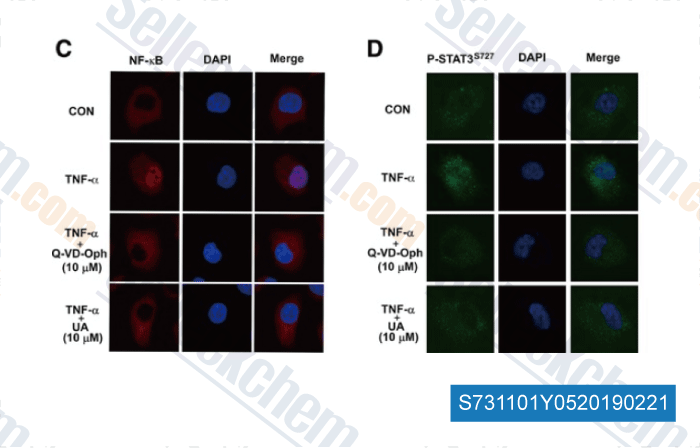
-
Daten von [ , , Mol Nutr Food Res, 2017, 61(12) ]
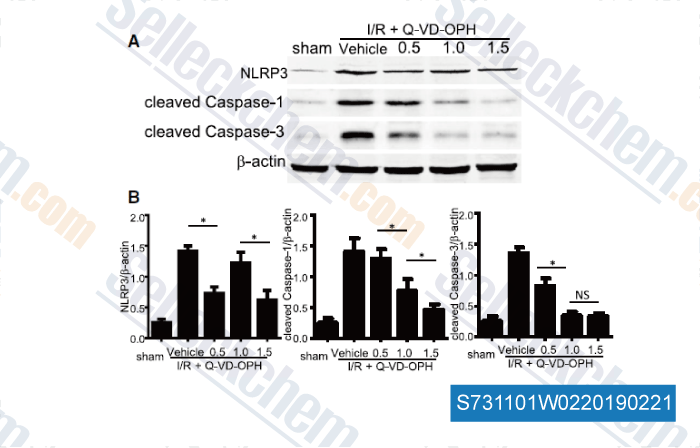
-
Daten von [ , , Neurochem Res, 2018, 43(6):1200-1209 ]
Sellecks Q-VD-Oph Wurde zitiert von 104 Publikationen
| Tumour-reactive heterotypic CD8 T cell clusters from clinical samples [ Nature, 2025, 10.1038/s41586-025-09754-w] | PubMed: 41261135 |
| Oligomeric cystatin C supports the immunosuppressive activity of myeloid cells through interaction with inhibitory receptors [ Signal Transduct Target Ther, 2025, 10(1):368] | PubMed: 41233352 |
| Tonic type I interferon signaling optimizes the antiviral function of plasmacytoid dendritic cells [ Nat Immunol, 2025, 26(11):1946-1961] | PubMed: 41087726 |
| Secondary Necrosis Following Caspase-Activation can Occur Independently of Gasdermin E [ Adv Sci (Weinh), 2025, 12(46):e07381] | PubMed: 41185624 |
| Enhanced regenerative and developmental potential of embryonal and stem cell-derived platelets compared to adult platelets [ Cell Rep Med, 2025, 6(8):102297] | PubMed: 40795844 |
| Ironomycin induces mantle cell lymphoma cell death by targeting iron metabolism addiction [ Theranostics, 2025, 15(7):2834-2851] | PubMed: 40083931 |
| Interplay of ferroptotic and apoptotic cell death and its modulation by BH3-mimetics [ Cell Death Differ, 2025, 10.1038/s41418-025-01514-7] | PubMed: 40301648 |
| A nonenzymatic dependency on inositol-requiring enzyme 1 controls cancer cell cycle progression and tumor growth [ PLoS Biol, 2025, 23(4):e3003086] | PubMed: 40208872 |
| Interferon regulatory factor 4 mediates nonenzymatic IRE1 dependency in multiple myeloma cells [ PLoS Biol, 2025, 23(4):e3003096] | PubMed: 40215234 |
| The reaction mechanism for glycolysis side product degradation by Parkinson's disease-linked DJ-1 [ J Cell Biol, 2025, 224(8)e202411078] | PubMed: 40464736 |
RÜCKGABERICHTLINIE
Die bedingungslose Rückgaberichtlinie von Selleck Chemical gewährleistet unseren Kunden ein reibungsloses Online-Einkaufserlebnis. Wenn Sie in irgendeiner Weise mit Ihrem Kauf unzufrieden sind, können Sie jeden Artikel innerhalb von 7 Tagen nach Erhalt zurückgeben. Im Falle von Produktqualitätsproblemen, sei es protokollbezogene oder produktbezogene Probleme, können Sie jeden Artikel innerhalb von 365 Tagen ab dem ursprünglichen Kaufdatum zurückgeben. Bitte befolgen Sie die nachstehenden Anweisungen, wenn Sie Produkte zurücksenden.
VERSAND UND LAGERUNG
Selleck-Produkte werden bei Raumtemperatur transportiert. Wenn Sie das Produkt bei Raumtemperatur erhalten, seien Sie versichert, dass die Qualitätskontrollabteilung von Selleck Experimente durchgeführt hat, um zu überprüfen, dass die normale Temperaturplatzierung von einem Monat die biologische Aktivität von Pulverprodukten nicht beeinträchtigt. Nach dem Sammeln lagern Sie das Produkt bitte gemäß den in der Datenblatt beschriebenen Anforderungen. Die meisten Selleck-Produkte sind unter den empfohlenen Bedingungen stabil.
NICHT FÜR DIE ANWENDUNG AM MENSCHEN, FÜR VETERINÄRMEDIZINISCHE DIAGNOSTIK ODER THERAPEUTISCHE ZWECKE.