
Technische Daten
| Formel | C51H79NO13 |
||||||||||
| Molekulargewicht | 914.18 | CAS-Nr. | 53123-88-9 | ||||||||
| Löslichkeit (25°C)* | In vitro | DMSO | 100 mg/mL (109.38 mM) | ||||||||
| Ethanol | 25 mg/mL (27.34 mM) | ||||||||||
| Water | Insoluble | ||||||||||
| In vivo (Lösungsmittel einzeln und der Reihe nach zum Produkt hinzufügen.) |
|
||||||||||
|
* <1 mg/ml bedeutet schwer löslich oder unlöslich. * Bitte beachten Sie, dass Selleck die Löslichkeit aller Verbindungen intern testet und die tatsächliche Löslichkeit geringfügig von veröffentlichten Werten abweichen kann. Dies ist normal und ist auf geringfügige Batch-zu-Batch-Variationen zurückzuführen. * Versand bei Raumtemperatur (Stabilitätstests zeigen, dass dieses Produkt ohne Kühlmaßnahmen versendet werden kann.) |
|||||||||||
Vorbereitung von Stammlösungen
Biologische Aktivität
| Beschreibung | Rapamycin ist ein spezifischer mTOR-Inhibitor mit einer IC50 von ~0,1 nM in HEK293-Zellen. Diese Verbindung bindet an FKBP12 und wirkt spezifisch als allosterischer Inhibitor von mTORC1. Es ist ein Autophagy-Aktivator und ein Immunsuppressivum. | ||
|---|---|---|---|
| Ziele |
|
||
| In vitro | Rapamycin hemmt die endogene mTOR-Aktivität in HEK293-Zellen mit einer IC50 von ~0,1 nM, potenter als iRap und AP21967 mit einer IC50 von ~5 nM bzw. ~10 nM. In Saccharomyces cerevisiae induziert die Behandlung mit dieser Verbindung einen schweren G1/S-Zellzyklusarrest und eine Hemmung der Translationsinitiierung auf Werte unter 20 % der Kontrolle. Es hemmt signifikant die Zellviabilität von T98G und U87-MG dosisabhängig mit einer IC50 von 2 nM bzw. 1 μM, während es wenig Aktivität gegen U373-MG-Zellen mit einer IC50 von >25 μM zeigt, trotz des ähnlichen Ausmaßes der Hemmung der mTOR-Signalgebung. Diese Chemikalie (100 nM) induziert G1-Arrest und Autophagy, aber keine Apoptose in Rapamycin-sensitiven U87-MG- und T98G-Zellen durch Hemmung der Funktion von mTOR. |
||
| In vivo | Die Behandlung mit Rapamycin in vivo blockiert spezifisch Ziele, die bekanntermaßen nachgeschaltet von mTOR liegen, wie die Phosphorylierung und Aktivierung von p70S6K und die Freisetzung der Hemmung von eIF4E durch PHAS-1/4E-BP1, was zu einer vollständigen Blockierung der hypertrophischen Zunahme des Plantaris-Muskelgewichts und der Fasergröße führt. Kurzzeitige Behandlung mit dieser Verbindung, selbst bei der niedrigsten Dosis von 0,16 mg/kg, führt zu einer tiefgreifenden Hemmung der p70S6K-Aktivität, die mit einer erhöhten Tumorzellapoptose und Nekrose der Eker-Nierentumoren korreliert. Diese Chemikalie hemmt das metastatische Tumorwachstum und die Angiogenese in CT-26-Xenograft-Modellen durch Reduzierung der VEGF-Produktion und Blockierung der VEGF-induzierten Endothelzell-Signalgebung. Die Behandlung mit dieser Verbindung bei 4 mg/kg/Tag reduziert signifikant das Tumorwachstum von C6-Xenografts und die Tumorvaskulärpermeabilität. |
Protokoll (aus Referenz)
| Kinase-Assay: |
|
|---|---|
| Zell-Assay: |
|
| Tierstudie: |
|
Referenzen
|
Kundenproduktvalidierung
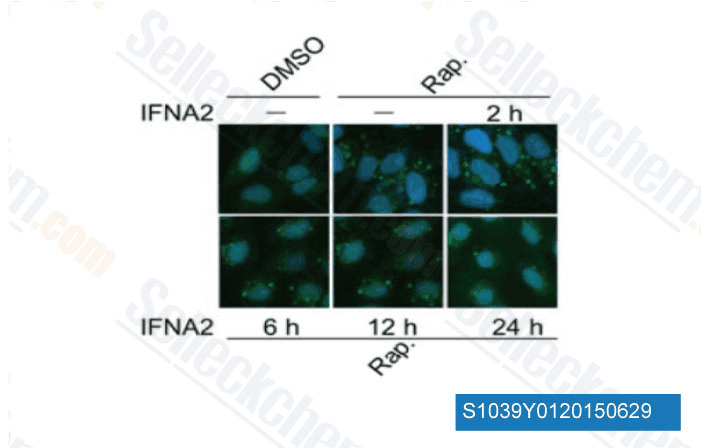
-
Daten von [ Autophagy , 2015 , 11(4), 617-28 ]
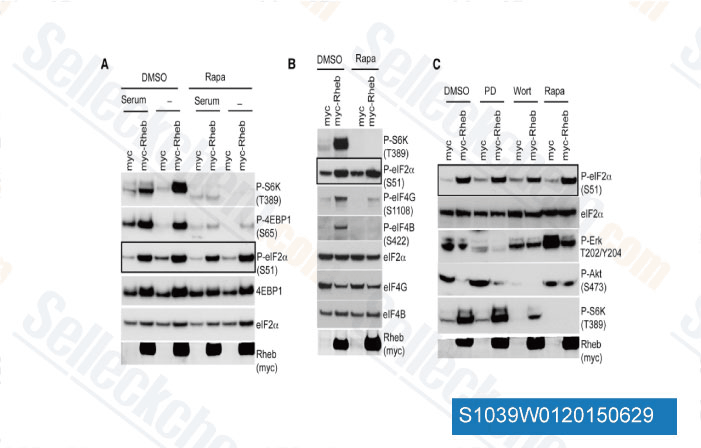
-
Daten von [ Cell Rep , 2015 , 10.1016/j.celrep.2015.01.014 ]

-
Daten von [ Biochem Pharmacol , 2015 , 95(3), 156-69 ]
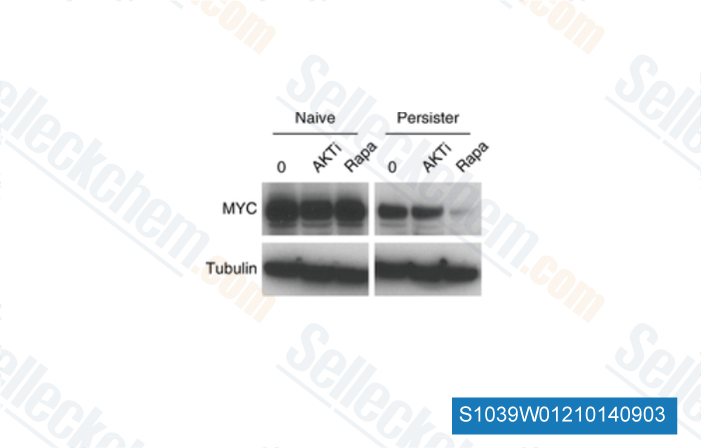
-
Daten von [ Nat Genet , 2014 , 46(4), 364-70 ]
Sellecks Rapamycin (Sirolimus) Wurde zitiert von 1914 Publikationen
| Taurine from tumour niche drives glycolysis to promote leukaemogenesis [ Nature, 2025, 10.1038/s41586-025-09018-7] | PubMed: 40369079 |
| High fructose consumption aggravates inflammation by promoting effector T cell generation via inducing metabolic reprogramming [ Signal Transduct Target Ther, 2025, 10(1):271] | PubMed: 40854873 |
| RIPK1 senses S-adenosylmethionine scarcity to drive cell death and inflammation [ Cell Metab, 2025, S1550-4131(25)00294-3] | PubMed: 40570842 |
| Interferon-responsive intestinal BEST4/CA7+ cells are targets of bacterial diarrheal toxins [ Cell Stem Cell, 2025, S1934-5909(25)00042-6] | PubMed: 40010349 |
| USP5 stabilizes YTHDF1 to control cancer immune surveillance through mTORC1-mediated phosphorylation [ Nat Commun, 2025, 16(1):1313] | PubMed: 39900921 |
| Macrophage-derived amphiregulin induces myofibroblast transition in adipogenic lineage precursors near Staphylococcus aureus abscess in bone marrow [ Nat Commun, 2025, 16(1):8409] | PubMed: 40998791 |
| WNK1 signalling regulates amino acid transport and mTORC1 activity to sustain acute myeloid leukaemia growth [ Nat Commun, 2025, 16(1):4920] | PubMed: 40425534 |
| Lysosomal NKG7 restrains mTORC1 activity to promote CD8+ T cell durability and tumor control [ Nat Commun, 2025, 16(1):1628] | PubMed: 39952956 |
| DRAM1 promotes the stability of lysosomal VAMP8 to enhance autolysosome formation and facilitates the extravasation [ Nat Commun, 2025, 16(1):5826] | PubMed: 40595569 |
| Lipoic acid functions in Paneth cells to prevent human intestinal stem cell aging [ Nat Commun, 2025, 16(1):6016] | PubMed: 40593722 |
RÜCKGABERICHTLINIE
Die bedingungslose Rückgaberichtlinie von Selleck Chemical gewährleistet unseren Kunden ein reibungsloses Online-Einkaufserlebnis. Wenn Sie in irgendeiner Weise mit Ihrem Kauf unzufrieden sind, können Sie jeden Artikel innerhalb von 7 Tagen nach Erhalt zurückgeben. Im Falle von Produktqualitätsproblemen, sei es protokollbezogene oder produktbezogene Probleme, können Sie jeden Artikel innerhalb von 365 Tagen ab dem ursprünglichen Kaufdatum zurückgeben. Bitte befolgen Sie die nachstehenden Anweisungen, wenn Sie Produkte zurücksenden.
VERSAND UND LAGERUNG
Selleck-Produkte werden bei Raumtemperatur transportiert. Wenn Sie das Produkt bei Raumtemperatur erhalten, seien Sie versichert, dass die Qualitätskontrollabteilung von Selleck Experimente durchgeführt hat, um zu überprüfen, dass die normale Temperaturplatzierung von einem Monat die biologische Aktivität von Pulverprodukten nicht beeinträchtigt. Nach dem Sammeln lagern Sie das Produkt bitte gemäß den in der Datenblatt beschriebenen Anforderungen. Die meisten Selleck-Produkte sind unter den empfohlenen Bedingungen stabil.
NICHT FÜR DIE ANWENDUNG AM MENSCHEN, FÜR VETERINÄRMEDIZINISCHE DIAGNOSTIK ODER THERAPEUTISCHE ZWECKE.