
Technische Daten
| Formel | C19H20F3IN2O5S |
||||||||||||||
| Molekulargewicht | 572.34 | CAS-Nr. | 923032-37-5 | ||||||||||||
| Löslichkeit (25°C)* | In vitro | DMSO | 100 mg/mL (174.72 mM) | ||||||||||||
| Ethanol | 100 mg/mL (174.72 mM) | ||||||||||||||
| Water | Insoluble | ||||||||||||||
| In vivo (Lösungsmittel einzeln und der Reihe nach zum Produkt hinzufügen.) |
|
||||||||||||||
|
* <1 mg/ml bedeutet schwer löslich oder unlöslich. * Bitte beachten Sie, dass Selleck die Löslichkeit aller Verbindungen intern testet und die tatsächliche Löslichkeit geringfügig von veröffentlichten Werten abweichen kann. Dies ist normal und ist auf geringfügige Batch-zu-Batch-Variationen zurückzuführen. * Versand bei Raumtemperatur (Stabilitätstests zeigen, dass dieses Produkt ohne Kühlmaßnahmen versendet werden kann.) |
|||||||||||||||
Vorbereitung von Stammlösungen
Biologische Aktivität
| Beschreibung | Refametinib (RDEA119, Bay 86-9766) ist ein potenter, ATP-nicht-kompetitiver und hochselektiver Inhibitor von MEK1 und MEK2 mit einer IC50 von 19 nM bzw. 47 nM. | ||||
|---|---|---|---|---|---|
| Ziele |
|
||||
| In vitro | Refametinib (RDEA119) bindet selektiv direkt an eine allosterische Tasche in den MEK1/2-Enzymen und ist hochwirksam bei der Hemmung der Zellproliferation in mehreren Tumorzelllinien, einschließlich A375, SK-MEI-28, Colo205, HT-29 und BxPC3. Es hemmt das Verankerungs-abhängige Wachstum menschlicher Krebszelllinien, die die Gain-of-Function-V600E-BRAF-Mutante beherbergen, mit GI50-Werten im Bereich von 67 bis 89 nM. Unter Verankerungs-unabhängigen Bedingungen sind die GI50-Werte für alle getesteten Zelllinien ähnlich (40-84 nM). Diese Verbindung zeigt eine Gewebeselektivität, die ihr Potenzial für Nebenwirkungen im Zusammenhang mit dem zentralen Nervensystem reduziert. Es hemmt potent die Proliferation der 4 Zelllinien, die eine BRAF-Mutation aufwiesen, hat aber keine oder geringe Auswirkungen auf die anderen 4 Zellen, die Wildtyp-BRAF aufwiesen (IC50 von 0,034-0,217 μM vs. 1,413-34,120 μM). Die hemmende Wirkung von Refametinib in ausgewählten Zelllinien OCUT1 (BRAF V600E(+), PIK3CA H1047R(+)) und SW1376 (BRAF V600E(+)) wird durch die Kombination mit dem mTOR-Inhibitor Temsirolimus verstärkt. Es und Temsirolimus zeigen auch synergistische Effekte auf den autophagischen Tod von OCUT1- und KAT18-Zellen, die selektiv getestet wurden. | ||||
| In vivo | Die orale Verabreichung von RDEA119 in einer Dosis von 50 mg/kg einmal täglich für 14 Tage führt zu einer 68%igen Tumorwachstumshemmung (TGI) im humanen Melanom-A375-Tumormodell. Diese Verbindung in einer Dosis von 25 mg/kg einmal täglich für 14 Tage führt zu einer 123%igen TGI im humanen Kolonkarzinom-Colo205-Tumormodell (TGI > 100% tritt auf, wenn der Tumor unter sein Ausgangsvolumen schrumpft). Eine Dosis von 25 mg/kg einmal täglich für 14 Tage erzeugt 56% und 67% TGI für HT-29- bzw. A431-Tumoren. |
Protokoll (aus Referenz)
| Kinase-Assay: |
|
|---|---|
| Zell-Assay: |
|
| Tierstudie: |
|
Referenzen
|
Kundenproduktvalidierung
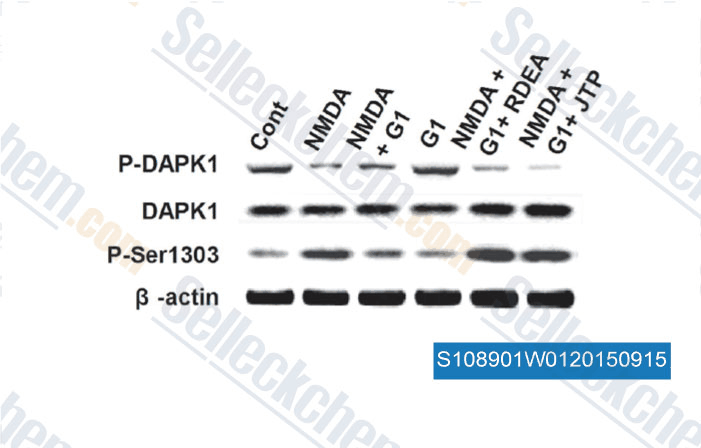
-
Daten von [ , , J Neurosci, 2012, 32(14): 4887-900 ]
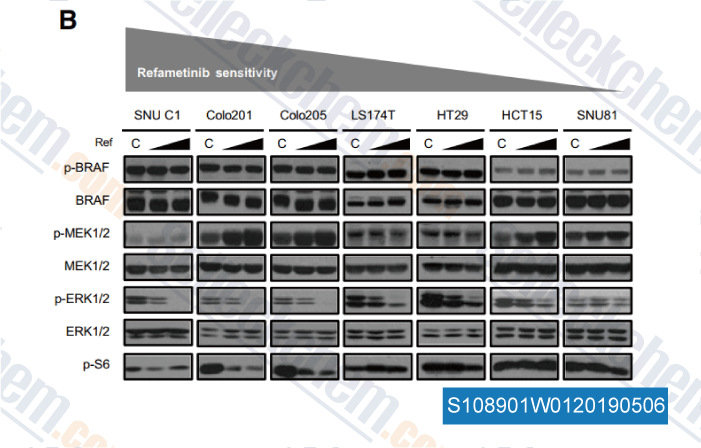
-
Daten von [ , , Mol Oncol, 2018, 12(8):1398-1409 ]
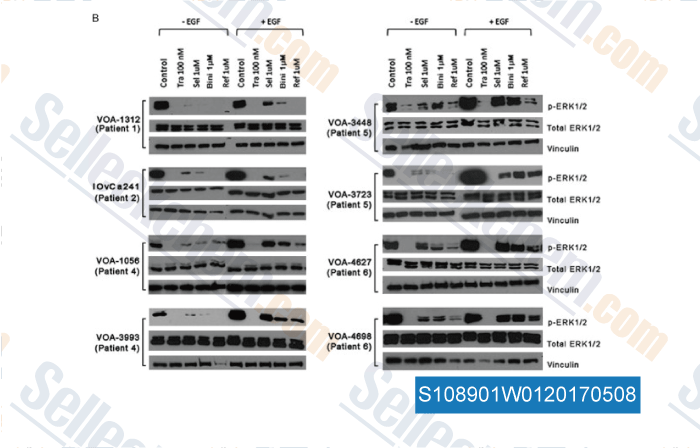
-
Daten von [ , , Am J Cancer Res, 2016, 6(10):2235-2251 ]
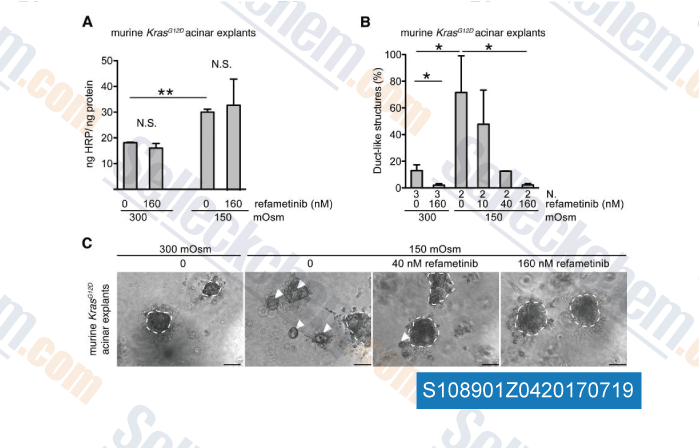
-
Daten von [ , , EBioMedicine, 2017, 15:90-99 ]
Sellecks Refametinib (RDEA119) Wurde zitiert von 29 Publikationen
| System analysis links SMARCD3 regulons to growth signaling and MEK inhibitor response in everolimus-resistant ER+ breast cancer cells [ Cell Rep Med, 2025, 6(11):102425] | PubMed: 41260207 |
| Histone deacetylase inhibitors promote breast cancer metastasis by elevating NEDD9 expression [ Signal Transduct Target Ther, 2023, 8(1):11] | PubMed: 36604412 |
| Salmonella effector SopB reorganizes cytoskeletal vimentin to maintain replication vacuoles for efficient infection [ Nat Commun, 2023, 14(1):478] | PubMed: 36717589 |
| Signaling-induced systematic repression of miRNAs uncovers cancer vulnerabilities and targeted therapy sensitivity [ Cell Rep Med, 2023, S2666-3791(23)00367-1] | PubMed: 37734378 |
| Signaling-induced systematic repression of miRNAs uncovers cancer vulnerabilities and targeted therapy sensitivity [ Cell Rep Med, 2023, 4(10):101200] | PubMed: 37734378 |
| Protein Tyrosine Phosphatase Non-Receptor 11 (PTPN11/Shp2) as a Driver Oncogene and a Novel Therapeutic Target in Non-Small Cell Lung Cancer (NSCLC) [ Int J Mol Sci, 2023, 24(13)10545] | PubMed: 37445722 |
| Anatomic position determines oncogenic specificity in melanoma [ Nature, 2022, 604(7905):354-361] | PubMed: 35355015 |
| NOTCH signaling limits the response of Low Grade Serous Ovarian Cancers to MEK inhibition [ Mol Cancer Ther, 2022, MCT-22-0004] | PubMed: 36198031 |
| Secondary resistance to anti-EGFR therapy by transcriptional reprogramming in patient-derived colorectal cancer models [ Genome Med, 2021, 13(1):116] | PubMed: 34271981 |
| Targeting the PI3K and MAPK pathways to improve response to HER2-targeted therapies in HER2-positive gastric cancer [ J Transl Med, 2021, 19(1):184] | PubMed: 33933113 |
RÜCKGABERICHTLINIE
Die bedingungslose Rückgaberichtlinie von Selleck Chemical gewährleistet unseren Kunden ein reibungsloses Online-Einkaufserlebnis. Wenn Sie in irgendeiner Weise mit Ihrem Kauf unzufrieden sind, können Sie jeden Artikel innerhalb von 7 Tagen nach Erhalt zurückgeben. Im Falle von Produktqualitätsproblemen, sei es protokollbezogene oder produktbezogene Probleme, können Sie jeden Artikel innerhalb von 365 Tagen ab dem ursprünglichen Kaufdatum zurückgeben. Bitte befolgen Sie die nachstehenden Anweisungen, wenn Sie Produkte zurücksenden.
VERSAND UND LAGERUNG
Selleck-Produkte werden bei Raumtemperatur transportiert. Wenn Sie das Produkt bei Raumtemperatur erhalten, seien Sie versichert, dass die Qualitätskontrollabteilung von Selleck Experimente durchgeführt hat, um zu überprüfen, dass die normale Temperaturplatzierung von einem Monat die biologische Aktivität von Pulverprodukten nicht beeinträchtigt. Nach dem Sammeln lagern Sie das Produkt bitte gemäß den in der Datenblatt beschriebenen Anforderungen. Die meisten Selleck-Produkte sind unter den empfohlenen Bedingungen stabil.
NICHT FÜR DIE ANWENDUNG AM MENSCHEN, FÜR VETERINÄRMEDIZINISCHE DIAGNOSTIK ODER THERAPEUTISCHE ZWECKE.