
Technische Daten
| Formel | C23H30N8O |
||||||
| Molekulargewicht | 434.54 | CAS-Nr. | 1211441-98-3 | ||||
| Löslichkeit (25°C)* | In vitro | DMSO | 20 mg/mL (46.02 mM) | ||||
| Water | Insoluble | ||||||
| Ethanol | Insoluble | ||||||
| In vivo (Lösungsmittel einzeln und der Reihe nach zum Produkt hinzufügen.) |
|
||||||
|
* <1 mg/ml bedeutet schwer löslich oder unlöslich. * Bitte beachten Sie, dass Selleck die Löslichkeit aller Verbindungen intern testet und die tatsächliche Löslichkeit geringfügig von veröffentlichten Werten abweichen kann. Dies ist normal und ist auf geringfügige Batch-zu-Batch-Variationen zurückzuführen. * Versand bei Raumtemperatur (Stabilitätstests zeigen, dass dieses Produkt ohne Kühlmaßnahmen versendet werden kann.) |
|||||||
Vorbereitung von Stammlösungen
Biologische Aktivität
| Beschreibung | Ribociclib ist ein oral verfügbarer und hochspezifischer Inhibitor von CDK4 und CDK6 mit IC50 von 10 nM und 39 nM. Phase 3. | ||||
|---|---|---|---|---|---|
| Ziele |
|
||||
| In vitro | LEE011 hemmt als dualer CDK4/CDK6-Inhibitor signifikant das Wachstum von 12 von 17 Neuroblastom-Zelllinien mit einer mittleren IC50 von 307 nM. Die Wachstumshemmung von Neuroblastom-Zelllinien ist primär zytostatisch und wird durch einen G1-Cell Cycle-Arrest und zelluläre Seneszenz vermittelt. |
||||
| In vivo | LEE011 (200 mg/kg täglich, p.o.) bewirkt eine signifikante Verzögerung des Tumorwachstums bei Mäusen, die BE2C- oder 1643-Xenografts tragen, ohne Gewichtsverlust oder andere Anzeichen von Toxizität. |
||||
| Merkmale | Oral bioverfügbarer CDK4/6-selektiver Inhibitor, der in klinischen Phase-III-Studien zur Behandlung von fortgeschrittenem Brustkrebs getestet wurde. |
Protokoll (aus Referenz)
| Zell-Assay: |
|
|---|---|
| Tierstudie: |
|
Referenzen
|
Kundenproduktvalidierung
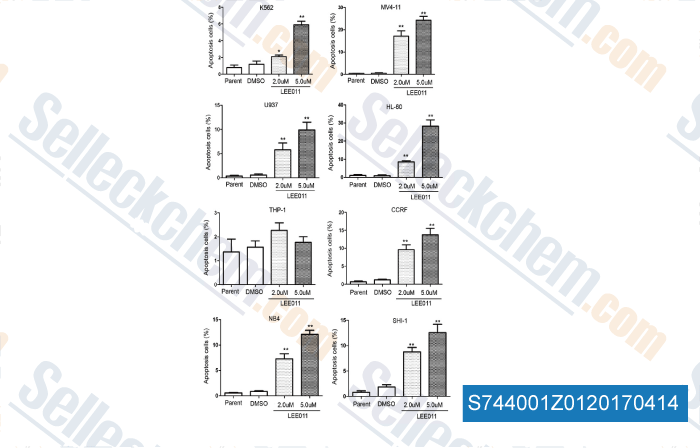
-
, , Cancer Cell Int, 2017, 17:35
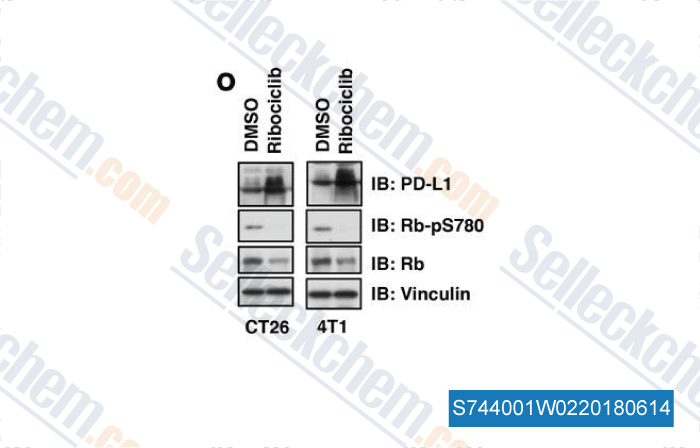
-
Daten von [ , , Nature, 2017, 553(7686):91-95 ]

-
Daten von [ , , Clin Cancer Res, 2017, 23(22):6958-6968 ]
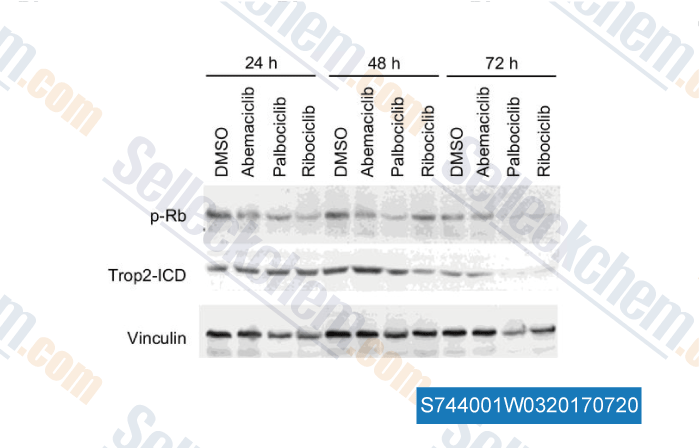
-
Daten von [ , , Cancer Res, 2016, 76(22):6723-6734 ]
Sellecks LEE011 (Ribociclib) Wurde zitiert von 116 Publikationen
| Cellular interactions within the immune microenvironment underpins resistance to cell cycle inhibition in breast cancers [ Nat Commun, 2025, 16(1):2132] | PubMed: 40032842 |
| Combined therapy with DR5-targeting antibody-drug conjugate and CDK inhibitors as a strategy for advanced colorectal cancer [ Cell Rep Med, 2025, S2666-3791(25)00231-9] | PubMed: 40449480 |
| Resistance to CDK7 inhibitors directed by acquired mutation of a conserved residue in cancer cells [ EMBO J, 2025, 10.1038/s44318-025-00554-6] | PubMed: 40921851 |
| Blocking cancer-fibroblast mutualism inhibits proliferation of endocrine therapy resistant breast cancer [ Mol Syst Biol, 2025, 10.1038/s44320-025-00104-6] | PubMed: 40341770 |
| Gene expression analysis in circulating tumour cells to determine resistance to CDK4/6 inhibitors plus endocrine therapy in HR + /HER2- metastatic breast cancer patients [ J Transl Med, 2025, 23(1):400] | PubMed: 40186268 |
| Efficacy of CDK4/6 Inhibition in colorectal cancer and the role of p16 expression in predicting drug resistance [ Cell Oncol (Dordr), 2025, 10.1007/s13402-025-01080-7] | PubMed: 40522623 |
| FLT4 activation promotes acute lymphoid leukemia survival through stabilization of MDM2/MDMX and inactivation of p53 [ Oncogenesis, 2025, 14(1):14] | PubMed: 40316529 |
| Preclinical Evaluation of the Efficacy of a Cyclin-dependent Kinase Inhibitor Ribociclib in Combination with Letrozole Against Patient-Derived Glioblastoma Cells [ Mol Cancer Ther, 2025, 10.1158/1535-7163.MCT-25-0277] | PubMed: 40994426 |
| Investigation of ribociclib, abemaciclib and palbociclib resistance in ER+ breast cancer cells reveal potential therapeutic opportunities` [ Sci Rep, 2025, 15(1):28579] | PubMed: 40764324 |
| Bacterial ubiquitin ligase engineered for small molecule and protein target identification [ bioRxiv, 2025, 2025.03.20.644192] | PubMed: 40166235 |
RÜCKGABERICHTLINIE
Die bedingungslose Rückgaberichtlinie von Selleck Chemical gewährleistet unseren Kunden ein reibungsloses Online-Einkaufserlebnis. Wenn Sie in irgendeiner Weise mit Ihrem Kauf unzufrieden sind, können Sie jeden Artikel innerhalb von 7 Tagen nach Erhalt zurückgeben. Im Falle von Produktqualitätsproblemen, sei es protokollbezogene oder produktbezogene Probleme, können Sie jeden Artikel innerhalb von 365 Tagen ab dem ursprünglichen Kaufdatum zurückgeben. Bitte befolgen Sie die nachstehenden Anweisungen, wenn Sie Produkte zurücksenden.
VERSAND UND LAGERUNG
Selleck-Produkte werden bei Raumtemperatur transportiert. Wenn Sie das Produkt bei Raumtemperatur erhalten, seien Sie versichert, dass die Qualitätskontrollabteilung von Selleck Experimente durchgeführt hat, um zu überprüfen, dass die normale Temperaturplatzierung von einem Monat die biologische Aktivität von Pulverprodukten nicht beeinträchtigt. Nach dem Sammeln lagern Sie das Produkt bitte gemäß den in der Datenblatt beschriebenen Anforderungen. Die meisten Selleck-Produkte sind unter den empfohlenen Bedingungen stabil.
NICHT FÜR DIE ANWENDUNG AM MENSCHEN, FÜR VETERINÄRMEDIZINISCHE DIAGNOSTIK ODER THERAPEUTISCHE ZWECKE.