
Technische Daten
| Formel | C24H27N5O3 |
||||||
| Molekulargewicht | 433.5 | CAS-Nr. | 1316214-52-4 | ||||
| Löslichkeit (25°C)* | In vitro | DMSO | 87 mg/mL (200.69 mM) | ||||
| Water | Insoluble | ||||||
| Ethanol | Insoluble | ||||||
| In vivo (Lösungsmittel einzeln und der Reihe nach zum Produkt hinzufügen.) |
|
||||||
|
* <1 mg/ml bedeutet schwer löslich oder unlöslich. * Bitte beachten Sie, dass Selleck die Löslichkeit aller Verbindungen intern testet und die tatsächliche Löslichkeit geringfügig von veröffentlichten Werten abweichen kann. Dies ist normal und ist auf geringfügige Batch-zu-Batch-Variationen zurückzuführen. * Versand bei Raumtemperatur (Stabilitätstests zeigen, dass dieses Produkt ohne Kühlmaßnahmen versendet werden kann.) |
|||||||
Vorbereitung von Stammlösungen
Biologische Aktivität
| Beschreibung | Ricolinostat (ACY-1215, Rocilinostat) ist ein selektiver HDAC6-Inhibitor mit einer IC50 von 5 nM in einem zellfreien Assay. Er ist >10-fach selektiver für HDAC6 als für HDAC1/2/3 (Klasse-I-HDACs) mit leichter Aktivität gegen HDAC8, minimaler Aktivität gegen HDAC4/5/7/9/11, Sirtuin1 und Sirtuin2. Ricolinostat (ACY-1215) unterdrückt die Zellproliferation und fördert die Apoptose. Phase 2. | ||||||||||
|---|---|---|---|---|---|---|---|---|---|---|---|
| Ziele |
|
||||||||||
| In vitro | ACY-1215 ist ein Hydroxamsäurederivat. ACY-1215 ist 12-, 10- und 11-fach weniger aktiv gegen HDAC1, HDAC2 bzw. HDAC3 (Klasse-I-HDACs). ACY-1215 hat eine minimale Aktivität (IC50 > 1μM) gegen HDAC4, HDAC5, HDAC7, HDAC9, HDAC11, Sirtuin1 und Sirtuin2 und eine leichte Aktivität gegen HDAC8 (IC50 = 0.1μM). Die IC50-Werte für ACY-1215 für die T-Zell-Toxizität betragen 2,5μM. ACY-1215 überwindet das durch BMSCs und Zytokine im BM-Milieu verliehene Tumorwachstum und -überleben. |
||||||||||
| In vivo | ACY-1215 wird leicht von Tumorgewebe aufgenommen. Darüber hinaus reichert sich das Medikament nicht im Tumorgewebe an, wie der parallele Rückgang von acetyliertem α-Tubulin in Blutzellen und Tumorgewebe 24 Stunden nach der Dosis zeigt. |
||||||||||
| Merkmale | Induzierte weniger Zytotoxizität in PHA-stimulierten PBMCs von 4 gesunden Spendern im Vergleich zum Pan-HDAC-Inhibitor SAHA. |
Protokoll (aus Referenz)
| Kinase-Assay: |
|
|---|---|
| Zell-Assay: |
|
| Tierstudie: |
|
Referenzen
|
Kundenproduktvalidierung
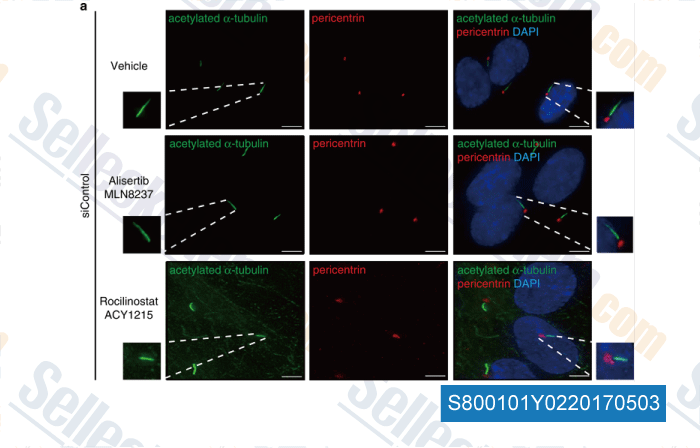
-
, , Oncogene, 2017, 36(24):3450-3463
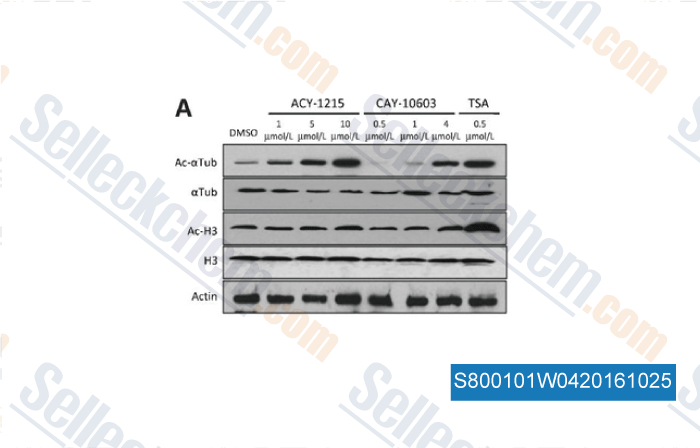
-
, , Mol Cancer Ther, 2015, 14(3):727-39.
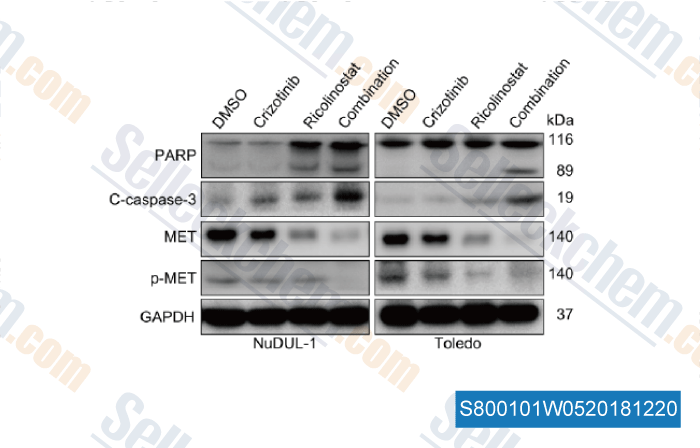
-
Daten von [ , , J Pathol, 2018, 246(2):141-153 ]
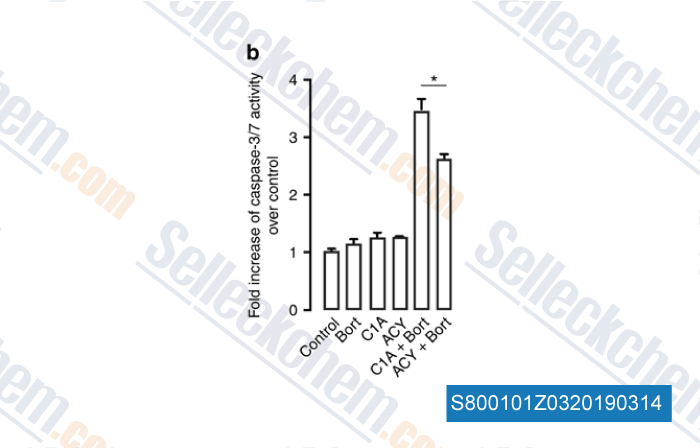
-
Daten von [ , , Br J Cancer, 2018, 119(10):1278-1287 ]
Sellecks Ricolinostat (ACY-1215) Wurde zitiert von 75 Publikationen
| Pharmacological Modulation of the Unfolded Protein Response as a Therapeutic Approach in Cutaneous T-Cell Lymphoma [ Biomolecules, 2025, 15(1)76] | PubMed: 39858470 |
| Potential of histone deacetylase 6 inhibitors in alleviating chemotherapy-induced peripheral neuropathy [ Korean J Pain, 2025, 38(2):152-162] | PubMed: 40159938 |
| HDAC6 inhibitor ACY-1215 enhances STAT1 acetylation to block PD-L1 for colorectal cancer immunotherapy [ Cancer Immunol Immunother, 2024, 73(1):7] | PubMed: 38231305 |
| Uveal Melanoma Zebrafish Xenograft Models Illustrate the Mutation Status-Dependent Effect of Compound Synergism or Antagonism [ Invest Ophthalmol Vis Sci, 2024, 65(10):26] | PubMed: 39163035 |
| HDAC Inhibition Induces CD26 Expression on Multiple Myeloma Cells via the c-Myc/Sp1-mediated Promoter Activation [ Cancer Res Commun, 2024, 4(2):349-364] | PubMed: 38284882 |
| Histone Deacetylase 6 Inhibition Exploits Selective Metabolic Vulnerabilities in LKB1 Mutant, KRAS Driven NSCLC [ J Thorac Oncol, 2023, 18(7):882-895] | PubMed: 36958689 |
| Histone Deacetylase 6 Inhibition Exploits Selective Metabolic Vulnerabilities in LKB1 Mutant, KRAS Driven NSCLC [ J Thorac Oncol, 2023, S1556-0864(23)00197-1] | PubMed: 36958689 |
| The lysosomal Ragulator complex activates NLRP3 inflammasome in vivo via HDAC6 [ EMBO J, 2023, 42(1):e111389] | PubMed: 36444797 |
| HDAC6 regulates human erythroid differentiation through modulation of JAK2 signalling [ J Cell Mol Med, 2023, 27(2):174-188] | PubMed: 36578217 |
| Non-decameric NLRP3 forms an MTOC-independent inflammasome [ bioRxiv, 2023, 10.1101/2023.07.07.548075] | PubMed: None |
RÜCKGABERICHTLINIE
Die bedingungslose Rückgaberichtlinie von Selleck Chemical gewährleistet unseren Kunden ein reibungsloses Online-Einkaufserlebnis. Wenn Sie in irgendeiner Weise mit Ihrem Kauf unzufrieden sind, können Sie jeden Artikel innerhalb von 7 Tagen nach Erhalt zurückgeben. Im Falle von Produktqualitätsproblemen, sei es protokollbezogene oder produktbezogene Probleme, können Sie jeden Artikel innerhalb von 365 Tagen ab dem ursprünglichen Kaufdatum zurückgeben. Bitte befolgen Sie die nachstehenden Anweisungen, wenn Sie Produkte zurücksenden.
VERSAND UND LAGERUNG
Selleck-Produkte werden bei Raumtemperatur transportiert. Wenn Sie das Produkt bei Raumtemperatur erhalten, seien Sie versichert, dass die Qualitätskontrollabteilung von Selleck Experimente durchgeführt hat, um zu überprüfen, dass die normale Temperaturplatzierung von einem Monat die biologische Aktivität von Pulverprodukten nicht beeinträchtigt. Nach dem Sammeln lagern Sie das Produkt bitte gemäß den in der Datenblatt beschriebenen Anforderungen. Die meisten Selleck-Produkte sind unter den empfohlenen Bedingungen stabil.
NICHT FÜR DIE ANWENDUNG AM MENSCHEN, FÜR VETERINÄRMEDIZINISCHE DIAGNOSTIK ODER THERAPEUTISCHE ZWECKE.