
Technische Daten
| Formel | C24H36N4O6S2 |
||||||||||
| Molekulargewicht | 540.7 | CAS-Nr. | 128517-07-7 | ||||||||
| Löslichkeit (25°C)* | In vitro | DMSO | 100 mg/mL (184.94 mM) | ||||||||
| Water | Insoluble | ||||||||||
| Ethanol | Insoluble | ||||||||||
| In vivo (Lösungsmittel einzeln und der Reihe nach zum Produkt hinzufügen.) |
|
||||||||||
|
* <1 mg/ml bedeutet schwer löslich oder unlöslich. * Bitte beachten Sie, dass Selleck die Löslichkeit aller Verbindungen intern testet und die tatsächliche Löslichkeit geringfügig von veröffentlichten Werten abweichen kann. Dies ist normal und ist auf geringfügige Batch-zu-Batch-Variationen zurückzuführen. * Versand bei Raumtemperatur (Stabilitätstests zeigen, dass dieses Produkt ohne Kühlmaßnahmen versendet werden kann.) |
|||||||||||
Vorbereitung von Stammlösungen
Biologische Aktivität
| Beschreibung | Romidepsin (FK228, Depsipeptid, FR 901228, NSC 630176) ist ein potenter HDAC1- und HDAC2-Inhibitor mit einer IC50 von 36 nM bzw. 47 nM in zellfreien Assays. Diese Verbindung kontrolliert das Wachstum und induziert die Apoptose in Neuroblastom-Tumorzellen. | ||||
|---|---|---|---|---|---|
| Ziele |
|
||||
| In vitro | Im Gegensatz zu TSA hemmt die aktive Form redFK von Romidepsin HDAC1 und HDAC2 stark mit IC50 von 1,6 nM bzw. 3,9 nM, ist aber relativ schwach in der Hemmung von HDAC4 und HDAC6 mit IC50 von 25 nM bzw. 790 nM. Diese Verbindung ist 17-23 Mal schwächer als redFK bei der Hemmung dieser HDACs mit IC50 von 36 nM, 47 nM, 510 nM und 14 μM. Die Behandlung mit dieser Chemikalie in HeLa-Zellen induziert Histonacetylierung und p21-Expression mit einer EC50 von 3,0 nM, stärker als redFK mit einer EC50 von 11 nM aufgrund der Instabilität von redFK. Zusätzlich zum G2/M-Arrest bewirkt diese Verbindung eine Herunterregulierung von Cyclin D1 und eine p53-unabhängige p21-Induktion, die zur Hemmung von CDK und zur Dephosphorylierung von Rb führt, was zu einem Wachstumsarrest in der frühen G1-Phase führt. Es ist 100-mal wirksamer als TSA und 1.000.000-mal wirksamer als Butyrat bei der Hemmung der Proliferation von A549-Zellen. Dieses Mittel hemmt das Wachstum von U-937-, K562- und CCRF-CEM-Zellen mit IC50 von 5,92 nM, 8,36 nM bzw. 6,95 nM. Es fördert die Apoptose in chronisch lymphatischer Leukämie (CLL)-Zellen in einer Konzentration, die derjenigen entspricht, bei der die H3- und H4-Acetylierung und HDAC-Hemmung auftritt, wobei selektiv die Aktivierung von Caspase 8 und Effektor-Caspase 3 sowie die Herunterregulierung des c-FLIP-Proteins involviert sind. In 11 von 13 (85%) Nierenzellkarzinom-Zelllinien und in 16 von 37 (43%) anderen Krebszelllinien reguliert diese Verbindung Tumortodesrezeptoren hoch und verstärkt die natürliche Killer (NK)-vermittelte Tumortötung. Es zeigt eine konzentrationsabhängige Zytotoxizität gegen eine Reihe von Mantelzelllymphom (MCL)-Zelllinien. | ||||
| In vivo | Die Behandlung mit Romidepsin hemmt die Neovaskularisation von Hühnerembryonen und erwachsenen Mäusen im Matrigel-Plug-Assay potent. Die Verabreichung dieser Verbindung in einer Dosis von 0,1-1 mg/kg zweimal pro Woche verlängert das Überleben von Mäusen mit U-937-Lymphom signifikant, mit medianen Überlebenszeiten von 30,5 (0,56 mg/kg) bzw. 33 Tagen (0,32 mg/kg) (im Vergleich zu 20 Tagen bei Kontrollmäusen). | ||||
| Merkmale | Wirksamer als andere klassische HDAC-Inhibitoren wie TSA, TPX und Butyrat. |
Protokoll (aus Referenz)
| Kinase-Assay: |
|
|---|---|
| Zell-Assay: |
|
| Tierstudie: |
|
Referenzen
|
Kundenproduktvalidierung
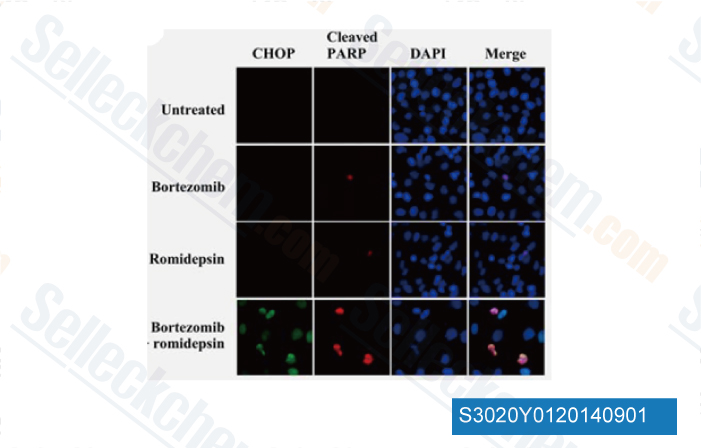
-
Daten von [ Int J Cancer , 2014 , 135(12):2950-61 ]
![An HIV-Gag-SLYNTVATL-specific CTL clone was labeled with Alexa-Fluor555 conjugated cholera toxin subunit B either cultured with 500 nM SAHA or 25 nM romidepsin for 20 hours, or maintained as an untreated control. These effector cells were combined with SLYNTVATL peptide pulsed target cells, matched on the restricting allele, in a collagen matrix medium containing sytox green viability dye. These mixtures were then plated in three separate wells of an 8-well cover slip and imaged by time-lapse brightfield and fluorescent microscopy. A. Shown are representative fields of view from the no treatment (upper panel), 500 nM SAHA (middle panel), and 25 nM romidepsin (lower panel) conditions advancing in time from left to right. Time stamps are given in hh[ratio]mm format. Clones described in the results are indicated with yellow arrows and killed target cells are indicated with white arrows in the upper right panel.](https://file.selleckchem.com/downloads/review/700px/Romidepsin-S3020Y0120141117.gif)
-
Daten von [ PLoS Pathog , 2014 , 10(8), e1004287 ]
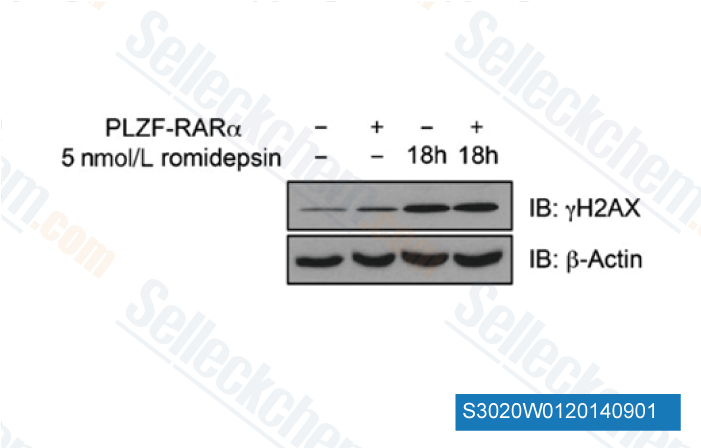
-
Daten von [ Mol Cancer Ther , 2013 , 12(8), 1591-604 ]
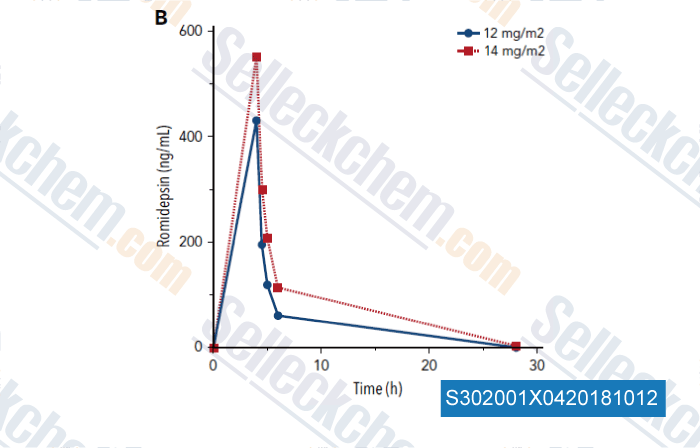
-
Daten von [ , , Blood, 2018, 131(4):397-407 ]
Sellecks Romidepsin (FK228) Wurde zitiert von 247 Publikationen
| Extracellular Histones as Exosome Membrane Proteins Regulated by Cell Stress [ J Extracell Vesicles, 2025, 14(2):e70042] | PubMed: 39976275 |
| The harmonized activities of HER2-HER3 heterodimer and deacetylated FOXA1 evade hormone response by regulating FOXA1 chromatin binding [ Nucleic Acids Res, 2025, 53(20)gkaf1086] | PubMed: 41224124 |
| A patient-derived T cell lymphoma biorepository uncovers pathogenetic mechanisms and host-related therapeutic vulnerabilities [ Cell Rep Med, 2025, S2666-3791(25)00102-8] | PubMed: 40147445 |
| Combined dendritic cell and anti-TIGIT immunotherapy potentiates adaptive NK cells against HIV-1 [ EMBO Mol Med, 2025, 10.1038/s44321-025-00255-x] | PubMed: 40473838 |
| HOXC8 impacts lung tumorigenesis by preventing pyroptotic cell death through the suppression of caspase-1 expression [ Cell Death Dis, 2025, 16(1):552] | PubMed: 40701951 |
| Heterozygous Kmt2d loss diminishes enhancers to render medulloblastoma cells vulnerable to combinatory inhibition of LSD1 and OXPHOS [ Cell Rep, 2025, 44(5):115619] | PubMed: 40286267 |
| Limitations and use of the Morpheus-V5 dual reporter virus in assessing interventions that target HIV latency [ J Virol Methods, 2025, 338:115236] | PubMed: 40754007 |
| Cognitive and Synaptic Impairment Induced by Deficiency of Autism Risk Gene Smarcc2 and its Rescue by Histone Deacetylase Inhibition [ bioRxiv, 2025, 2025.05.29.656867] | PubMed: 40492195 |
| Screening FDA-Approved Oncology Drugs with Three-Dimensional Spheroids Identifies Romidepsin as a Therapeutic Candidate for Osteosarcoma [ Cancer Res Commun, 2025, 10.1158/2767-9764.CRC-25-0121] | PubMed: 40952917 |
| Repurposing Romidepsin for Osteosarcoma: Screening FDA-Approved Oncology Drugs with Three-Dimensional Osteosarcoma Spheroids [ bioRxiv, 2025, 2025.05.22.654354] | PubMed: 40475499 |
RÜCKGABERICHTLINIE
Die bedingungslose Rückgaberichtlinie von Selleck Chemical gewährleistet unseren Kunden ein reibungsloses Online-Einkaufserlebnis. Wenn Sie in irgendeiner Weise mit Ihrem Kauf unzufrieden sind, können Sie jeden Artikel innerhalb von 7 Tagen nach Erhalt zurückgeben. Im Falle von Produktqualitätsproblemen, sei es protokollbezogene oder produktbezogene Probleme, können Sie jeden Artikel innerhalb von 365 Tagen ab dem ursprünglichen Kaufdatum zurückgeben. Bitte befolgen Sie die nachstehenden Anweisungen, wenn Sie Produkte zurücksenden.
VERSAND UND LAGERUNG
Selleck-Produkte werden bei Raumtemperatur transportiert. Wenn Sie das Produkt bei Raumtemperatur erhalten, seien Sie versichert, dass die Qualitätskontrollabteilung von Selleck Experimente durchgeführt hat, um zu überprüfen, dass die normale Temperaturplatzierung von einem Monat die biologische Aktivität von Pulverprodukten nicht beeinträchtigt. Nach dem Sammeln lagern Sie das Produkt bitte gemäß den in der Datenblatt beschriebenen Anforderungen. Die meisten Selleck-Produkte sind unter den empfohlenen Bedingungen stabil.
NICHT FÜR DIE ANWENDUNG AM MENSCHEN, FÜR VETERINÄRMEDIZINISCHE DIAGNOSTIK ODER THERAPEUTISCHE ZWECKE.