
Technische Daten
| Formel | C17H18N6 |
||||||||||||||
| Molekulargewicht | 306.37 | CAS-Nr. | 941678-49-5 | ||||||||||||
| Löslichkeit (25°C)* | In vitro | DMSO | 300 mg/mL (979.2 mM) | ||||||||||||
| Ethanol | 12 mg/mL (39.16 mM) | ||||||||||||||
| Water | Insoluble | ||||||||||||||
| In vivo (Lösungsmittel einzeln und der Reihe nach zum Produkt hinzufügen.) |
|
||||||||||||||
|
* <1 mg/ml bedeutet schwer löslich oder unlöslich. * Bitte beachten Sie, dass Selleck die Löslichkeit aller Verbindungen intern testet und die tatsächliche Löslichkeit geringfügig von veröffentlichten Werten abweichen kann. Dies ist normal und ist auf geringfügige Batch-zu-Batch-Variationen zurückzuführen. * Versand bei Raumtemperatur (Stabilitätstests zeigen, dass dieses Produkt ohne Kühlmaßnahmen versendet werden kann.) |
|||||||||||||||
Vorbereitung von Stammlösungen
Biologische Aktivität
| Beschreibung | Ruxolitinib (INCB18424) ist der erste potente, selektive JAK1/2-Inhibitor, der in die Klinik gelangt ist, mit einer IC50 von 3,3 nM/2,8 nM in zellfreien Assays und einer >130-fachen Selektivität für JAK1/2 gegenüber JAK3. Diese Verbindung tötet Tumorzellen durch toxische Mitophagy. Sie induziert Autophagy und verstärkt Apoptosis related. | ||||
|---|---|---|---|---|---|
| Ziele |
|
||||
| In vitro | Ruxolitinib (INCB18424) potently and selectively inhibits JAK2V617F-mediated signaling and proliferation in Ba/F3 cells and HEL cells. This compound markedly increases apoptosis in a dose dependent manner in Ba/F3 cells. It (64 nM) results in a doubling of cells with depolarized mitochondria in Ba/F3 cells. This chemical inhibits proliferating of erythroid progenitors from normal donors and polycythemia vera patients with IC50 of 407 nM and 223 nM, respectively. It demonstrates remarkable potency against erythroid colony formation with IC50 of 67nM. | ||||
| In vivo | INCB018424 (180 mg/kg, orally, twice a day) results in a survival rate of greater than 90% by day 22 in a JAK2V617F-driven mouse model. This compound (180 mg/kg, orally, twice a day) markedly reduces splenomegaly and circulating levels of inflammatory cytokines, and preferentially eliminates neoplastic cells, resulting in significantly prolonged survival without myelosuppressive or immunosuppressive effects in a JAK2V617F-driven mouse model. In the double-blind trial of myelofibrosis, the primary end point is reached in 41.9% of patients in the Ruxolitinib (INCB18424) group as compared with 0.7% in the placebo group. It results in maintaining reduction in spleen volume and improvement of 50% or more in the total symptom score. A total of 28% of the patients in the group receiving this compound (15 mg twice daily) has at least a 35% reduction in spleen volume at week 48 in patients with myelofibrosis, as compared with 0% in the group receiving the best available therapy. The mean palpable spleen length has decreased by 56% with it but has increased by 4% with the best available therapy at week 48. Patients in the ruxolitinib group has an improvement in overall quality-of-life measures and a reduction in symptoms associated with myelofibrosis. |
Protokoll (aus Referenz)
| Kinase-Assay:[1] |
|
|---|---|
| Zell-Assay:[1] |
|
| Tierstudie:[1] |
|
Referenzen
|
Kundenproduktvalidierung
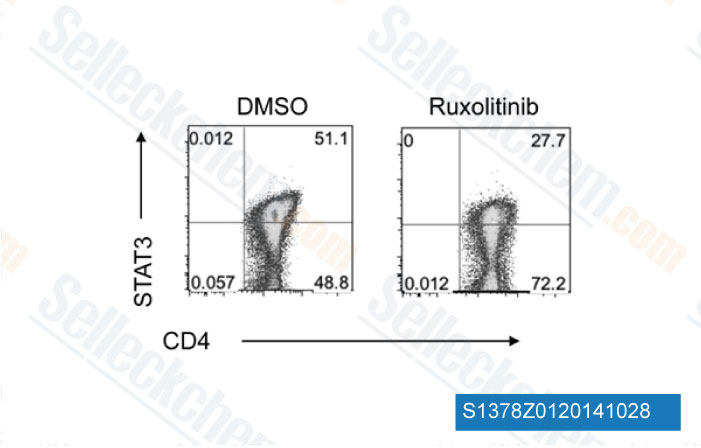
-
Daten von [ Blood , 2014 , 123(24), 3832-42 ]
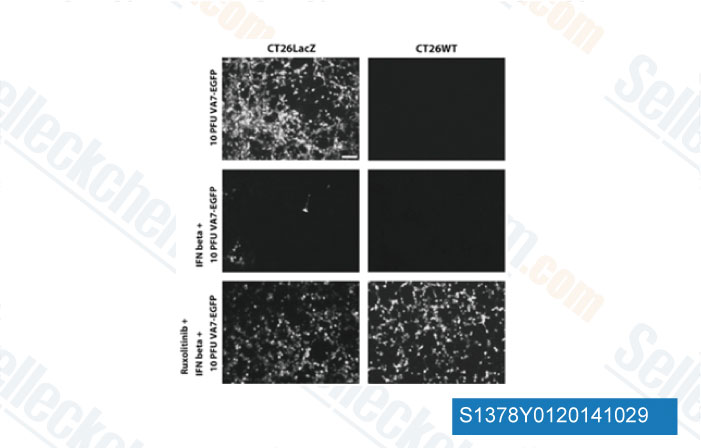
-
Daten von [ Gene Ther , 2014 , 10.1038/gt.2014.83 ]
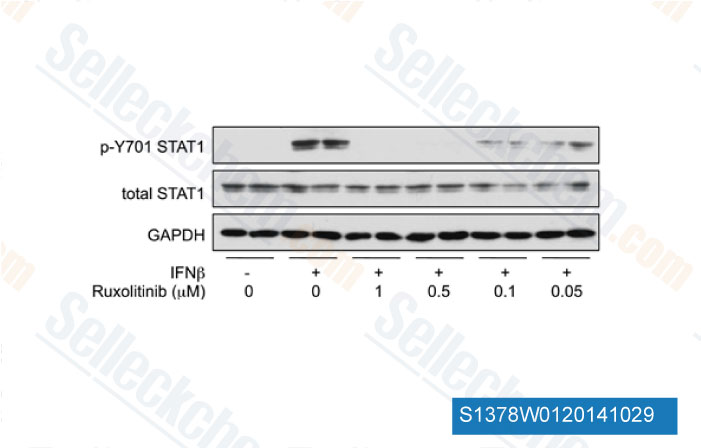
-
Daten von [ J Immunol , 2012 , 189(6), 2784-92 ]
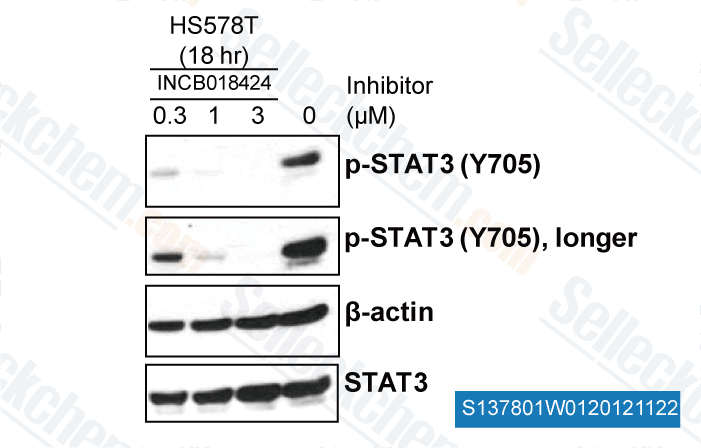
-
, , Yong Weon Yi Georgetown University
Selleck's Ruxolitinib (INCB18424) Wurde zitiert von 676 Publikationen
| Systematic design of combination therapy by targeting master regulators of coexisting diffuse midline glioma cell states [ Nat Genet, 2026, 58(5):1112-1125.] | PubMed: 42020604 |
| Biomarkers of response to neoadjuvant palbociclib plus anastrozole in endocrine-resistant estrogen receptor-positive/HER2-negative breast cancer: a phase 2 trial [ Nat Commun, 2026, 17(1):949] | PubMed: 41593097 |
| Prolonged KRAS-MAPK Inhibition Induces Interferon Signaling that Promotes Cell State Transition and Confers Therapeutic Vulnerabilities [ Cancer Res, 2026, 10.1158/0008-5472.CAN-25-4114.] | PubMed: 42008116 |
| JAK1/2 inhibitor ruxolitinib reduces aggregates in cardiac proteinopathy [ EMBO Mol Med, 2026, 10.1038/s44321-026-00411-x] | PubMed: 41917326 |
| Wntless degradation mediated by CaMKII inhibition drives endoplasmic reticulum stress and apoptosis [ Cell Rep, 2026, 45(4):117256] | PubMed: 41966825 |
| ADA2-deficient cells exhibit increased levels of cell death and metabolic disturbances [ Cell Death Discov, 2026, 12(1)167] | PubMed: 41866403 |
| Non-gene-edited neural stem cells reverse neuroinflammation and microbiota dysbiosis in a sprague-dawley rat model of autism spectrum disorder [ Transl Psychiatry, 2026, 10.1038/s41398-026-03841-w] | PubMed: 41922322 |
| The tumor suppressor NDRG2 recruits protein phosphatase 2A to suppress STAT5 phosphorylation in adult T-cell leukemia/lymphoma [ J Biol Chem, 2026, S0021-9258(26)01952-6] | PubMed: 42055322 |
| Microbial metabolite drives ageing-related clonal haematopoiesis via ALPK1 [ Nature, 2025, 10.1038/s41586-025-08938-8] | PubMed: 40269158 |
| Macrophage-derived amphiregulin induces myofibroblast transition in adipogenic lineage precursors near Staphylococcus aureus abscess in bone marrow [ Nat Commun, 2025, 16(1):8409] | PubMed: 40998791 |
RÜCKGABERICHTLINIE
Die bedingungslose Rückgaberichtlinie von Selleck Chemical gewährleistet unseren Kunden ein reibungsloses Online-Einkaufserlebnis. Wenn Sie in irgendeiner Weise mit Ihrem Kauf unzufrieden sind, können Sie jeden Artikel innerhalb von 7 Tagen nach Erhalt zurückgeben. Im Falle von Produktqualitätsproblemen, sei es protokollbezogene oder produktbezogene Probleme, können Sie jeden Artikel innerhalb von 365 Tagen ab dem ursprünglichen Kaufdatum zurückgeben. Bitte befolgen Sie die nachstehenden Anweisungen, wenn Sie Produkte zurücksenden.
VERSAND UND LAGERUNG
Selleck-Produkte werden bei Raumtemperatur transportiert. Wenn Sie das Produkt bei Raumtemperatur erhalten, seien Sie versichert, dass die Qualitätskontrollabteilung von Selleck Experimente durchgeführt hat, um zu überprüfen, dass die normale Temperaturplatzierung von einem Monat die biologische Aktivität von Pulverprodukten nicht beeinträchtigt. Nach dem Sammeln lagern Sie das Produkt bitte gemäß den in der Datenblatt beschriebenen Anforderungen. Die meisten Selleck-Produkte sind unter den empfohlenen Bedingungen stabil.
NICHT FÜR DIE ANWENDUNG AM MENSCHEN, FÜR VETERINÄRMEDIZINISCHE DIAGNOSTIK ODER THERAPEUTISCHE ZWECKE.