
Technische Daten
| Formel | C13H10BrN3O4 |
||||||
| Molekulargewicht | 352.14 | CAS-Nr. | 182498-32-4 | ||||
| Löslichkeit (25°C)* | In vitro | DMSO | 70 mg/mL (198.78 mM) | ||||
| Ethanol | 14 mg/mL (39.75 mM) | ||||||
| Water | Insoluble | ||||||
| In vivo (Lösungsmittel einzeln und der Reihe nach zum Produkt hinzufügen.) |
|
||||||
|
* <1 mg/ml bedeutet schwer löslich oder unlöslich. * Bitte beachten Sie, dass Selleck die Löslichkeit aller Verbindungen intern testet und die tatsächliche Löslichkeit geringfügig von veröffentlichten Werten abweichen kann. Dies ist normal und ist auf geringfügige Batch-zu-Batch-Variationen zurückzuführen. * Versand bei Raumtemperatur (Stabilitätstests zeigen, dass dieses Produkt ohne Kühlmaßnahmen versendet werden kann.) |
|||||||
Vorbereitung von Stammlösungen
Biologische Aktivität
| Beschreibung | SB225002 ist ein potenter und selektiver CXCR2-Antagonist mit einer IC50 von 22 nM zur Hemmung der Interleukin-IL-8-Bindung an CXCR2 und einer >150-fachen Selektivität gegenüber den anderen getesteten 7-TMRs. | ||
|---|---|---|---|
| Ziele |
|
||
| In vitro | In vitro hemmt SB225002 die GROα-stimulierte Kalziummobilisierung und hemmt potent die Chemotaxis menschlicher und Kaninchen-Neutrophiler, die sowohl durch IL-8 als auch durch GROalpha induziert wird. Diese Verbindung reduziert die Spiegel von phosphoryliertem ERK1/2 erheblich und verringert die Zellproliferation in WHCO1-Zellen. Es zeigt auch die Antitumoraktivität als Mikrotubulusinhibitor. | ||
| In vivo | Bei Kaninchen blockiert SB225002 selektiv die IL-8-induzierte Neutrophilen-Marginierung. Im Mausmodell des intrahepatischen cholangiozellulären Karzinoms unterdrückt diese Verbindung (1 mg/kg i.p.) das Wachstum transplantierter subkutaner Tumoren. Darüber hinaus zeigt sie auch lang anhaltende antinozizeptive Effekte und reduziert die TNBS-induzierte Kolitis in Mausmodellen. |
Protokoll (aus Referenz)
| Kinase-Assay:[1] |
|
|---|---|
| Zell-Assay:[2] |
|
| Tierstudie:[1] |
|
Referenzen
|
Kundenproduktvalidierung
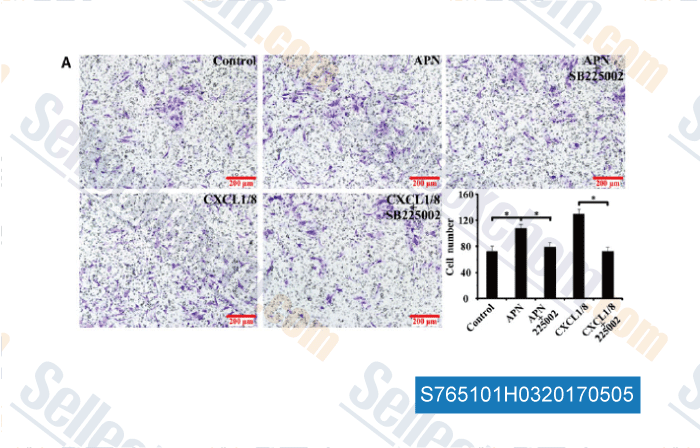
-
, , J Cell Mol Med, 2017, 21(7):1411-1419
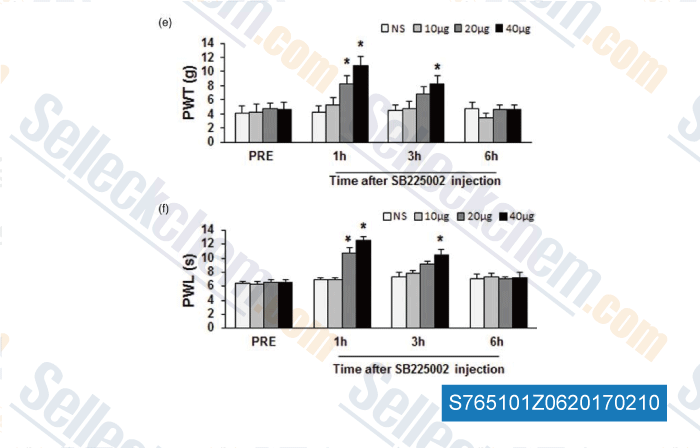
-
, , Mol Pain, 2016, doi: 10.1177/1744806916646381
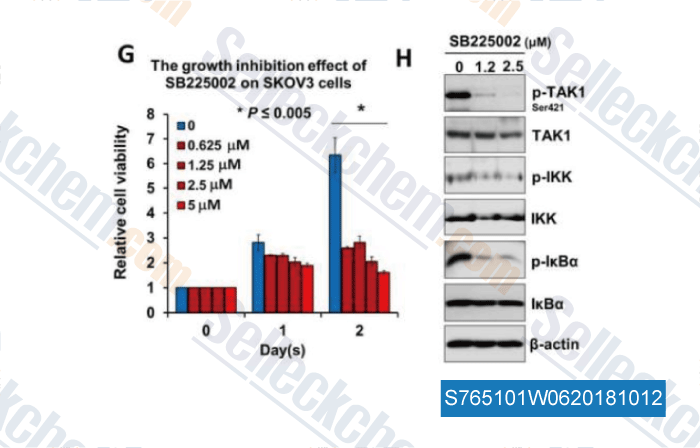
-
Daten von [ , , Theranostics, 2018, 8(5):1270-1285 ]
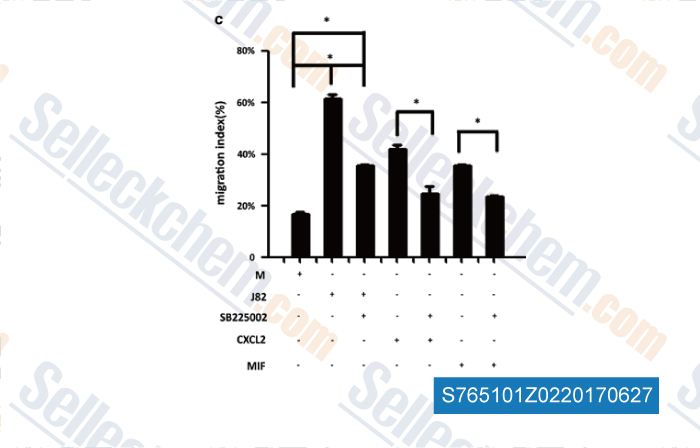
-
Daten von [ , , Oncogene, 2017, 36(15):2095-2104 ]
Sellecks SB 225002 Wurde zitiert von 91 Publikationen
| Myeloid-Derived Suppressor Cell Accumulation Drives Intestinal Fibrosis through mCCL6/hCCL15 Chemokine-Mediated Fibroblast Activation [ Adv Sci (Weinh), 2025, 12(8):e2411711] | PubMed: 39739231 |
| Tumor-derived exosomes induce neutrophil infiltration and reprogramming to promote T-cell exhaustion in hepatocellular carcinoma [ Theranostics, 2025, 15(7):2852-2869] | PubMed: 40083930 |
| USP15 Facilitates Colorectal Cancer Immune Evasion through SMYD3/CCL2-Dependent Myeloid-Derived Suppressor Cell Recruitment [ Cancer Immunol Res, 2025, 10.1158/2326-6066.CIR-24-1194] | PubMed: 40323348 |
| Cholesterol 25-Hydroxylase Enhances Myeloid-Derived Suppressor Cell (MDSC) Immunosuppression via the Stimulator of Interferon Genes (STING)-Tank-Binding Kinase 1 (TBK1)-Receptor-Interacting Protein Kinase 3 (RIPK3) Pathway in Colorectal Cancer [ MedComm (2020), 2025, 6(10):e70411] | PubMed: 41020041 |
| CXCR2 mediates rotenone-induced neuroinflammation and neurodegeneration through neurotrophil infiltration and extracellular traps formation in mice [ Int J Biol Macromol, 2025, 330(Pt 4):148305] | PubMed: 41093199 |
| KRASG12D drives immunosuppression in lung adenocarcinoma through paracrine signaling [ JCI Insight, 2025, 10(1)e182228] | PubMed: 39782689 |
| Induction of cell death by the CXCR2 antagonist SB225002 in colorectal cancer and stromal cells [ Biomed Pharmacother, 2025, 188:118203] | PubMed: 40412356 |
| The crosstalk of monocyte-neutrophil in hair follicles regulates neutrophil transepidermal migration in contact dermatitis [ Commun Biol, 2025, 8(1):564] | PubMed: 40185981 |
| IDO1 promotes Echinococcus multilocularis infection by regulating the formation of neutrophil extracellular traps [ Vet Res, 2025, 56(1):131] | PubMed: 40597301 |
| Extracellular-vesicle-packaged S100A11 from osteosarcoma cells mediates lung premetastatic niche formation by recruiting gMDSCs [ Cell Rep, 2024, 43(2):113751] | PubMed: 38341855 |
RÜCKGABERICHTLINIE
Die bedingungslose Rückgaberichtlinie von Selleck Chemical gewährleistet unseren Kunden ein reibungsloses Online-Einkaufserlebnis. Wenn Sie in irgendeiner Weise mit Ihrem Kauf unzufrieden sind, können Sie jeden Artikel innerhalb von 7 Tagen nach Erhalt zurückgeben. Im Falle von Produktqualitätsproblemen, sei es protokollbezogene oder produktbezogene Probleme, können Sie jeden Artikel innerhalb von 365 Tagen ab dem ursprünglichen Kaufdatum zurückgeben. Bitte befolgen Sie die nachstehenden Anweisungen, wenn Sie Produkte zurücksenden.
VERSAND UND LAGERUNG
Selleck-Produkte werden bei Raumtemperatur transportiert. Wenn Sie das Produkt bei Raumtemperatur erhalten, seien Sie versichert, dass die Qualitätskontrollabteilung von Selleck Experimente durchgeführt hat, um zu überprüfen, dass die normale Temperaturplatzierung von einem Monat die biologische Aktivität von Pulverprodukten nicht beeinträchtigt. Nach dem Sammeln lagern Sie das Produkt bitte gemäß den in der Datenblatt beschriebenen Anforderungen. Die meisten Selleck-Produkte sind unter den empfohlenen Bedingungen stabil.
NICHT FÜR DIE ANWENDUNG AM MENSCHEN, FÜR VETERINÄRMEDIZINISCHE DIAGNOSTIK ODER THERAPEUTISCHE ZWECKE.