
Technische Daten
| Formel | C17H15BrClFN4O3 |
||||||
| Molekulargewicht | 457.68 | CAS-Nr. | 606143-52-6 | ||||
| Löslichkeit (25°C)* | In vitro | DMSO | 91 mg/mL (198.82 mM) | ||||
| Water | Insoluble | ||||||
| Ethanol | Insoluble | ||||||
| In vivo (Lösungsmittel einzeln und der Reihe nach zum Produkt hinzufügen.) |
|
||||||
|
* <1 mg/ml bedeutet schwer löslich oder unlöslich. * Bitte beachten Sie, dass Selleck die Löslichkeit aller Verbindungen intern testet und die tatsächliche Löslichkeit geringfügig von veröffentlichten Werten abweichen kann. Dies ist normal und ist auf geringfügige Batch-zu-Batch-Variationen zurückzuführen. * Versand bei Raumtemperatur (Stabilitätstests zeigen, dass dieses Produkt ohne Kühlmaßnahmen versendet werden kann.) |
|||||||
Vorbereitung von Stammlösungen
Biologische Aktivität
| Beschreibung | Selumetinib (AZD6244, ARRY-142886) ist ein potenter, hochselektiver MEK-Inhibitor mit einem IC50 von 14 nM für MEK1 und einem Kd-Wert von 530 nM für MEK2. Es hemmt auch die ERK1/2-Phosphorylierung mit einem IC50 von 10 nM, keine Hemmung von p38α, MKK6, EGFR, ErbB2, ERK2, B-Raf, etc. Selumetinib unterdrückt die Zellproliferation, -migration und löst Apoptose aus. Phase 3. | ||||||
|---|---|---|---|---|---|---|---|
| Ziele |
|
||||||
| In vitro | Selumetinib (AZD6244) ist nicht kompetitiv mit ATP und inaktiviert die ERK1/2-Phosphorylierung mit IC50-Konzentrationen unter 40 nM. Es hemmt auch das Wachstum primärer HCC-Zellen durch Hemmung der ERK1/2- und p90RSK-Phosphorylierung, begleitet von einer Erhöhung der Spaltung von Caspase-3 und Caspase-7 sowie gespaltener Poly(ADP)ribose-Polymerase. Diese Verbindung hat geringe Auswirkungen auf die p38-, c-Jun-NH2-Kinase-, Phosphatidylinositol-3-Kinase- und MEK5/ERK5-Signalwege. Es ist empfindlich gegenüber Raf-Mutationen in Brustkrebszelllinien und Ras-Mutationen in NSCLC-Zelllinien. |
||||||
| In vivo | Selumetinib (AZD6244) hemmt signifikant die Phosphorylierung von ERK1/2 in 2-1318-, 5-1318-, 26-1004- und 4-1318-Xenografts und induziert Apoptose in primären 2-1318-Zellen durch Aktivierung des Caspase-Signalwegs. Es könnte das Tumorwachstum in HT-29-Xenografts, einem Darmkrebsmodell mit einer B-Raf-Mutation, bei einer Dosis von 100 mg/kg hemmen, und die Tumorwachstumshemmung dieser Verbindung ist besser. Andernfalls könnte es das Tumorwachstum von HCC-Xenografts hemmen, was mit erhöhter Apoptose und Herunterregulierung von Zellzyklusregulatoren, einschließlich Cyclin D1, Cdc-2, CDK2 und 4, Cyclin B1 und c-Myc, verbunden ist. |
||||||
| Merkmale | Erster MEK-Inhibitor, der in Phase-II-Studien getestet wird. |
Protokoll (aus Referenz)
| Kinase-Assay: |
|
|---|---|
| Zell-Assay: |
|
| Tierstudie: |
|
Referenzen
|
Kundenproduktvalidierung
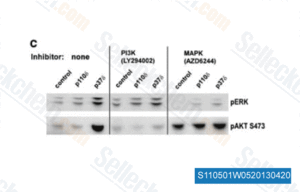
-
Daten von [ Oncogene , 2012 , 31, 3277–3286 ]
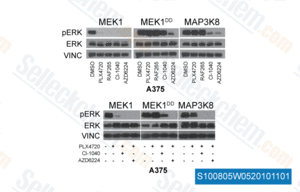
-
Daten von [ Nature , 2010 , 468, 968-972 ]
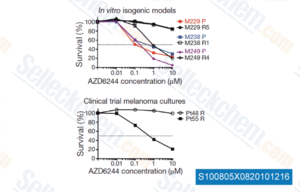
-
Daten von [ Nature , 2010 , 468, 973-977 ]
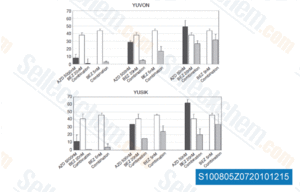
-
Daten von [ Clin Cancer Res , 2010 , 16, 6029-6039 ]
Sellecks AZD6244 (Selumetinib) Wurde zitiert von 737 Publikationen
| Spike-in enhanced phosphoproteomics uncovers synergistic signaling responses to MEK inhibition in colon cancer cells [ Nat Commun, 2025, 16(1):4884] | PubMed: 40419504 |
| A patient-derived T cell lymphoma biorepository uncovers pathogenetic mechanisms and host-related therapeutic vulnerabilities [ Cell Rep Med, 2025, S2666-3791(25)00102-8] | PubMed: 40147445 |
| GCLM lactylation mediated by ACAT2 promotes ferroptosis resistance in KRASG12D-mutant cancer [ Cell Rep, 2025, 44(6):115774] | PubMed: 40503938 |
| Targeting LINC02320 prevents colorectal cancer growth via GRB7-dependent inhibition of MAPK signaling pathway [ Cell Mol Biol Lett, 2025, 30(1):86] | PubMed: 40691533 |
| Methylstat sensitizes ovarian cancer cells to PARP-inhibition by targeting the histone demethylases JMJD1B/C [ Cancer Gene Ther, 2025, 10.1038/s41417-025-00874-z] | PubMed: 39915607 |
| Fibroblasts Attenuate Anti-Tumor Drug Efficacy in Tumor Cells via Paracrine Interactions with Tumor Cells in 3D Plexiform Neurofibroma Cultures [ Cells, 2025, 14(16)1276] | PubMed: 40862755 |
| Basroparib overcomes acquired resistance to MEK inhibitors by inhibiting Wnt-mediated cancer stemness in KRAS-mutated colorectal cancer [ Biochem Pharmacol, 2025, 235:116842] | PubMed: 40024348 |
| Molecular Evidence Supporting MEK Inhibitor Therapy in NF1 Pseudarthrosis [ J Bone Joint Surg Am, 2025, 107(10):1098-1106] | PubMed: 40168468 |
| Oncogenic KRAS Mutations Confer a Unique Mechanotransduction Response to Peristalsis in Colorectal Cancer Cells [ Mol Cancer Res, 2025, 23(2):128-142] | PubMed: 39485528 |
| Secreted Cytokines From Inflammatory Macrophages Modulate Sex Differences in Valvular Interstitial Cells on Hydrogel Biomaterials [ J Biomed Mater Res A, 2025, 113(3):e37885] | PubMed: 39995146 |
RÜCKGABERICHTLINIE
Die bedingungslose Rückgaberichtlinie von Selleck Chemical gewährleistet unseren Kunden ein reibungsloses Online-Einkaufserlebnis. Wenn Sie in irgendeiner Weise mit Ihrem Kauf unzufrieden sind, können Sie jeden Artikel innerhalb von 7 Tagen nach Erhalt zurückgeben. Im Falle von Produktqualitätsproblemen, sei es protokollbezogene oder produktbezogene Probleme, können Sie jeden Artikel innerhalb von 365 Tagen ab dem ursprünglichen Kaufdatum zurückgeben. Bitte befolgen Sie die nachstehenden Anweisungen, wenn Sie Produkte zurücksenden.
VERSAND UND LAGERUNG
Selleck-Produkte werden bei Raumtemperatur transportiert. Wenn Sie das Produkt bei Raumtemperatur erhalten, seien Sie versichert, dass die Qualitätskontrollabteilung von Selleck Experimente durchgeführt hat, um zu überprüfen, dass die normale Temperaturplatzierung von einem Monat die biologische Aktivität von Pulverprodukten nicht beeinträchtigt. Nach dem Sammeln lagern Sie das Produkt bitte gemäß den in der Datenblatt beschriebenen Anforderungen. Die meisten Selleck-Produkte sind unter den empfohlenen Bedingungen stabil.
NICHT FÜR DIE ANWENDUNG AM MENSCHEN, FÜR VETERINÄRMEDIZINISCHE DIAGNOSTIK ODER THERAPEUTISCHE ZWECKE.