
Technische Daten
| Formel | C29H27F5N2O5S |
||||||
| Molekulargewicht | 610.59 | CAS-Nr. | 1456632-40-8 | ||||
| Löslichkeit (25°C)* | In vitro | DMSO | 100 mg/mL (163.77 mM) | ||||
| Ethanol | 50 mg/mL (81.88 mM) | ||||||
| Water | Insoluble | ||||||
| In vivo (Lösungsmittel einzeln und der Reihe nach zum Produkt hinzufügen.) |
|
||||||
|
* <1 mg/ml bedeutet schwer löslich oder unlöslich. * Bitte beachten Sie, dass Selleck die Löslichkeit aller Verbindungen intern testet und die tatsächliche Löslichkeit geringfügig von veröffentlichten Werten abweichen kann. Dies ist normal und ist auf geringfügige Batch-zu-Batch-Variationen zurückzuführen. * Versand bei Raumtemperatur (Stabilitätstests zeigen, dass dieses Produkt ohne Kühlmaßnahmen versendet werden kann.) |
|||||||
Vorbereitung von Stammlösungen
Biologische Aktivität
| Beschreibung | SH-4-54 ist ein potenter STAT-Inhibitor mit einem KD von 300 nM bzw. 464 nM für STAT3 und STAT5. | ||||
|---|---|---|---|---|---|
| Ziele |
|
||||
| In vitro | SH-4-54 zeigt eine beispiellose Zytotoxizität in menschlichen Glioblastom-Hirnkrebs-Stammzellen (BTSCs), während es keine Toxizität in menschlichen fötalen Astrozyten aufweist. Darüber hinaus unterdrückt diese Verbindung effektiv die STAT3-Phosphorylierung und ihre nachgeschalteten transkriptionellen Ziele. | ||||
| In vivo | Bei Mäusen, die orthotop mit BT73 xenotransplantiert wurden, zeigt SH-4-54 (10 mg/kg i.p.) BBB-Permeabilität, unterdrückt potent das Wachstum von Gliom-Tumoren und hemmt pSTAT3. |
Protokoll (aus Referenz)
| Kinase-Assay: |
|
|---|---|
| Zell-Assay: |
|
| Tierstudie: |
|
Referenzen
|
Kundenproduktvalidierung
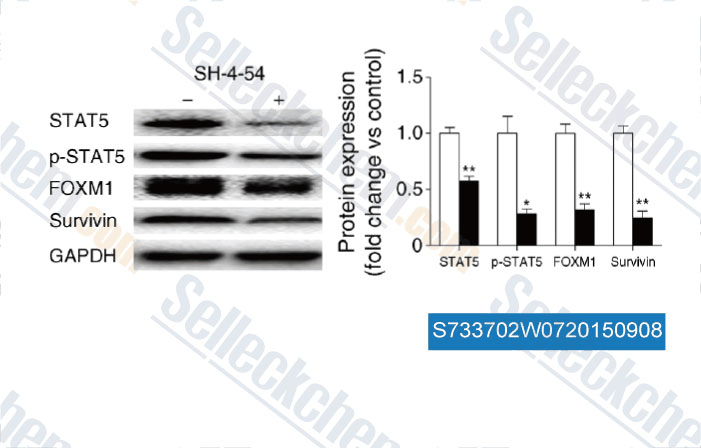
-
Daten von [ , , Diabetologia, 2015, 58: 2064–2073 ]
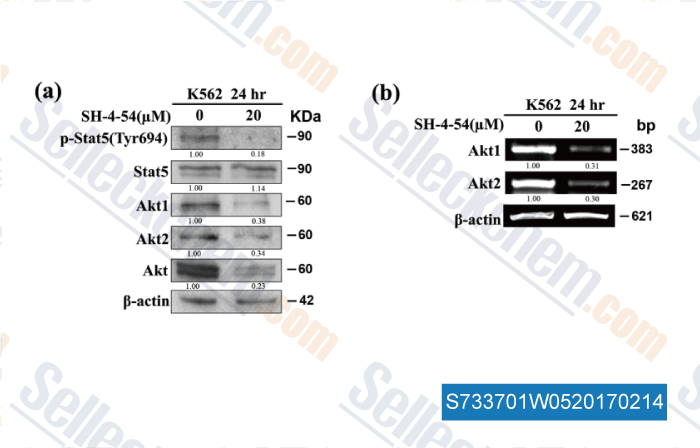
-
Daten von [ , , Sci Rep, 2016, 6:33358. ]
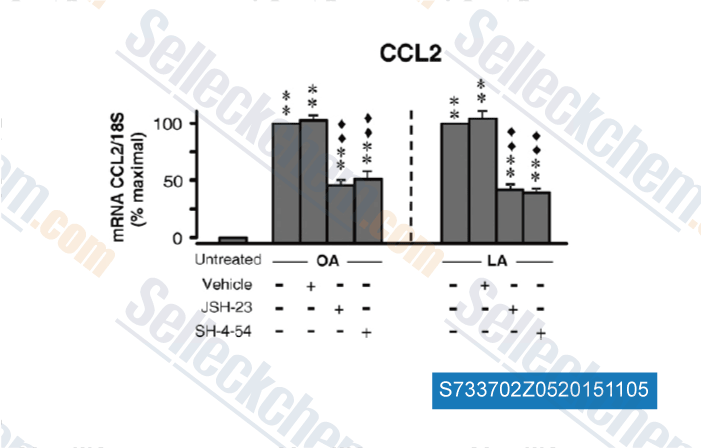
-
Daten von [ , , Biochim Biophys Acta, 2015, 1852(12):2671-7 ]
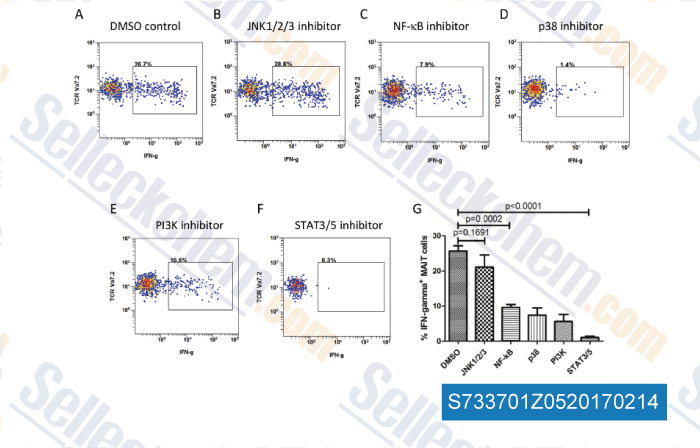
-
Daten von [ , , J Infect, 2016, 72(3):338-52. ]
Sellecks SH-4-54 Wurde zitiert von 66 Publikationen
| Targeting synergetic endothelial inflammation by inhibiting NFKB and JAK-STAT pathways [ iScience, 2025, 28(9):113307] | PubMed: 40894883 |
| BTLA contributes to acute-on-chronic liver failure infection and mortality through CD4+ T-cell exhaustion [ Nat Commun, 2024, 15(1):1835] | PubMed: 38418488 |
| Blocking the MIR155HG/miR-155 axis reduces CTGF-induced inflammatory cytokine production and α-SMA expression via upregulating AZGP1 in hypertrophic scar fibroblasts [ Cell Signal, 2024, S0898-6568(24)00170-0] | PubMed: 38729323 |
| The Aconitate Decarboxylase 1/Itaconate Pathway Modulates Immune Dysregulation and Associates with Cardiovascular Disease Markers and Disease Activity in Systemic Lupus Erythematosus [ J Immunol, 2024, 213(4):419-434] | PubMed: 38949522 |
| JAK3/STAT5 signaling-triggered upregulation of PIK3CD contributes to gastric carcinoma development [ J Cell Commun Signal, 2024, 18(1):e12017] | PubMed: 38545256 |
| GM-CSF engages multiple signaling pathways to enhance pro-inflammatory cytokine responses in human monocytes during Legionella infection [ bioRxiv, 2024, 2024.12.05.627084] | PubMed: 39713445 |
| JAK-STAT Signaling in Inflammatory Breast Cancer Enables Chemotherapy-Resistant Cell States [ Cancer Res, 2023, 83(2):264-284] | PubMed: 36409824 |
| Homeostatic cytokines reciprocally modulate the emergence of prenatal effector PLZF+CD4+ T cells in humans [ JCI Insight, 2023, 8(22)e164672] | PubMed: 37856221 |
| CRISPR/Cas9-engineering of HMC-1.2 cells renders a human mast cell line with a single D816V-KIT mutation: An improved preclinical model for research on mastocytosis [ Front Immunol, 2023, 14:1078958] | PubMed: 37025992 |
| Single-cell transcriptome profiling of the immune space-time landscape reveals dendritic cell regulatory program in polymicrobial sepsis [ Theranostics, 2022, 12(10):4606-4628] | PubMed: 35832091 |
RÜCKGABERICHTLINIE
Die bedingungslose Rückgaberichtlinie von Selleck Chemical gewährleistet unseren Kunden ein reibungsloses Online-Einkaufserlebnis. Wenn Sie in irgendeiner Weise mit Ihrem Kauf unzufrieden sind, können Sie jeden Artikel innerhalb von 7 Tagen nach Erhalt zurückgeben. Im Falle von Produktqualitätsproblemen, sei es protokollbezogene oder produktbezogene Probleme, können Sie jeden Artikel innerhalb von 365 Tagen ab dem ursprünglichen Kaufdatum zurückgeben. Bitte befolgen Sie die nachstehenden Anweisungen, wenn Sie Produkte zurücksenden.
VERSAND UND LAGERUNG
Selleck-Produkte werden bei Raumtemperatur transportiert. Wenn Sie das Produkt bei Raumtemperatur erhalten, seien Sie versichert, dass die Qualitätskontrollabteilung von Selleck Experimente durchgeführt hat, um zu überprüfen, dass die normale Temperaturplatzierung von einem Monat die biologische Aktivität von Pulverprodukten nicht beeinträchtigt. Nach dem Sammeln lagern Sie das Produkt bitte gemäß den in der Datenblatt beschriebenen Anforderungen. Die meisten Selleck-Produkte sind unter den empfohlenen Bedingungen stabil.
NICHT FÜR DIE ANWENDUNG AM MENSCHEN, FÜR VETERINÄRMEDIZINISCHE DIAGNOSTIK ODER THERAPEUTISCHE ZWECKE.