
Technische Daten
| Formel | C28H27N3O3.HCl |
||||||||||
| Molekulargewicht | 489.99 | CAS-Nr. | 521984-48-5 | ||||||||
| Löslichkeit (25°C)* | In vitro | DMSO | 98 mg/mL (200.0 mM) | ||||||||
| Water | Insoluble | ||||||||||
| Ethanol | Insoluble | ||||||||||
| In vivo (Lösungsmittel einzeln und der Reihe nach zum Produkt hinzufügen.) |
|
||||||||||
|
* <1 mg/ml bedeutet schwer löslich oder unlöslich. * Bitte beachten Sie, dass Selleck die Löslichkeit aller Verbindungen intern testet und die tatsächliche Löslichkeit geringfügig von veröffentlichten Werten abweichen kann. Dies ist normal und ist auf geringfügige Batch-zu-Batch-Variationen zurückzuführen. * Versand bei Raumtemperatur (Stabilitätstests zeigen, dass dieses Produkt ohne Kühlmaßnahmen versendet werden kann.) |
|||||||||||
Vorbereitung von Stammlösungen
Biologische Aktivität
| Beschreibung | SIS3, ein neuartiger spezifischer Inhibitor von Smad3, hemmt die TGF-β- und Activin-Signalübertragung durch Unterdrückung der Smad3-Phosphorylierung, ohne die MAPK/p38-, ERK- oder PI3-Kinase-Signalwege zu beeinflussen. | |
|---|---|---|
| Ziele |
|
|
| In vitro | Die Zugabe von SIS3 schwächt die Wirkungen von TGF-β1 ab, indem es die transkriptionelle Aktivität reduziert. SIS3 hemmt auch die Myofibroblastendifferenzierung von Fibroblasten durch TGF-β1. SIS3 verringert vollständig die konstitutive Phosphorylierung von Smad3 sowie die hochregulierte Typ-I-Kollagenexpression in Sklerodermie-Fibroblasten und hebt somit die ECM-Überexpression in TGF-β1-behandelten normalen dermalen Fibroblasten und Sklerodermie-Fibroblasten in vitro auf. | |
| In vivo | SIS3 hemmt die Smad3-Aktivierung bei Streptozotocin (STZ)-induzierter diabetischer Nephropathie in Tie2-Cre;Loxp-EGFP-Mäusen. Es reduziert auch AGE-induzierte EndoMT und verringert EndoMT bei STZ-induzierter diabetischer Nephropathie in Tie2-Cre;Loxp-EGFP-Mäusen. SIS3 reduziert signifikant die Kollagen-IV- und Fibronektin-Expression in den Glomeruli und dem Tubulointerstitium von STZ-injizierten Tie2-Cre;Loxp-EGFP-Mäusen, was darauf hindeutet, dass SIS3 die frühe Entwicklung der STZ-induzierten diabetischen Glomerulosklerose und tubulointerstitiellen Fibrose verzögert. Die SIS3-Verabreichung reduziert jedoch nicht die Proteinurie. |
Protokoll (aus Referenz)
| Zell-Assay: |
|
|---|---|
| Tierstudie: |
|
Referenzen
|
Kundenproduktvalidierung
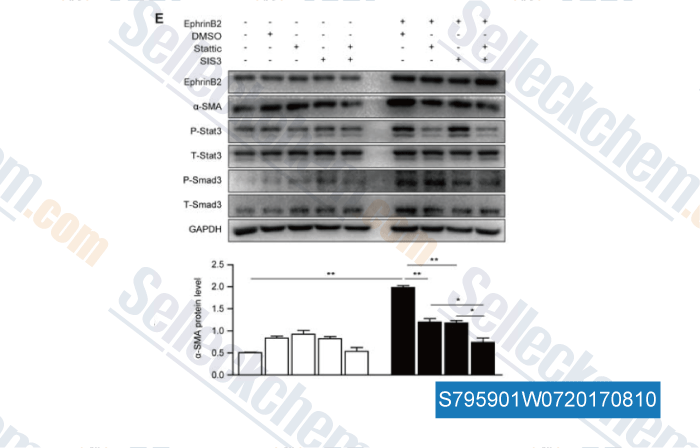
-
, , Circ Res, 2017, 121(6):617-627
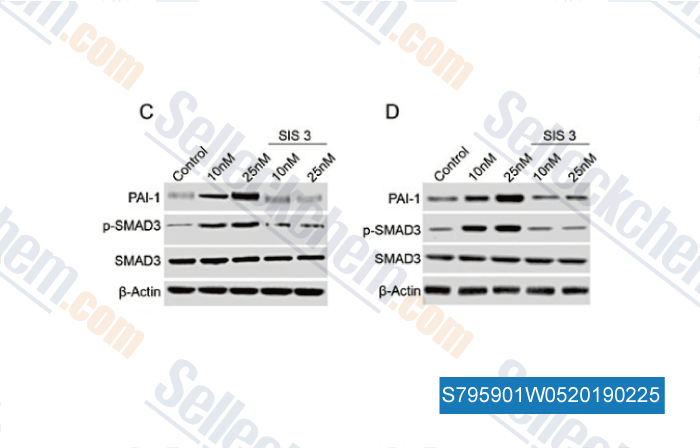
-
Daten von [ , , Cell Physiol Biochem, 2017, 44(6):2201-2211 ]
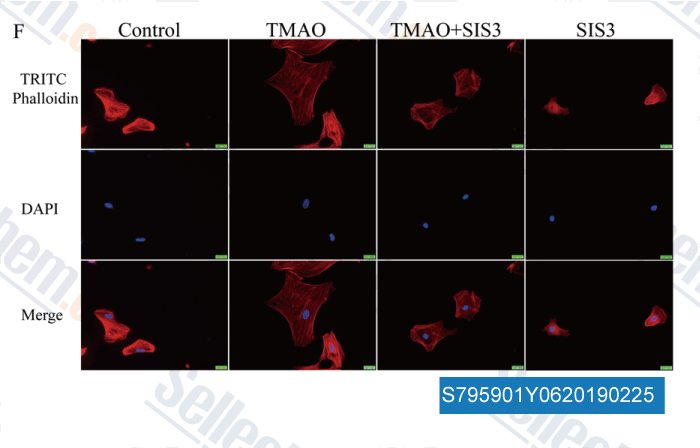
-
Daten von [ , , Lab Invest, 2018, doi: 10.1038/s41374-018-0091-y ]
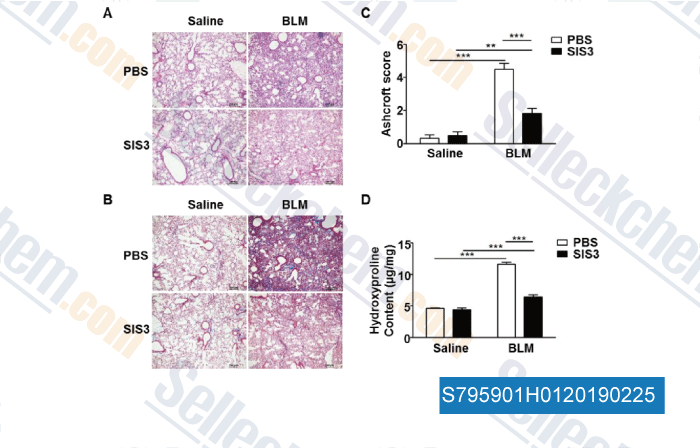
-
Daten von [ , , Biochem Biophys Res Commun, 2018, 503(2):757-762 ]
Sellecks SIS3 Hydrochloride Wurde zitiert von 87 Publikationen
| Smad3 Mediates Renal Fibrosis via GPX4-Dependent Ferroptosis [ Int J Biol Sci, 2025, 21(13):5922-5935] | PubMed: 41079940 |
| Elevated TGF-β1 impairs synaptic and cognitive function through activation of Smad2/3-Sp1 pathway in AngII-related hypertension [ EMBO Rep, 2025, 26(12):3162-3186] | PubMed: 40425782 |
| KLHL25-ACLY module functions as a switch in the fate determination of the differentiation of iTreg/Th17 [ Commun Biol, 2025, 8(1):471] | PubMed: 40119138 |
| Inhibition of XPO1 by selinexor enhances terminal erythroid maturation through modulation of HSP70 trafficking in severe β0-thalassemia/HbE [ PLoS One, 2025, 20(9):e0333127] | PubMed: 40997022 |
| UBR5 mediates colorectal cancer chemoresistance by attenuating ferroptosis via Lys 11 ubiquitin-dependent stabilization of Smad3-SLC7A11 signaling [ Redox Biol, 2024, 76:103349] | PubMed: 39260061 |
| Vulnerability to APOBEC3G linked to the pathogenicity of deltaretroviruses [ Proc Natl Acad Sci U S A, 2024, 121(13):e2309925121] | PubMed: 38502701 |
| Therapeutic targeting of PLK1 in TERT promoter-mutant hepatocellular carcinoma [ Clin Transl Med, 2024, 14(5):e1703] | PubMed: 38769666 |
| Treatment for type 2 diabetes and diabetic nephropathy by targeting Smad3 signaling [ Int J Biol Sci, 2024, 20(1):200-217] | PubMed: 38164169 |
| Sleeve gastrectomy links the attenuation of diabetic kidney disease to the inhibition of renal tubular ferroptosis through down-regulating TGF-β1/Smad3 signaling pathway [ J Endocrinol Invest, 2024, 10.1007/s40618-023-02267-1] | PubMed: 38512446 |
| Smad3 is essential for polarization of tumor-associated neutrophils in non-small cell lung carcinoma [ Nature Communications-, 2023, 1794-2023)] | PubMed: None |
RÜCKGABERICHTLINIE
Die bedingungslose Rückgaberichtlinie von Selleck Chemical gewährleistet unseren Kunden ein reibungsloses Online-Einkaufserlebnis. Wenn Sie in irgendeiner Weise mit Ihrem Kauf unzufrieden sind, können Sie jeden Artikel innerhalb von 7 Tagen nach Erhalt zurückgeben. Im Falle von Produktqualitätsproblemen, sei es protokollbezogene oder produktbezogene Probleme, können Sie jeden Artikel innerhalb von 365 Tagen ab dem ursprünglichen Kaufdatum zurückgeben. Bitte befolgen Sie die nachstehenden Anweisungen, wenn Sie Produkte zurücksenden.
VERSAND UND LAGERUNG
Selleck-Produkte werden bei Raumtemperatur transportiert. Wenn Sie das Produkt bei Raumtemperatur erhalten, seien Sie versichert, dass die Qualitätskontrollabteilung von Selleck Experimente durchgeführt hat, um zu überprüfen, dass die normale Temperaturplatzierung von einem Monat die biologische Aktivität von Pulverprodukten nicht beeinträchtigt. Nach dem Sammeln lagern Sie das Produkt bitte gemäß den in der Datenblatt beschriebenen Anforderungen. Die meisten Selleck-Produkte sind unter den empfohlenen Bedingungen stabil.
NICHT FÜR DIE ANWENDUNG AM MENSCHEN, FÜR VETERINÄRMEDIZINISCHE DIAGNOSTIK ODER THERAPEUTISCHE ZWECKE.