
Technische Daten
| Formel | C15H11ClN2OS |
||||||
| Molekulargewicht | 302.78 | CAS-Nr. | 312636-16-1 | ||||
| Löslichkeit (25°C)* | In vitro | DMSO | 61 mg/mL (201.46 mM) | ||||
| Ethanol | 61 mg/mL (201.46 mM) | ||||||
| Water | Insoluble | ||||||
| In vivo (Lösungsmittel einzeln und der Reihe nach zum Produkt hinzufügen.) |
|
||||||
|
* <1 mg/ml bedeutet schwer löslich oder unlöslich. * Bitte beachten Sie, dass Selleck die Löslichkeit aller Verbindungen intern testet und die tatsächliche Löslichkeit geringfügig von veröffentlichten Werten abweichen kann. Dies ist normal und ist auf geringfügige Batch-zu-Batch-Variationen zurückzuführen. * Versand bei Raumtemperatur (Stabilitätstests zeigen, dass dieses Produkt ohne Kühlmaßnahmen versendet werden kann.) |
|||||||
Vorbereitung von Stammlösungen
Biologische Aktivität
| Beschreibung | SKI II (SphK-I2) ist ein hochselektiver und nicht ATP-kompetitiver Sphingosinkinase (SphK)-Inhibitor mit einer IC50 von 0,5 μM, während diese Verbindung keine hemmende Wirkung auf andere Kinasen, einschließlich PI3K, PKCα und ERK2, zeigt. | ||
|---|---|---|---|
| Ziele |
|
||
| In vitro | SKI II hemmt potent endogene SK-Aktivitäten in der Brustkrebszelllinie MDA-MB-231. Diese Verbindung zeigt signifikant antiproliferative Effekte in menschlichen Krebszelllinien, einschließlich T-24, MCF-7, MCF-7/VP, NCI/ADR mit einer IC50 von 4,6 μM, 1,2 μM, 0,9 μM bzw. 1,3 μM. Es induziert auch die Apoptose von T24-Zellen, was mit der hypothetischen Konsequenz der Reduzierung der S1P-Spiegel übereinstimmt. Wie zuvor in MDA-MB-231-Zellen gezeigt, verringert diese Chemikalie die S1P-Bildung in JC-Zellen in einer konzentrationsabhängigen Weise mit einer IC50 von 12 μM. |
||
| In vivo | SKI II (50 mg/kg) reduziert nach intraperitonealer oder oraler Verabreichung signifikant das Tumorwachstum in einem syngenen Balb/c-Maus-Solidtumormodell, das JC-Mammakarzinomzellen verwendet, im Vergleich zu Kontrollgruppen ohne offensichtliche Toxizität oder Gewichtsverlust. Diese Verbindung (50 mg/kg ip) verbessert die Antigen-induzierte bronchiale glatte Muskelhyperreaktivität bei Mäusen durch endogene Hemmung der S1P-Generierung. |
Protokoll (aus Referenz)
| Kinase-Assay: |
|
|---|---|
| Zell-Assay: |
|
| Tierstudie: |
|
Referenzen
|
Kundenproduktvalidierung
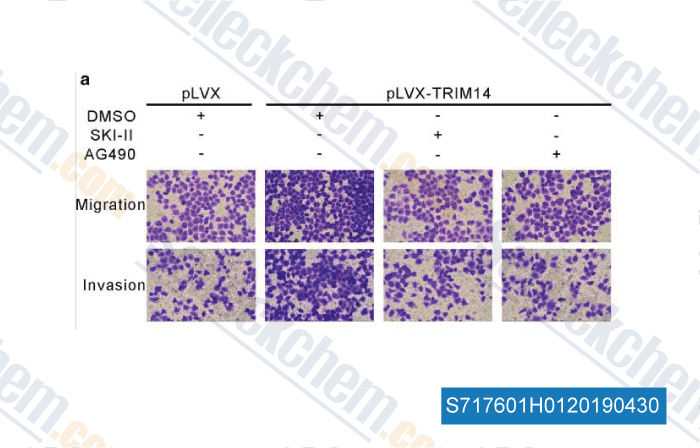
-
Daten von [ , , Cancer Cell Int, 2018, 18:202 ]
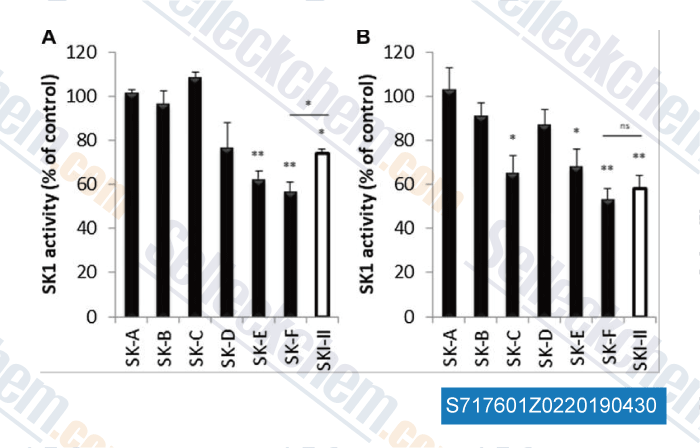
-
Daten von [ , , Breast Cancer Res Treat, 2018, 172(1):33-43 ]
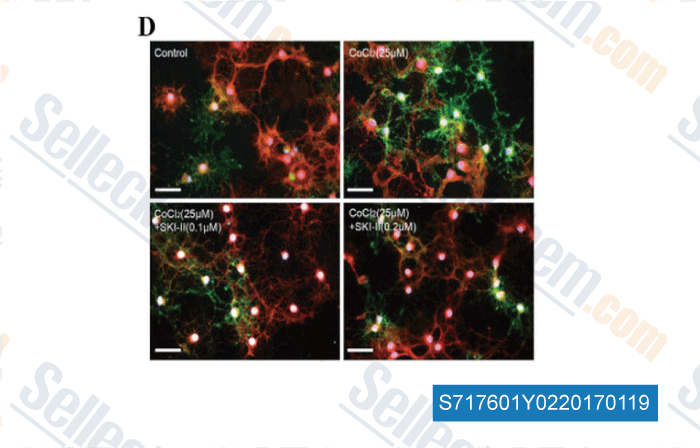
-
Daten von [ , , Neurochemistry International, 2016, 94: 90-97. ]
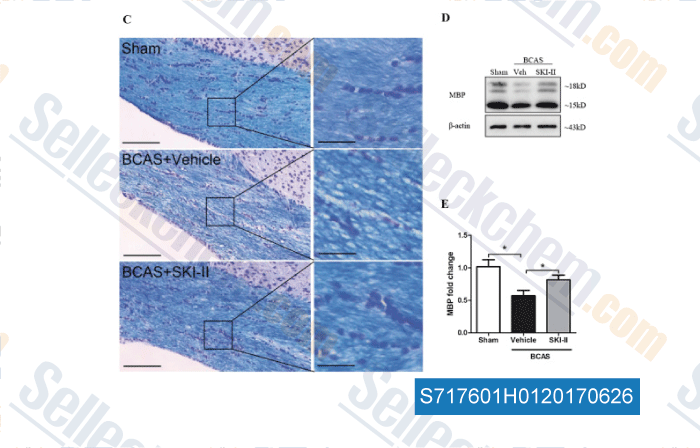
-
Daten von [ , , Neurochem Int, 2016, 94:90-7 ]
Sellecks SKI II Wurde zitiert von 17 Publikationen
| Extracellular vesicles isolated from SphK1 inhibitor SKI II-medium restrain the migration of colorectal cancer [ Transl Cancer Res, 2025, 14(5):2594-2602] | PubMed: 40530117 |
| The central role of Sphingosine kinase 1 in the development of neuroendocrine prostate cancer (NEPC): A new targeted therapy of NEPC [ Clin Transl Med, 2022, 12(2):e695] | PubMed: 35184376 |
| The sphingosine kinase inhibitor SKI-V suppresses cervical cancer cell growth [ Int J Biol Sci, 2022, 18(7):2994-3005] | PubMed: 35541904 |
| The anti-osteosarcoma cell activity by the sphingosine kinase 1 inhibitor SKI-V [ Cell Death Discov, 2022, 8(1):48] | PubMed: 35115496 |
| Proteomic-Based Approach Reveals the Involvement of Apolipoprotein A-I in Related Phenotypes of Autism Spectrum Disorder in the BTBR Mouse Model [ Int J Mol Sci, 2022, 23(23)15290] | PubMed: 36499620 |
| MAPK activity dynamics regulate non-cell autonomous effects of oncogene expression [ Elife, 2020, 9e60541] | PubMed: 32940599 |
| Follicle-stimulating hormone promotes the proliferation of epithelial ovarian cancer cells by activating sphingosine kinase [ Sci Rep, 2020, 10(1):13834] | PubMed: 32796926 |
| The Intra-nuclear SphK2-S1P Axis Facilitates M1-to-M2 Shift of Microglia via Suppressing HDAC1-Mediated KLF4 Deacetylation. [ Front Immunol, 2019, 10:1241] | PubMed: 31214192 |
| Acid ceramidase promotes drug resistance in acute myeloid leukemia through NF-κB-dependent P-glycoprotein upregulation. [ J Lipid Res, 2019, 60(6):1078-1086] | PubMed: 30962310 |
| TRIM14 promotes colorectal cancer cell migration and invasion through the SPHK1/STAT3 pathway [Jin Z Cancer Cell Int, 2018, 18:202] | PubMed: 30555277 |
RÜCKGABERICHTLINIE
Die bedingungslose Rückgaberichtlinie von Selleck Chemical gewährleistet unseren Kunden ein reibungsloses Online-Einkaufserlebnis. Wenn Sie in irgendeiner Weise mit Ihrem Kauf unzufrieden sind, können Sie jeden Artikel innerhalb von 7 Tagen nach Erhalt zurückgeben. Im Falle von Produktqualitätsproblemen, sei es protokollbezogene oder produktbezogene Probleme, können Sie jeden Artikel innerhalb von 365 Tagen ab dem ursprünglichen Kaufdatum zurückgeben. Bitte befolgen Sie die nachstehenden Anweisungen, wenn Sie Produkte zurücksenden.
VERSAND UND LAGERUNG
Selleck-Produkte werden bei Raumtemperatur transportiert. Wenn Sie das Produkt bei Raumtemperatur erhalten, seien Sie versichert, dass die Qualitätskontrollabteilung von Selleck Experimente durchgeführt hat, um zu überprüfen, dass die normale Temperaturplatzierung von einem Monat die biologische Aktivität von Pulverprodukten nicht beeinträchtigt. Nach dem Sammeln lagern Sie das Produkt bitte gemäß den in der Datenblatt beschriebenen Anforderungen. Die meisten Selleck-Produkte sind unter den empfohlenen Bedingungen stabil.
NICHT FÜR DIE ANWENDUNG AM MENSCHEN, FÜR VETERINÄRMEDIZINISCHE DIAGNOSTIK ODER THERAPEUTISCHE ZWECKE.