
Technische Daten
| Formel | C22H20N2O5 |
||||||||||
| Molekulargewicht | 392.4 | CAS-Nr. | 86639-52-3 | ||||||||
| Löslichkeit (25°C)* | In vitro | DMSO | 20 mg/mL (50.96 mM) | ||||||||
| Water | Insoluble | ||||||||||
| Ethanol | Insoluble | ||||||||||
| In vivo (Lösungsmittel einzeln und der Reihe nach zum Produkt hinzufügen.) |
|
||||||||||
|
* <1 mg/ml bedeutet schwer löslich oder unlöslich. * Bitte beachten Sie, dass Selleck die Löslichkeit aller Verbindungen intern testet und die tatsächliche Löslichkeit geringfügig von veröffentlichten Werten abweichen kann. Dies ist normal und ist auf geringfügige Batch-zu-Batch-Variationen zurückzuführen. * Versand bei Raumtemperatur (Stabilitätstests zeigen, dass dieses Produkt ohne Kühlmaßnahmen versendet werden kann.) |
|||||||||||
Vorbereitung von Stammlösungen
Biologische Aktivität
| Beschreibung | SN-38 (NK012) ist ein aktiver Metabolit von CPT-11, hemmt die DNA-Topoisomerase I, die DNA-Synthese und verursacht häufig Einzelstrangbrüche der DNA. SN-38 induziert Autophagie. | |
|---|---|---|
| Ziele |
|
|
| In vitro | SN-38, ein biologisch aktiver Metabolit von CPT-11. Diese Verbindung verursacht die stärkste Hemmung der DNA topoisomerase I, gefolgt von CPT und dann CPT-11. CPT-11 verschiebt die Position der entspannten DNA dosisabhängig in Richtung der geschnittenen DNA, aber diese Verbindung und CPT zeigen keinen Effekt auf die Position der entspannten DNA. Sie hemmt die DNA-Synthese dosis- und zeitabhängig. Die jeweiligen IC50-Werte dieser Chemikalie in der DNA-Synthese betragen 0,077 µM. Die hemmende Wirkung auf die RNA-Synthese ist geringer als die auf die DNA-Synthese und sie hemmt die Proteinsynthese nicht. Dieser Metabolit verursachte häufig Einzelstrangbrüche der DNA in P388-Zellen. |
|
| In vivo | Nach oraler Verabreichung treten Spitzenkonzentrationen dieser Verbindung innerhalb von 1 Stunde auf, und der prozentuale Anteil des ungebundenen Lactons im murinen Plasma bei 1000 ng/mL beträgt 3,4 +/- 0,67 %, während bei 100 ng/mL der prozentuale Anteil des ungebundenen Lactons 1,18 +/- 0,14 % beträgt. Die Laktone-AUCs bei Mäusen mit humanen Neuroblastom-Xenotransplantaten sind größer als bei Tieren ohne Tumor. |
Protokoll (aus Referenz)
| Kinase-Assay: |
|
|---|---|
| Zell-Assay: |
|
| Tierstudie: |
|
Referenzen
|
Kundenproduktvalidierung
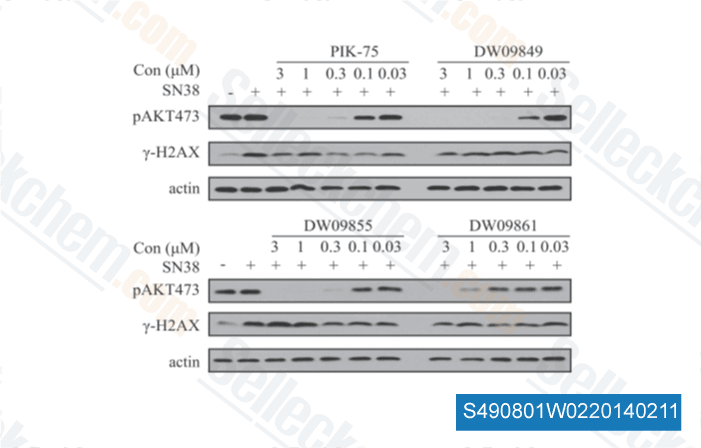
-
Daten von [ J Pharmacol Exp Ther , 2014 , 348(3), 432-41 ]
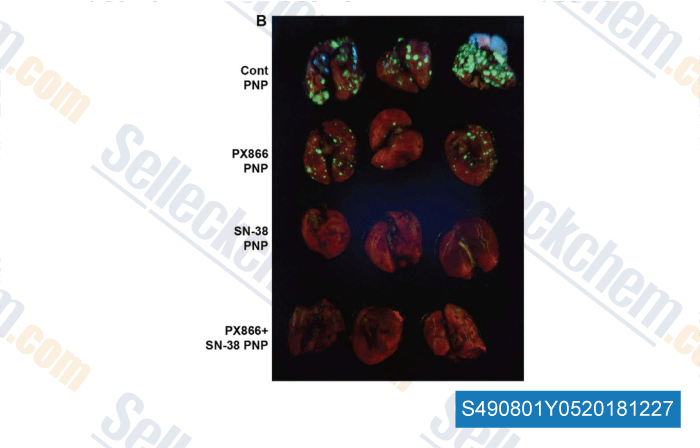
-
Daten von [ , , J Control Release, 2018, 275:85-91 ]
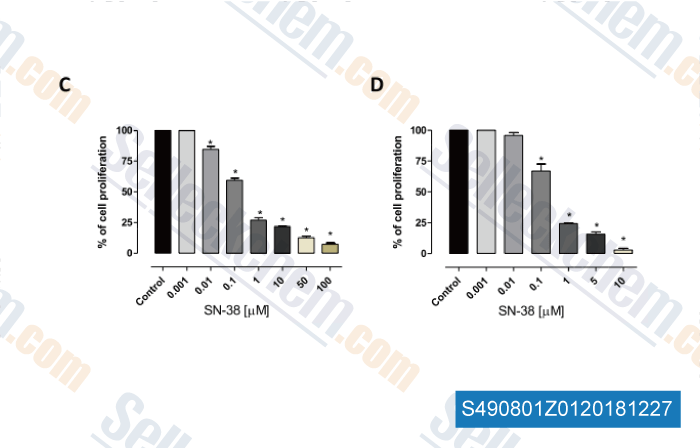
-
Daten von [ , , Cancer Lett, 2017, 411:35-43 ]
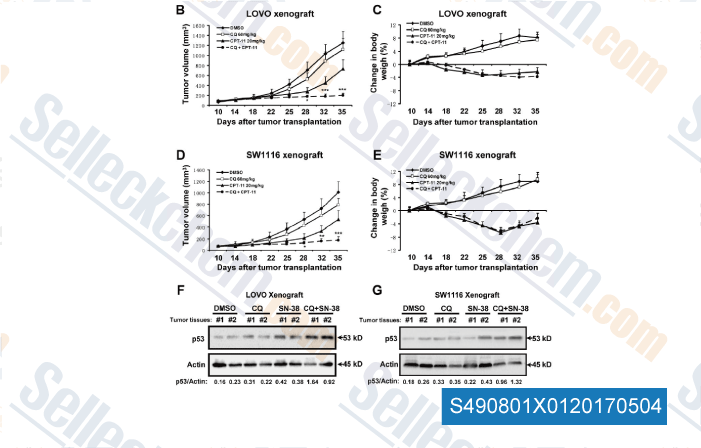
-
Daten von [ , , Free Radic Biol Med, 2017, 104:280-297 ]
Sellecks SN-38 Wurde zitiert von 100 Publikationen
| Activation of lysosomal iron triggers ferroptosis in cancer [ Nature, 2025, 10.1038/s41586-025-08974-4] | PubMed: 40335696 |
| Cisplatin and temozolomide combinatorial treatment triggers hypermutability and immune surveillance in experimental cancer models [ Cancer Cell, 2025, S1535-6108(25)00223-5] | PubMed: 40513578 |
| KEAP1 and STK11/LKB1 alterations enhance vulnerability to ATR inhibition in KRAS mutant non-small cell lung cancer [ Cancer Cell, 2025, 43(8):1530-1548.e9] | PubMed: 40645185 |
| The molecular and functional landscape of resistance to FOLFIRI chemotherapy in metastatic colorectal cancer [ Cancer Discov, 2025, 10.1158/2159-8290.CD-24-0556] | PubMed: 40981426 |
| A patient-derived T cell lymphoma biorepository uncovers pathogenetic mechanisms and host-related therapeutic vulnerabilities [ Cell Rep Med, 2025, S2666-3791(25)00102-8] | PubMed: 40147445 |
| AREG and EREG Are Predictive Biomarkers of Response to EGFR Inhibition in Gastroesophageal Cancer [ Cancer Res, 2025, 85(16):3111-3122] | PubMed: 40637454 |
| Synthesis of carbon dots from spent coffee grounds: transforming waste into potential biomedical tools [ Nanoscale, 2025, 17(16):9947-9962] | PubMed: 40067158 |
| Targeted Inhibition of CHD1L by OTI-611 Reprograms Chemotherapy and Targeted Therapy-Induced Cell Cycle Arrest and Suppresses Proliferation to Produce Synergistic Antitumor Effects in Breast and Colorectal Cancer [ Cells, 2025, 14(5)318] | PubMed: 40072047 |
| ATR Inhibition Synergizes With Alkylating PI Polyamide Targeting MYCN by Suppressing DNA Repair in MYCN-Amplified Neuroblastoma [ Cancer Sci, 2025, 10.1111/cas.70043] | PubMed: 40052411 |
| PD-L1-Targeting Nanoparticles for the Treatment of Triple-Negative Breast Cancer: A Preclinical Model [ Int J Mol Sci, 2025, 26(7)3295] | PubMed: 40244130 |
RÜCKGABERICHTLINIE
Die bedingungslose Rückgaberichtlinie von Selleck Chemical gewährleistet unseren Kunden ein reibungsloses Online-Einkaufserlebnis. Wenn Sie in irgendeiner Weise mit Ihrem Kauf unzufrieden sind, können Sie jeden Artikel innerhalb von 7 Tagen nach Erhalt zurückgeben. Im Falle von Produktqualitätsproblemen, sei es protokollbezogene oder produktbezogene Probleme, können Sie jeden Artikel innerhalb von 365 Tagen ab dem ursprünglichen Kaufdatum zurückgeben. Bitte befolgen Sie die nachstehenden Anweisungen, wenn Sie Produkte zurücksenden.
VERSAND UND LAGERUNG
Selleck-Produkte werden bei Raumtemperatur transportiert. Wenn Sie das Produkt bei Raumtemperatur erhalten, seien Sie versichert, dass die Qualitätskontrollabteilung von Selleck Experimente durchgeführt hat, um zu überprüfen, dass die normale Temperaturplatzierung von einem Monat die biologische Aktivität von Pulverprodukten nicht beeinträchtigt. Nach dem Sammeln lagern Sie das Produkt bitte gemäß den in der Datenblatt beschriebenen Anforderungen. Die meisten Selleck-Produkte sind unter den empfohlenen Bedingungen stabil.
NICHT FÜR DIE ANWENDUNG AM MENSCHEN, FÜR VETERINÄRMEDIZINISCHE DIAGNOSTIK ODER THERAPEUTISCHE ZWECKE.