
Technische Daten
| Formel | C18H15N2O4.Na |
||||||||||||||
| Molekulargewicht | 346.31 | CAS-Nr. | 848318-25-2 | ||||||||||||
| Löslichkeit (25°C)* | In vitro | DMSO | 69 mg/mL (199.24 mM) | ||||||||||||
| Water | 1 mg/mL (2.88 mM) | ||||||||||||||
| Ethanol | Insoluble | ||||||||||||||
| In vivo (Lösungsmittel einzeln und der Reihe nach zum Produkt hinzufügen.) |
|
||||||||||||||
|
* <1 mg/ml bedeutet schwer löslich oder unlöslich. * Bitte beachten Sie, dass Selleck die Löslichkeit aller Verbindungen intern testet und die tatsächliche Löslichkeit geringfügig von veröffentlichten Werten abweichen kann. Dies ist normal und ist auf geringfügige Batch-zu-Batch-Variationen zurückzuführen. * Versand bei Raumtemperatur (Stabilitätstests zeigen, dass dieses Produkt ohne Kühlmaßnahmen versendet werden kann.) |
|||||||||||||||
Vorbereitung von Stammlösungen
Biologische Aktivität
| Beschreibung | SSR128129E ist ein oral aktiver und allosterischer FGFR1-Inhibitor mit einer IC50 von 1,9 μM, der andere verwandte RTKs nicht beeinflusst. | ||
|---|---|---|---|
| Ziele |
|
||
| In vitro | SSR128129E zeigt aufgrund seines allosterischen Mechanismus eine effektivere Aktivität im Zelltest. Diese Verbindung hemmt dosisabhängig die FGF2-induzierte EC-Proliferation und -Migration mit einer IC50 von 31 nM bzw. 15,2 nM. Als Multi-FGFR-Inhibitor hemmt es die durch FGFR1-4 vermittelten Reaktionen und führt so zur Blockade der Proliferation und/oder Migration in verschiedenen Zelllinien, einschließlich mPanc02, HEK-hFGFR2WT, PAE-hFGFR1, hB9-Myelom und HUVEC. | ||
| In vivo | Bei Arthritismäusen hemmt SSR128129E (30 mg/kg, p.o.) Angiogenesis, Entzündungen und Knochenresorption und reduziert die Schwere der klinischen Symptome. Bei Mäusen mit verschiedenen Tumormodellen hemmt diese Verbindung (30 mg/kg, p.o.) sowohl das Wachstum von Primärtumoren als auch die Metastasierung. Darüber hinaus hemmt sie das Wachstum von anti-VEGFR2-refraktären und -sensitiven Tumormodellen und verstärkt die Antitumoraktivität von anti-VEGFR2. Diese Chemikalie hemmt auch Arteriosklerose in einem Maus-Venenpfropfmodell und Atherosklerose bei Apolipoprotein-E-defizienten Mäusen. |
Protokoll (aus Referenz)
| Kinase-Assay: |
|
|---|---|
| Zell-Assay: |
|
| Tierstudie: |
|
Referenzen
|
Kundenproduktvalidierung
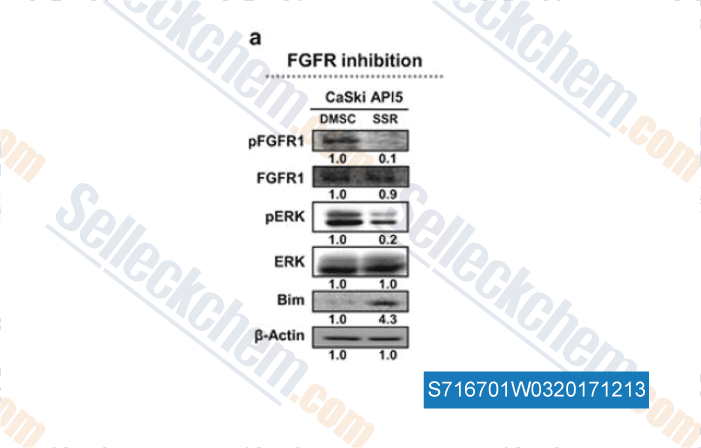
-
Daten von [ , , Exp Mol Med, 2017, 49(9):e374 ]
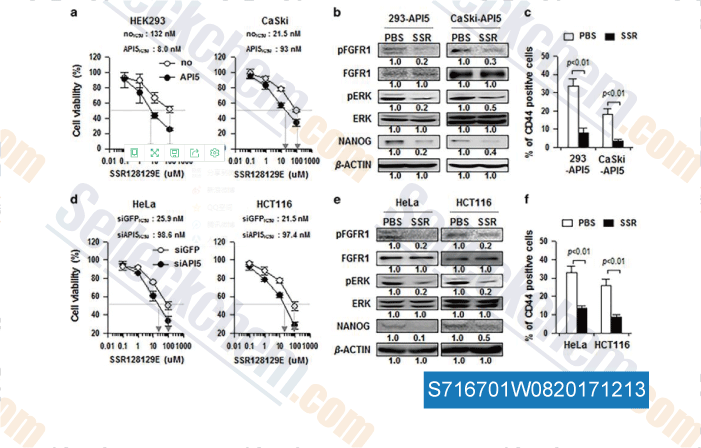
-
Daten von [ , , Oncogenesis, 2017, 6(1):e285 ]
Sellecks SSR128129E Wurde zitiert von 9 Publikationen
| FGF-2 promotes angiogenesis through a SRSF1/SRSF3/SRPK1-dependent axis that controls VEGFR1 splicing in endothelial cells [ BMC Biol, 2021, 19(1):173] | PubMed: 34433435 |
| MEKK1 Regulates Chemokine Expression in Mammary Fibroblasts: Implications for the Breast Tumor Microenvironment [ Front Oncol, 2021, 11:609918] | PubMed: 33868996 |
| Extracellular vesicles from human airway basal cells respond to cigarette smoke extract and affect vascular endothelial cells [ Sci Rep, 2021, 11(1):6104] | PubMed: 33731767 |
| Cisplatin Resistance in Osteosarcoma: In vitro Validation of Candidate DNA Repair-Related Therapeutic Targets and Drugs for Tailored Treatments. [ Front Oncol, 2020, 10;10:331] | PubMed: 32211337 |
| VEGF pathway-targeting drugs induce evasive adaptation by activation of neuropilin-1/cMet in colon cancer cells. [ Int J Oncol, 2018, 52(4):1350-1362] | PubMed: 29532881 |
| API5 induces cisplatin resistance through FGFR signaling in human cancer cells. [Jang HS, et al. Exp Mol Med, 2017, 49(9):e374] | PubMed: 28883546 |
| API5 confers cancer stem cell-like properties through the FGF2-NANOG axis. [Song KH, et al. Oncogenesis, 2017, 6(1):e285] | PubMed: 28092370 |
| Ferulic Acid Exerts Anti-Angiogenic and Anti-Tumor Activity by Targeting Fibroblast Growth Factor Receptor 1-Mediated Angiogenesis. [ Int J Mol Sci, 2015, 16(10):24011-31] | PubMed: 26473837 |
| Integration of signals along orthogonal axes of the vertebrate neural tube controls progenitor competence and increases cell diversity [ PLoS Biol, 2014, 12(7):e1001907] | PubMed: 25026549 |
RÜCKGABERICHTLINIE
Die bedingungslose Rückgaberichtlinie von Selleck Chemical gewährleistet unseren Kunden ein reibungsloses Online-Einkaufserlebnis. Wenn Sie in irgendeiner Weise mit Ihrem Kauf unzufrieden sind, können Sie jeden Artikel innerhalb von 7 Tagen nach Erhalt zurückgeben. Im Falle von Produktqualitätsproblemen, sei es protokollbezogene oder produktbezogene Probleme, können Sie jeden Artikel innerhalb von 365 Tagen ab dem ursprünglichen Kaufdatum zurückgeben. Bitte befolgen Sie die nachstehenden Anweisungen, wenn Sie Produkte zurücksenden.
VERSAND UND LAGERUNG
Selleck-Produkte werden bei Raumtemperatur transportiert. Wenn Sie das Produkt bei Raumtemperatur erhalten, seien Sie versichert, dass die Qualitätskontrollabteilung von Selleck Experimente durchgeführt hat, um zu überprüfen, dass die normale Temperaturplatzierung von einem Monat die biologische Aktivität von Pulverprodukten nicht beeinträchtigt. Nach dem Sammeln lagern Sie das Produkt bitte gemäß den in der Datenblatt beschriebenen Anforderungen. Die meisten Selleck-Produkte sind unter den empfohlenen Bedingungen stabil.
NICHT FÜR DIE ANWENDUNG AM MENSCHEN, FÜR VETERINÄRMEDIZINISCHE DIAGNOSTIK ODER THERAPEUTISCHE ZWECKE.