
Technische Daten
| Formel |
C19H14F2N6O
|
||||||
| Molekulargewicht | 380.35 | CAS-Nr. | 1207456-01-6 | ||||
| Löslichkeit (25°C)* | In vitro | DMSO | 19 mg/mL (49.95 mM) | ||||
| Water | Insoluble | ||||||
| Ethanol | Insoluble | ||||||
| In vivo (Lösungsmittel einzeln und der Reihe nach zum Produkt hinzufügen.) |
|
||||||
|
* <1 mg/ml bedeutet schwer löslich oder unlöslich. * Bitte beachten Sie, dass Selleck die Löslichkeit aller Verbindungen intern testet und die tatsächliche Löslichkeit geringfügig von veröffentlichten Werten abweichen kann. Dies ist normal und ist auf geringfügige Batch-zu-Batch-Variationen zurückzuführen. * Versand bei Raumtemperatur (Stabilitätstests zeigen, dass dieses Produkt ohne Kühlmaßnahmen versendet werden kann.) |
|||||||
Vorbereitung von Stammlösungen
Biologische Aktivität
| Beschreibung | Talazoparib (BMN 673, LT-673) ist ein neuartiger PARP-Inhibitor mit einer IC50 von 0,57 nM für PARP1 in einem zellfreien Assay. Es ist auch ein potenter Inhibitor von PARP-2, hemmt aber PARG nicht und ist hoch empfindlich gegenüber PTEN-Mutation. Phase 3. | ||
|---|---|---|---|
| Ziele |
|
||
| In vitro | BMN-673 bindet selektiv an PARP und verhindert die PARP-vermittelte DNA-Reparatur von Einzelstrang-DNA-Brüchen über den Basenexzisionsreparaturweg. Dies verstärkt die Akkumulation von DNA-Strangbrüchen, fördert genomische Instabilität und führt schließlich zur Apoptose. BMN 673 tötet selektiv Krebszellen mit BRCA-1- oder BRCA-2-Mutationen ab. BMN 673 zeigt eine Einzelwirkstoff-Zytotoxizität in BRCA-1-mutierten (MX-1, IC50 = 0,3 nM) und BRCA-2-mutierten Zellen (Capan-1, IC50 = 5 nM). Im Gegensatz dazu liegt die IC50 von BMN 673 in MRC-5 normalen menschlichen Fibroblasten und anderen Tumorzelllinien mit Wildtyp-BRCA-1- und BRCA-2-Genen zwischen 90 nM und 1,9 μM. Off-Target-Molekül-Screening identifizierte keine signifikante unspezifische Aktivität für diese Klasse von PARP-Inhibitoren. |
||
| In vivo | In pharmakokinetischen Studien an Ratten zeigt BMN 673 eine orale Bioverfügbarkeit von >50 % und pharmakokinetische Eigenschaften, die eine einmal tägliche Dosierung ermöglichen. In Studien am MX-1-Xenograft-Tumormodell verstärkt die tägliche orale Verabreichung von BMN 673 die Antitumorwirkungen zytotoxischer Therapien dosisabhängig signifikant. |
||
| Merkmale | Der bisher potenteste und selektivste PARPi. |
Protokoll (aus Referenz)
| Zell-Assay: |
|
|---|---|
| Tierstudie: |
|
Referenzen
|
Kundenproduktvalidierung
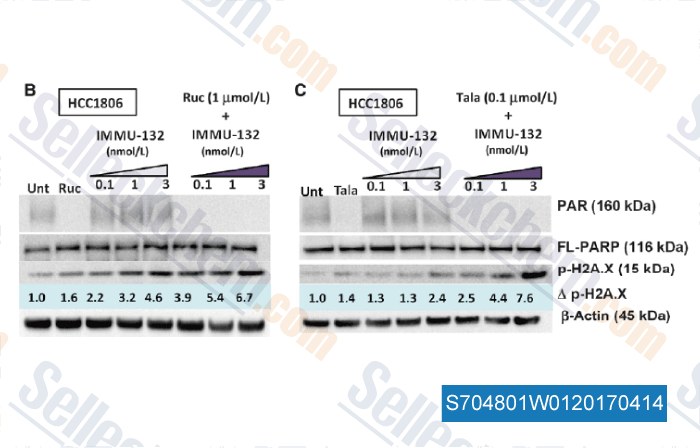
-
, , Clin Cancer Res, 2017, 23(13):3405-3415
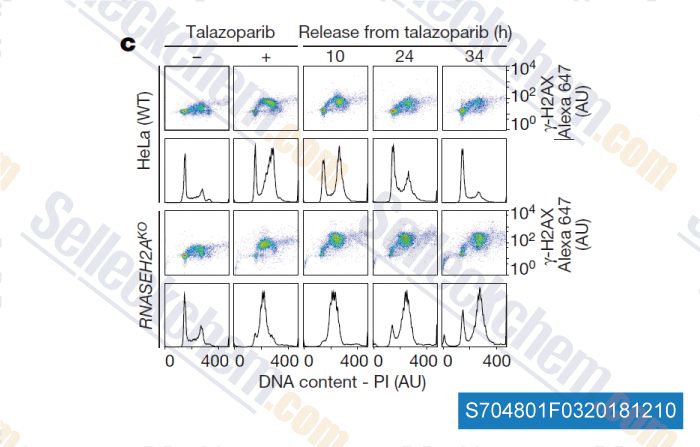
-
Daten von [ , , Nature, 2018, 559(7713):285-289 ]
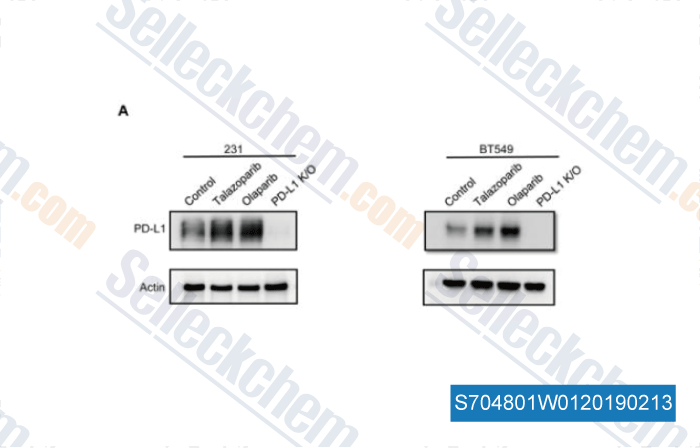
-
Daten von [ , , Clin Cancer Res, 2017, 23(14):3711-3720 ]
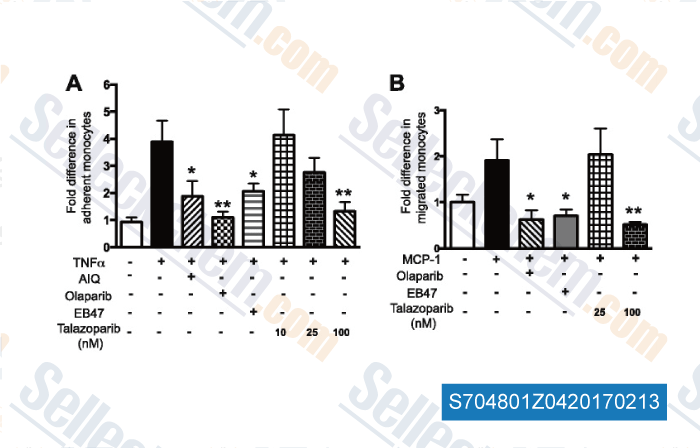
-
Daten von [ , , J Neuroinflammation, 2016, 13(1):254. ]
Sellecks BMN-673 (Talazoparib) Wurde zitiert von 282 Publikationen
| Jab1 regulates HRR mRNA stability to modulate PARP inhibitor sensitivity in triple-negative breast cancer [ Mol Cancer, 2025, 24(1):217] | PubMed: 40819058 |
| EXO1 as a therapeutic target for Fanconi Anaemia, ZRSR2 and BRCA1-A complex deficient cancers [ Nat Commun, 2025, 16(1):8476] | PubMed: 41006228 |
| Autocrine interferon poisoning mediates ADAR1-dependent synthetic lethality in BRCA1/2-mutant cancers [ Nat Commun, 2025, 16(1):6972] | PubMed: 40730818 |
| The inflammasome sensor NLRP3 interacts with REV7 to maintain genome integrity through homologous recombination [ Nucleic Acids Res, 2025, 53(12)gkaf554] | PubMed: 40613708 |
| A cancer persistent DNA repair circuit driven by MDM2, MDM4 (MDMX), and mutant p53 for recruitment of MDC1 and 53BP1 on chromatin [ Nucleic Acids Res, 2025, 53(13)gkaf627] | PubMed: 40626562 |
| Combined MEK and PARP inhibition enhances radiation response in rectal cancer [ Cell Rep Med, 2025, 6(8):102284] | PubMed: 40782795 |
| Targeting CDK12/13 Drives Mitotic Arrest to Overcome Resistance to KRASG12C Inhibitors [ Cancer Res, 2025, 10.1158/0008-5472.CAN-25-0450] | PubMed: 41165466 |
| BCL2 drives castration resistance in castration-sensitive prostate cancer by orchestrating reciprocal crosstalk between oncogenic pathways [ Cell Rep, 2025, 44(6):115779] | PubMed: 40448998 |
| PARP inhibitor-induced anti-tumour chemokine response is suppressed by dipeptidyl peptidase 4 (DPP4) in ovarian cancer [ Br J Cancer, 2025, 10.1038/s41416-025-03076-4] | PubMed: 40579444 |
| Low dose DNA methyltransferase inhibitors potentiate PARP inhibitors in homologous recombination repair deficient tumors [ Breast Cancer Res, 2025, 27(1):8] | PubMed: 39819384 |
RÜCKGABERICHTLINIE
Die bedingungslose Rückgaberichtlinie von Selleck Chemical gewährleistet unseren Kunden ein reibungsloses Online-Einkaufserlebnis. Wenn Sie in irgendeiner Weise mit Ihrem Kauf unzufrieden sind, können Sie jeden Artikel innerhalb von 7 Tagen nach Erhalt zurückgeben. Im Falle von Produktqualitätsproblemen, sei es protokollbezogene oder produktbezogene Probleme, können Sie jeden Artikel innerhalb von 365 Tagen ab dem ursprünglichen Kaufdatum zurückgeben. Bitte befolgen Sie die nachstehenden Anweisungen, wenn Sie Produkte zurücksenden.
VERSAND UND LAGERUNG
Selleck-Produkte werden bei Raumtemperatur transportiert. Wenn Sie das Produkt bei Raumtemperatur erhalten, seien Sie versichert, dass die Qualitätskontrollabteilung von Selleck Experimente durchgeführt hat, um zu überprüfen, dass die normale Temperaturplatzierung von einem Monat die biologische Aktivität von Pulverprodukten nicht beeinträchtigt. Nach dem Sammeln lagern Sie das Produkt bitte gemäß den in der Datenblatt beschriebenen Anforderungen. Die meisten Selleck-Produkte sind unter den empfohlenen Bedingungen stabil.
NICHT FÜR DIE ANWENDUNG AM MENSCHEN, FÜR VETERINÄRMEDIZINISCHE DIAGNOSTIK ODER THERAPEUTISCHE ZWECKE.