
Technische Daten
| Formel | C34H44N4O4 |
||||||
| Molekulargewicht | 572.74 | CAS-Nr. | 1403254-99-8 | ||||
| Löslichkeit (25°C)* | In vitro | DMSO | 100 mg/mL (174.59 mM) | ||||
| Water | Insoluble | ||||||
| Ethanol | Insoluble | ||||||
| In vivo (Lösungsmittel einzeln und der Reihe nach zum Produkt hinzufügen.) |
|
||||||
|
* <1 mg/ml bedeutet schwer löslich oder unlöslich. * Bitte beachten Sie, dass Selleck die Löslichkeit aller Verbindungen intern testet und die tatsächliche Löslichkeit geringfügig von veröffentlichten Werten abweichen kann. Dies ist normal und ist auf geringfügige Batch-zu-Batch-Variationen zurückzuführen. * Versand bei Raumtemperatur (Stabilitätstests zeigen, dass dieses Produkt ohne Kühlmaßnahmen versendet werden kann.) |
|||||||
Vorbereitung von Stammlösungen
Biologische Aktivität
| Beschreibung | Tazemetostat (EPZ-6438, E7438) ist ein potenter und selektiver EZH2-Inhibitor mit Ki und IC50 von 2,5 nM und 11 nM in zellfreien Assays, der eine 35-fache Selektivität gegenüber EZH1 und eine >4.500-fache Selektivität gegenüber 14 anderen HMTs aufweist. | ||
|---|---|---|---|
| Ziele |
|
||
| In vitro | Tazemetostat (EPZ-6438) reduziert konzentrationsabhängig die globalen H3K27Me3-Spiegel in Wildtyp- oder SMARCB1-Mutanten-Zellen und induziert starke antiproliferative Effekte mit IC50-Werten von 32 nM bis 1000 nM in SMARCB1-deletierten MRT-Zelllinien. Es induziert die Genexpression der neuronalen Differenzierung und der Zellzyklushemmung, während es die Expression von Hedgehog-Signalweg-Genen, MYC und EZH2 hemmt. Die antiproliferative Wirkung dieser Verbindung wird durch NSC-9900 oder Hexadecadrol in mehreren EZH2-mutierten Lymphomzelllinien verstärkt. |
||
| In vivo | In SCID-Mäusen mit s.c. G401-Xenografts induziert Tazemetostat (EPZ-6438) während der Verabreichungsperiode eine Tumorstase und führt zu einer signifikanten Verzögerung des Tumorwachstums mit minimalen Auswirkungen auf das Körpergewicht. |
||
| Merkmale | Oral bioverfügbarer EZH2-selektiver Inhibitor sowohl für Wildtyp als auch für Mutanten. Wird derzeit in klinischen Phase-II-Studien zur Behandlung des diffus großzelligen B-Zell-Lymphoms getestet. |
Protokoll (aus Referenz)
| Kinase-Assay: |
|
|---|---|
| Zell-Assay: |
|
| Tierstudie: |
|
Referenzen
|
Kundenproduktvalidierung
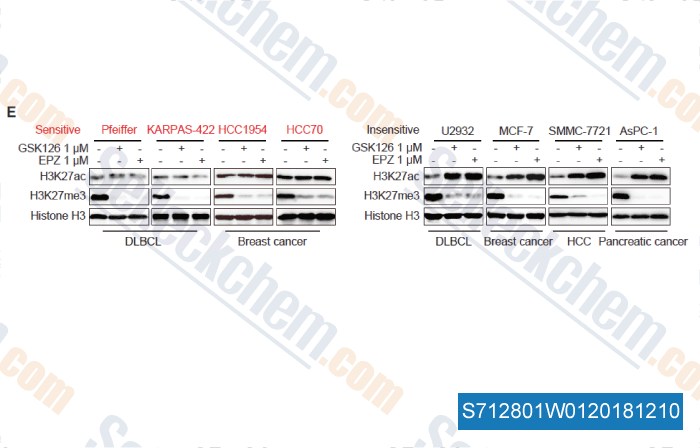
-
Daten von [ , , Cell, 2018, 175(1):186-199 ]
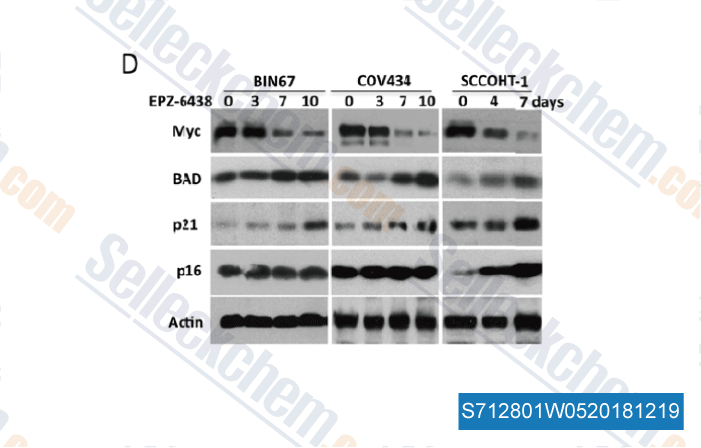
-
Daten von [ , , J Pathol, 2017, 242(3):371-383 ]
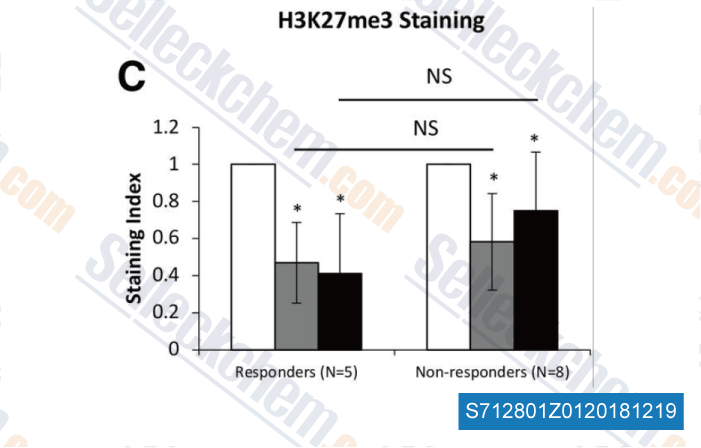
-
Daten von [ , , Clin Epigenetics, 2018, 10(1):121 ]
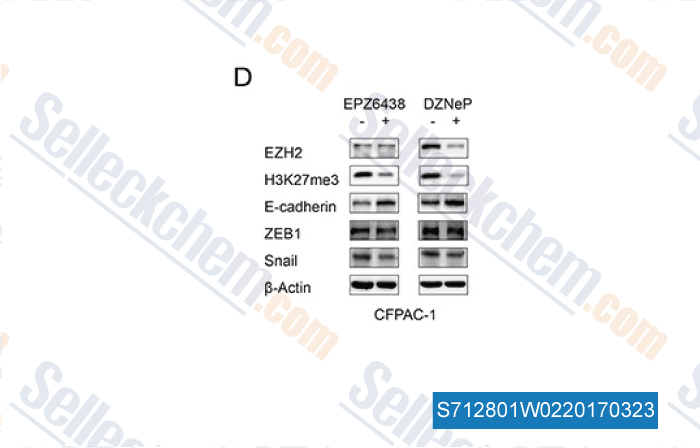
-
Daten von [ , , Oncotarget, 2016, 7(10):11194-207 ]
Sellecks EPZ-6438 (Tazemetostat) Wurde zitiert von 189 Publikationen
| Whole-exome tumor-agnostic ctDNA analysis enhances minimal residual disease detection and reveals relapse mechanisms in localized colon cancer [ Nat Cancer, 2025, 10.1038/s43018-025-00960-z] | PubMed: 40301653 |
| Genome-wide CRISPR screen identifies Menin and SUZ12 as regulators of human developmental timing [ Nat Cell Biol, 2025, 27(9):1411-1421] | PubMed: 40897805 |
| Microprotein PLUM encoded by Lin28b uORF is a cytoplasmic determinant of pluripotency and embryonic development [ Nat Commun, 2025, 16(1):10324] | PubMed: 41298451 |
| Single cell suppression profiling of human regulatory T cells [ Nat Commun, 2025, 16(1):1325] | PubMed: 39900891 |
| Constitutive expression of the transcriptional co-activator IκBζ promotes melanoma growth and immunotherapy resistance [ Nat Commun, 2025, 16(1):5387] | PubMed: 40562773 |
| HIF-independent oxygen sensing via KDM6A regulates ferroptosis [ Mol Cell, 2025, 85(15):2973-2987.e6] | PubMed: 40712585 |
| A specific form of cPRC1 containing CBX4 is co-opted to mediate oncogenic gene repression in diffuse midline glioma [ Mol Cell, 2025, 85(11):2110-2127.e7] | PubMed: 40403727 |
| The NEXT complex regulates H3K27me3 levels to affect cancer progression by degrading G4/U-rich lncRNAs [ Nucleic Acids Res, 2025, 53(4)gkaf107] | PubMed: 39988317 |
| Differential regulation of FADS2 by EZH2 reveals a metabolic vulnerability in ovarian cancer treatment [ EBioMedicine, 2025, 119:105879] | PubMed: 40818202 |
| EZH2 inhibition mitigates HIV immune evasion, reduces reservoir formation, and promotes skewing of CD8+ T cells toward less-exhausted phenotypes [ Cell Rep, 2025, 44(5):115652] | PubMed: 40333189 |
RÜCKGABERICHTLINIE
Die bedingungslose Rückgaberichtlinie von Selleck Chemical gewährleistet unseren Kunden ein reibungsloses Online-Einkaufserlebnis. Wenn Sie in irgendeiner Weise mit Ihrem Kauf unzufrieden sind, können Sie jeden Artikel innerhalb von 7 Tagen nach Erhalt zurückgeben. Im Falle von Produktqualitätsproblemen, sei es protokollbezogene oder produktbezogene Probleme, können Sie jeden Artikel innerhalb von 365 Tagen ab dem ursprünglichen Kaufdatum zurückgeben. Bitte befolgen Sie die nachstehenden Anweisungen, wenn Sie Produkte zurücksenden.
VERSAND UND LAGERUNG
Selleck-Produkte werden bei Raumtemperatur transportiert. Wenn Sie das Produkt bei Raumtemperatur erhalten, seien Sie versichert, dass die Qualitätskontrollabteilung von Selleck Experimente durchgeführt hat, um zu überprüfen, dass die normale Temperaturplatzierung von einem Monat die biologische Aktivität von Pulverprodukten nicht beeinträchtigt. Nach dem Sammeln lagern Sie das Produkt bitte gemäß den in der Datenblatt beschriebenen Anforderungen. Die meisten Selleck-Produkte sind unter den empfohlenen Bedingungen stabil.
NICHT FÜR DIE ANWENDUNG AM MENSCHEN, FÜR VETERINÄRMEDIZINISCHE DIAGNOSTIK ODER THERAPEUTISCHE ZWECKE.