
Technische Daten
| Formel | C27H22Cl2N4O |
||||||
| Molekulargewicht | 489.4 | CAS-Nr. | 192185-72-1 | ||||
| Löslichkeit (25°C)* | In vitro | DMSO | 12 mg/mL (24.51 mM) | ||||
| Water | Insoluble | ||||||
| Ethanol | Insoluble | ||||||
| In vivo (Lösungsmittel einzeln und der Reihe nach zum Produkt hinzufügen.) |
|
||||||
|
* <1 mg/ml bedeutet schwer löslich oder unlöslich. * Bitte beachten Sie, dass Selleck die Löslichkeit aller Verbindungen intern testet und die tatsächliche Löslichkeit geringfügig von veröffentlichten Werten abweichen kann. Dies ist normal und ist auf geringfügige Batch-zu-Batch-Variationen zurückzuführen. * Versand bei Raumtemperatur (Stabilitätstests zeigen, dass dieses Produkt ohne Kühlmaßnahmen versendet werden kann.) |
|||||||
Vorbereitung von Stammlösungen
Biologische Aktivität
| Beschreibung | Tipifarnib ist ein potenter und spezifischer farnesyltransferase (FTase)-Inhibitor mit einem IC50 von 0,6 nM. Seine antiproliferativen Effekte sind am ausgeprägtesten in H-ras- oder N-ras-mutierten Zellen. Phase 3. | ||
|---|---|---|---|
| Ziele |
|
||
| In vitro | Bei einer Behandlung mit Tipifarnib 5 μM über 72 Stunden ist der Prozentsatz apoptotischer Zellen in medikamentenbehandelten LGL-T-Zellen im Vergleich zu DMSO-behandelten Zellen signifikant höher. Bei der Verwendung von T-Zellen von gesunden Spendern reduziert diese Verbindung den Prozentsatz IFNγ-positiver Zellen zeitabhängig. Sie reduziert die Menge an aktiviertem Ras in Präzipitaten im Vergleich zu DMSO. Diese Chemikalie übt eine selektive In-vitro-Toxizität gegen klonale MDS-Hämatopoese bei Konzentrationen von weniger als 10 nM aus, wobei der Effekt in Vorläuferzellen der weißen Blutkörperchen ausgeprägter ist. Diese Wirkung ist nicht auf die Induktion von Apoptose zurückzuführen, da sowohl normale als auch MDS-Progenitoren bis zu 72 Stunden nach Exposition gegenüber dieser Verbindung eine äquivalente DiOC3- und Annexin-V-Expression aufweisen. Die Kombination mit 10 nM 4-OH-ICI 46474 in Anwesenheit von E2 reduziert den IC50-Wert um das 8-fache von 400 auf 50 nM. Sie induziert Apoptose in U937-Zellen. Darüber hinaus hemmt diese Chemikalie isolierte humane Farnesyltransferase für ein Lamin-B-Peptid und für das K-RasB-Peptid mit IC50-Werten von 0,86 nM bzw. 7,9 nM. |
||
| In vivo | Ki-67 ist in den Tumoren, die mit E2-Entzug plus dieser Verbindung behandelt wurden, niedriger als beim alleinigen E2-Entzug. Die Kombination von ICI 46474 und dieser Chemikalie führt zu einem signifikant niedrigeren Ki-67 im Vergleich zu ICI 46474 oder diesem Wirkstoff allein (Durchschnitt von 5% gegenüber 16,9% bzw. 67,3%). Im Gegensatz dazu wird kein signifikanter Unterschied in den apoptotischen Scores zwischen den Behandlungsgruppen festgestellt. Diese Verbindung allein reduziert auch den CTI im Vergleich zur Kontrolle. Die Kombination von ICI 46474 und diesem Wirkstoff oder dieser Chemikalie in Verbindung mit E2-Entzug ist am effektivsten bei der Senkung des CTI (0,8 bzw. 0,7), was den Rückgang des Tumorvolumens erklären könnte. |
||
| Merkmale | Ein potenter und selektiver Farnesylprotein-Transferase-Inhibitor mit signifikanten Antitumorwirkungen. |
Protokoll (aus Referenz)
| Zell-Assay: |
|
|---|---|
| Tierstudie: |
|
Referenzen
|
Kundenproduktvalidierung
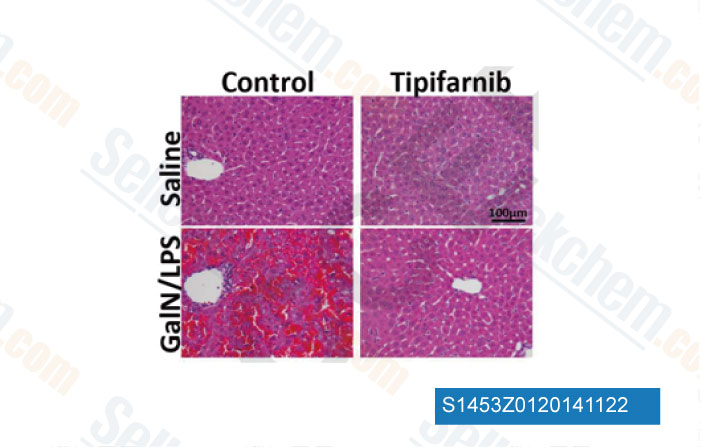
-
Daten von [ Shock , 2014 , 42(6), 570-7 ]
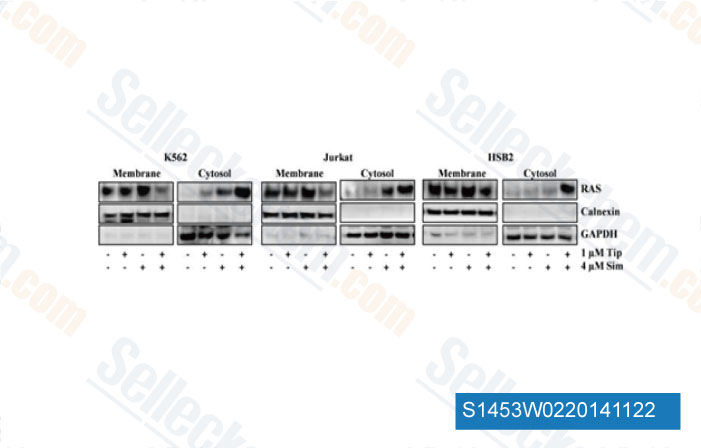
-
Daten von [ Leuk Res , 2014 , 10.1016/j.leukres.2014.09.002 ]
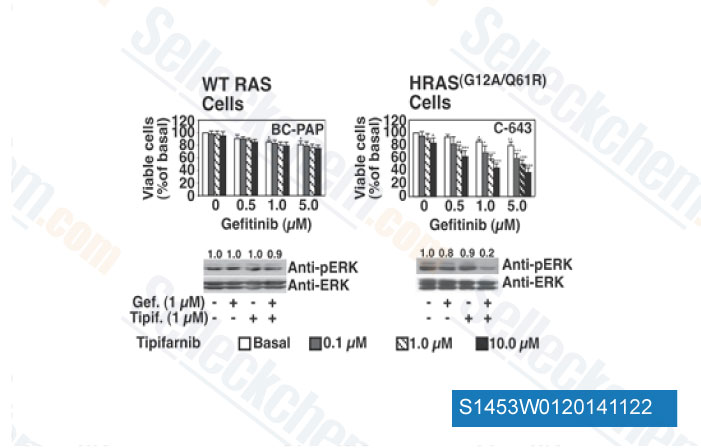
-
Daten von [ J Clin Endocrinol Metab , 2013 , 98(6), 2502-12 ]
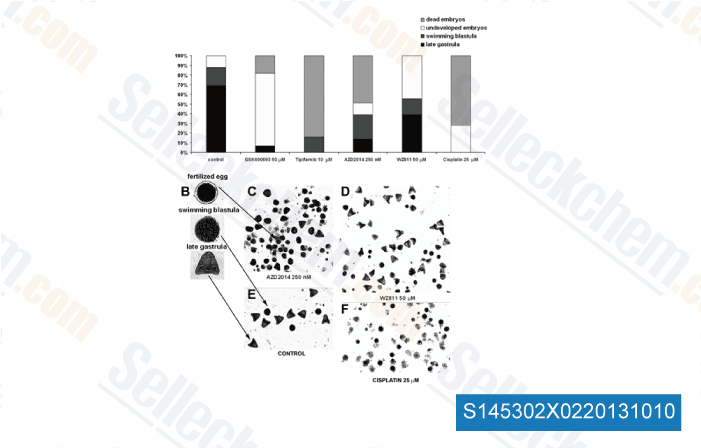
-
, , Dr. Milica Pesic from Institute for Biological Research
Sellecks Tipifarnib (IND 58359) Wurde zitiert von 38 Publikationen
| Impaired MC3T3-E1 osteoblast differentiation triggered by oncogenic HRAS is rescued by the farnesyltransferase inhibitor Tipifarnib [ Sci Rep, 2025, 15(1):6832] | PubMed: 40000861 |
| In Vitro synergy of Farnesyltransferase inhibitors in combination with colistin against ESKAPE bacteria [ PLoS One, 2025, 20(9):e0331440] | PubMed: 40911556 |
| Mitotic perturbation is a key mechanism of action of decitabine in myeloid tumor treatment [ Cell Rep, 2023, 42(9):113098] | PubMed: 37714156 |
| Salivary gland cancer organoids are valid for preclinical genotype-oriented medical precision trials [ iScience, 2023, 26(5):106695] | PubMed: 37207275 |
| Suppression of NASH-Related HCC by Farnesyltransferase Inhibitor through Inhibition of Inflammation and Hypoxia-Inducible Factor-1α Expression [ Int J Mol Sci, 2023, 24(14)11546] | PubMed: 37511305 |
| Cooperative Genomic Lesions in HRAS-Mutant Cancers Predict Resistance to Farnesyltransferase Inhibitors [ Res Sq, 2023, rs.3.rs-3154719] | PubMed: 37503077 |
| BRAF activation by metabolic stress promotes glycolysis sensitizing NRASQ61-mutated melanomas to targeted therapy [ Nat Commun, 2022, 13(1):7113] | PubMed: 36402789 |
| Impact of a conserved N-terminal proline-rich region of the α-subunit of CAAX-prenyltransferases on their enzyme properties [ Cell Commun Signal, 2022, 20(1):118] | PubMed: 35941619 |
| Combination of Tipifarnib and Sunitinib Overcomes Renal Cell Carcinoma Resistance to Tyrosine Kinase Inhibitors via Tumor-Derived Exosome and T Cell Modulation [ Cancers (Basel), 2022, 14(4)903] | PubMed: 35205655 |
| Bacteria Are New Targets for Inhibitors of Human Farnesyltransferase [ Front Microbiol, 2021, 12:628283] | PubMed: 34917041 |
RÜCKGABERICHTLINIE
Die bedingungslose Rückgaberichtlinie von Selleck Chemical gewährleistet unseren Kunden ein reibungsloses Online-Einkaufserlebnis. Wenn Sie in irgendeiner Weise mit Ihrem Kauf unzufrieden sind, können Sie jeden Artikel innerhalb von 7 Tagen nach Erhalt zurückgeben. Im Falle von Produktqualitätsproblemen, sei es protokollbezogene oder produktbezogene Probleme, können Sie jeden Artikel innerhalb von 365 Tagen ab dem ursprünglichen Kaufdatum zurückgeben. Bitte befolgen Sie die nachstehenden Anweisungen, wenn Sie Produkte zurücksenden.
VERSAND UND LAGERUNG
Selleck-Produkte werden bei Raumtemperatur transportiert. Wenn Sie das Produkt bei Raumtemperatur erhalten, seien Sie versichert, dass die Qualitätskontrollabteilung von Selleck Experimente durchgeführt hat, um zu überprüfen, dass die normale Temperaturplatzierung von einem Monat die biologische Aktivität von Pulverprodukten nicht beeinträchtigt. Nach dem Sammeln lagern Sie das Produkt bitte gemäß den in der Datenblatt beschriebenen Anforderungen. Die meisten Selleck-Produkte sind unter den empfohlenen Bedingungen stabil.
NICHT FÜR DIE ANWENDUNG AM MENSCHEN, FÜR VETERINÄRMEDIZINISCHE DIAGNOSTIK ODER THERAPEUTISCHE ZWECKE.