
Technische Daten
| Formel | C16H20N6O.C6H8O7 |
|||
| Molekulargewicht | 504.49 | CAS-Nr. | 540737-29-9 | |
| Löslichkeit (25°C)* | In vitro | DMSO | 100 mg/mL (198.21 mM) | |
| Water | Insoluble | |||
| Ethanol | Insoluble | |||
|
* <1 mg/ml bedeutet schwer löslich oder unlöslich. * Bitte beachten Sie, dass Selleck die Löslichkeit aller Verbindungen intern testet und die tatsächliche Löslichkeit geringfügig von veröffentlichten Werten abweichen kann. Dies ist normal und ist auf geringfügige Batch-zu-Batch-Variationen zurückzuführen. * Versand bei Raumtemperatur (Stabilitätstests zeigen, dass dieses Produkt ohne Kühlmaßnahmen versendet werden kann.) |
||||
Vorbereitung von Stammlösungen
Biologische Aktivität
| Beschreibung | CP-690550 (Tofacitinib) Citrate (CP-690550, Tasocitinib) ist ein neuartiger JAK Inhibitor mit einer IC50 von 1 nM, 20 nM und 112 nM gegen JAK3, JAK2 bzw. JAK1. Es hat auch Anti-infection Aktivität. | ||||
|---|---|---|---|---|---|
| Ziele |
|
||||
| In vitro | CP-690550 (Tofacitinib) Citrate hemmt die IL-2-vermittelte Proliferation menschlicher T-Zellen und die IL-15-induzierte CD69-Expression mit einer IC50 von 11 nM bzw. 48 nM. CP-690550 (Tofacitinib) Citrate verhindert gemischte Lymphozytenreaktionen mit einer IC50 von 87 nM. Die Behandlung von murinen Faktor-abhängigen Zell Patersen-Erythropoietin-Rezeptor (FDCP-EpoR)-Zellen, die menschliches Wildtyp- oder V617F-JAK2 beherbergen, mit CP-690550 (Tofacitinib) Citrate führt zur Verhinderung der Zellproliferation mit einer IC50 von 2,1 µM bzw. 0,25 µM. CP-690550 (Tofacitinib) Citrate hemmt die Interleukin-6-induzierte Phosphorylierung von STAT1 und STAT3 mit einer IC50 von 23 nM bzw. 77 nM. Darüber hinaus erzeugt CP-690550 (Tofacitinib) Citrate einen signifikanten pro-apoptotischen Effekt auf murine FDCP-EpoR-Zellen, die JAK2VV617F tragen, während ein geringerer Effekt für Zellen beobachtet wird, die Wildtyp-JAK2 tragen. Diese Aktivität ist gekoppelt mit der Hemmung der Phosphorylierung der wichtigen JAK2V617F-abhängigen nachgeschalteten Signaltransduktor- und Aktivator-der-Transkription (STAT)3, STAT5 und v-akt murines Thymom-virales Onkogen-Homolog (AKT). Zusätzlich verhindert CP-690550 (Tofacitinib) Citrate die IL-15-induzierte CD69-Expression in menschlichen und Javaneraffen-NK- und CD8+-T-Zellen in vitro. | ||||
| In vivo | CP-690550 (Tofacitinib) Citrate verringert eine verzögerte Überempfindlichkeitsreaktion und verlängert die Überlebensdauer von Herztransplantaten in murinen Modellen. Darüber hinaus führt die Behandlung ex-vivo-expandierter erythropoider Vorläufer von JAK2V617F-positiven PV-Patienten mit CP-690550 (Tofacitinib) Citrate zu einer spezifischen, antiproliferativen (IC50 = 0,2 μM) und pro-apoptotischen Aktivität. Im Gegensatz dazu sind expandierte Vorläufer von gesunden Kontrollen in Proliferations- (IC50 > 1,0 μM) und Apoptose-Assays weniger empfindlich gegenüber CP-690550 (Tofacitinib) Citrate. Während 2 Wochen der CP-690550 (Tofacitinib) Citrate-Dosierung mit 10 und 30 mg/kg/Tag wird ein signifikanter, zeitabhängiger Rückgang der NK-Zellzahlen im Vergleich zur Vehikelbehandlung beobachtet. Die Zahlen der Effektorzellen des Gedächtnisses CD8+ in der mit CP-690550 (Tofacitinib) Citrate behandelten Gruppe sind 55 % geringer als die in mit Vehikel behandelten Tieren beobachteten. |
Protokoll (aus Referenz)
| Kinase-Assay: |
|
|---|---|
| Zell-Assay: |
|
| Tierstudie: |
|
Referenzen
|
Kundenproduktvalidierung
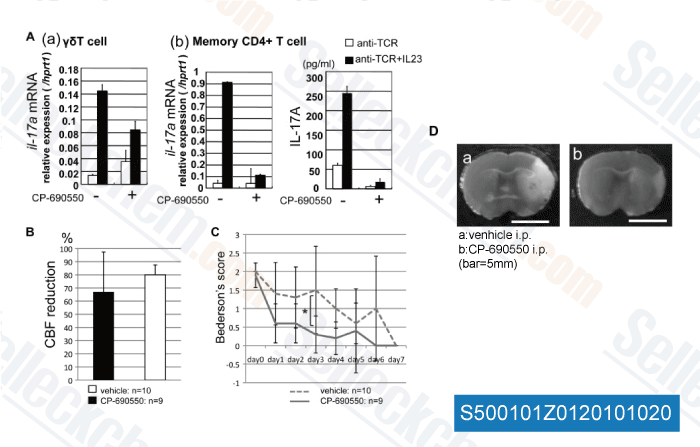
-
Daten von [ Biochem Biophy Res Commun , 2010 , 402, 500–506 ]
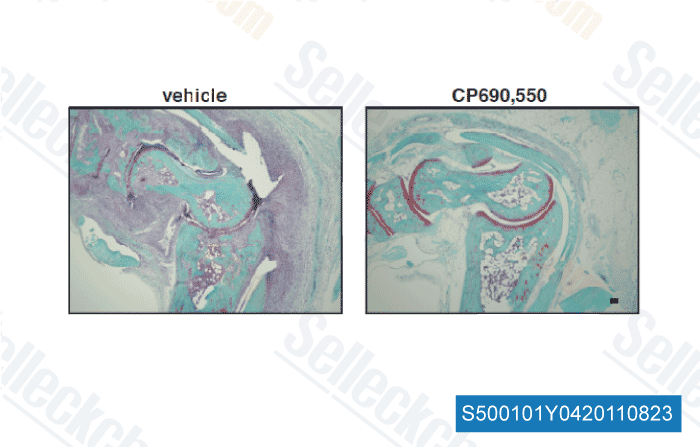
-
, , Dr. Akihiko Yoshimura of Akihiko Yoshimura
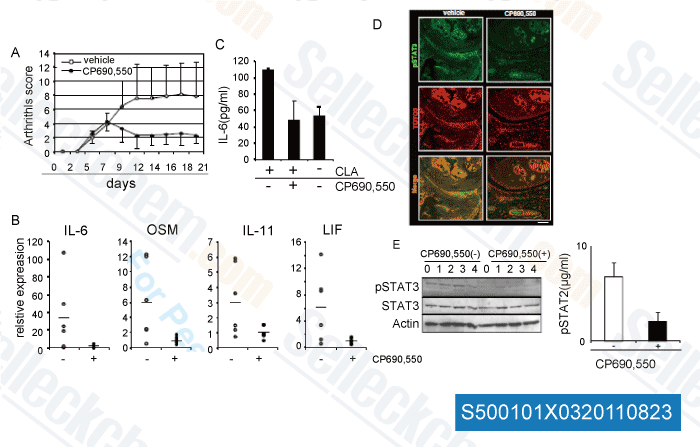
-
, , Saraswati Sukumar of Johns Hopkins University School of Medicine
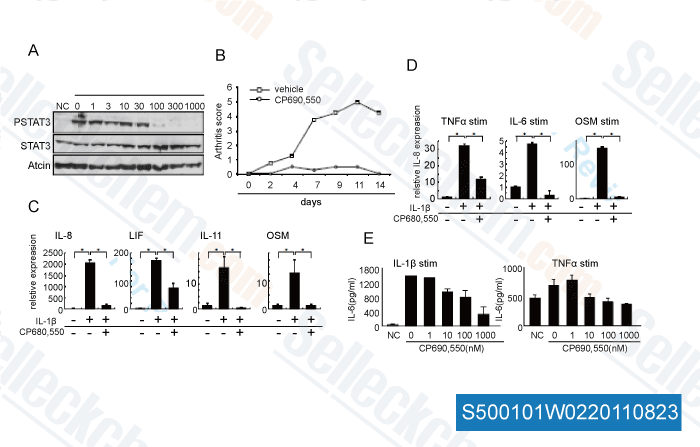
-
, , Dr. Akihiko Yoshimura of Akihiko Yoshimura
Sellecks CP-690550 (Tofacitinib) Citrate Wurde zitiert von 198 Publikationen
| Unveiling the Anti-Angiogenic Potential of Small-Molecule (Kinase) Inhibitors for Application in Rheumatoid Arthritis [ Cells, 2025, 14(2)102] | PubMed: 39851530 |
| Pharmacological evaluation of drug therapies in Aicardi-Goutières syndrome: insights from patient-derived neural stem cells [ Front Pharmacol, 2025, 16:1549183] | PubMed: 40183101 |
| JAK/STAT3 represents a therapeutic target for colorectal cancer patients with stromal-rich tumors [ J Exp Clin Cancer Res, 2024, 43(1):64] | PubMed: 38424636 |
| Patient-derived rhabdomyosarcoma cells recapitulate the genetic and transcriptomic landscapes of primary tumors [ iScience, 2024, 27(10):110862] | PubMed: 39319271 |
| A panel of janus kinase inhibitors identified with anti-inflammatory effects protect mice from lethal influenza virus infection [ Antimicrob Agents Chemother, 2024, 68(4):e0135023.] | PubMed: 38470034 |
| Tofacitinib to prevent anti-drug antibody formation against LMB-100 immunotoxin in patients with advanced mesothelin-expressing cancers [ Front Oncol, 2024, 14:1386190] | PubMed: 38706610 |
| Metabolic signature and proteasome activity controls synovial migration of CDC42hiCD14+ cells in rheumatoid arthritis [ Front Immunol, 2023, 14:1187093] | PubMed: 37662900 |
| Comprehensive protocols for culturing and molecular biological analysis of IBD patient-derived colon epithelial organoids [ Front Immunol, 2023, 14:1097383] | PubMed: 36911731 |
| In vitro and in vivo modelling of mutant JAK3/STAT5 signaling in leukemia [ Heliyon, 2023, 9(11):e22085] | PubMed: 38053908 |
| Cap analysis of gene expression (CAGE) 法を用いた nestin-induced Ikk2 deficient マウスにおける皮膚炎の分子病態解析 [ University of Toyama Graduate School of Medical and Pharmaceutical Education (Doctoral Course), 2023, ] | PubMed: none |
RÜCKGABERICHTLINIE
Die bedingungslose Rückgaberichtlinie von Selleck Chemical gewährleistet unseren Kunden ein reibungsloses Online-Einkaufserlebnis. Wenn Sie in irgendeiner Weise mit Ihrem Kauf unzufrieden sind, können Sie jeden Artikel innerhalb von 7 Tagen nach Erhalt zurückgeben. Im Falle von Produktqualitätsproblemen, sei es protokollbezogene oder produktbezogene Probleme, können Sie jeden Artikel innerhalb von 365 Tagen ab dem ursprünglichen Kaufdatum zurückgeben. Bitte befolgen Sie die nachstehenden Anweisungen, wenn Sie Produkte zurücksenden.
VERSAND UND LAGERUNG
Selleck-Produkte werden bei Raumtemperatur transportiert. Wenn Sie das Produkt bei Raumtemperatur erhalten, seien Sie versichert, dass die Qualitätskontrollabteilung von Selleck Experimente durchgeführt hat, um zu überprüfen, dass die normale Temperaturplatzierung von einem Monat die biologische Aktivität von Pulverprodukten nicht beeinträchtigt. Nach dem Sammeln lagern Sie das Produkt bitte gemäß den in der Datenblatt beschriebenen Anforderungen. Die meisten Selleck-Produkte sind unter den empfohlenen Bedingungen stabil.
NICHT FÜR DIE ANWENDUNG AM MENSCHEN, FÜR VETERINÄRMEDIZINISCHE DIAGNOSTIK ODER THERAPEUTISCHE ZWECKE.