
|
Wie zu zitieren 1. Für Zitate im Text (Materialien & Methoden): 2. Für die Tabelle der Schlüsselressourcen: |
||
|
Gebührenfrei: (877) 796-6397 -- Nur USA und Kanada -- |
Fax: +1-832-582-8590 Bestellungen: +1-832-582-8158 |
Technischer Support: +1-832-582-8158 Ext:3 Bitte geben Sie Ihre Bestellnummer in der E-Mail an. Wir bemühen uns, alle E-Mail-Anfragen innerhalb eines Werktages zu beantworten. |
Biologische Beschreibung
| Spezifität | TRAF6 Antibody [B8B10] erkennt endogene Spiegel des gesamten TRAF6-Proteins. Es wird nicht erwartet, dass dieser Antikörper mit anderen TRAF-Familienmitgliedern kreuzreagiert. |
|---|---|
| Hintergrund | Tumornekrosefaktor-Rezeptor-assoziierte Faktoren (TRAFs) bilden eine Familie zytoplasmatischer Adapterproteine, die verschiedene intrazelluläre Signalereignisse vermitteln. Bei Säugetieren wurden sieben TRAF-Familienmitglieder identifiziert, darunter sechs klassische Mitglieder (TRAF1–TRAF6) und ein nicht-klassisches Mitglied (TRAF7). Die klassischen TRAFs teilen eine konservierte carboxyterminale TRAF-Domäne, die im nicht-klassischen TRAF7 fehlt. Funktionell sind TRAFs an der Signaltransduktion der Tumornekrosefaktor-Superfamilie (TNFSF) sowie an Mitgliedern der Toll-like/IL-1-Rezeptor (TLR/ILR)-Superfamilie beteiligt, wodurch sie nachgeschaltete Signalkaskaden wie den Mitogen-aktivierten Proteinkinase (MAPK)-Signalweg regulieren. Über die Rezeptorsignalisierung hinaus spielen TRAFs eine wesentliche Rolle bei der Zellproliferation, -differenzierung, -apoptose und dem Überleben, während sie auch Immun- und Entzündungsreaktionen modulieren. Eine Dysregulation von TRAF-Proteinen trägt zur Onkogenese bei, wobei verschiedene Mitglieder entweder onkogene oder tumorunterdrückende Funktionen ausüben. TRAF1, TRAF2, TRAF4, TRAF5 und TRAF6 wurden in die Karzinogenese involviert, während TRAF3 überwiegend als Tumorsuppressor fungiert. Innerhalb der Familie zeichnet sich TRAF6 durch seine einzigartige Rezeptorbindungspezifität aus, die es ihm ermöglicht, nicht nur mit Mitgliedern der TNF-Rezeptor-Superfamilie, sondern auch mit IL-1R/TLR-Superfamilienproteinen zu interagieren. Eine Überexpression von TRAF6 wurde bei mehreren Tumortypen, einschließlich Kolon-, Magen- und Mammakarzinomen sowie Melanomen, berichtet. Funktionell fördert TRAF6 die Tumorentstehung und -progression, indem es Apoptose, Proliferation, Überleben und Invasion moduliert. Mechanistisch aktiviert TRAF6 mehrere Signalwege, wobei die Toll-like-Rezeptor-4 (TLR4)-Kaskade besonders bedeutsam ist. Sowohl über MyD88-abhängige als auch MyD88-unabhängige Wege verstärkt TRAF6 entzündliche und Überlebenssignale. Darüber hinaus verstärkt TRAF6 die Aktivierung des PI3K–AKT-Signalwegs, indem es die PI3K-Ubiquitinierung erleichtert, wodurch die AKT-Phosphorylierung erhöht und das Zellwachstum angetrieben wird. Zusammengenommen unterstreichen diese Ergebnisse TRAF6 als einen kritischen Adapter, der die Rezeptorsignalisierung mit onkogenen Prozessen integriert. |
Nutzungsinformationen
| Anwendung | WB, IP | Verdünnung |
|
||||
|---|---|---|---|---|---|---|---|
| Reaktivität | Human, Monkey | ||||||
| Quelle | Rabbit Monoclonal Antibody | MW | 60 kDa | ||||
| Lagerpuffer | PBS, pH 7.2+50% Glycerol+0.05% BSA+0.01% NaN3 | Lagerung (Ab dem Datum des Erhalts) |
-20°C (avoid freeze-thaw cycles), 2 years | ||||
| WB |
Experimental Protocol:
Sample preparation
1. Tissue: Lyse the tissue sample by adding an appropriate volume of ice-cold RIPA/NP-40 Lysis Buffer (containing Protease Inhibitor Cocktail),and homogenize the tissue at a low temperature. 2. Adherent cell: Aspirate the culture medium and wash the cells with ice-cold PBS twice. Lyse the cells by adding an appropriate volume of RIPA/NP-40 Lysis Buffer (containing Protease Inhibitor Cocktail) and put the sample on ice for 5 min. 3. Suspension cell: Transfer the culture medium to a pre-cooled centrifuge tube. Centrifuge and aspirate the supernatant. Wash the cells with ice-cold PBS twice. Lyse the cells by adding an appropriate volume of RIPA/NP-40 Lysis Buffer (containing Protease Inhibitor Cocktail) and put the sample on ice for 5 min. 4. Place the lysate into a pre-cooled microcentrifuge tube. Centrifuge at 4°C for 15 min. Collect the supernatant;
5. Remove a small volume of lysate to determine the protein concentration;
6. Combine the lysate with protein loading buffer. Boil 20 µL sample under 95-100°C for 5 min. Centrifuge for 5 min after cool down on ice.
Electrophoretic separation
1. According to the concentration of extracted protein, load appropriate amount of protein sample and marker onto SDS-PAGE gels for electrophoresis. Recommended separating gel (lower gel) concentration: 10%. Reference Table for Selecting SDS-PAGE Separation Gel Concentrations 2. Power up 80V for 30 minutes. Then the power supply is adjusted (110 V~150 V), the Marker is observed, and the electrophoresis can be stopped when the indicator band of the predyed protein Marker where the protein is located is properly separated. (Note that the current should not be too large when electrophoresis, too large current (more than 150 mA) will cause the temperature to rise, affecting the result of running glue. If high currents cannot be avoided, an ice bath can be used to cool the bath.)
Transfer membrane
1. Take out the converter, soak the clip and consumables in the pre-cooled converter;
2. Activate PVDF membrane with methanol for 1 min and rinse with transfer buffer;
3. Install it in the order of "black edge of clip - sponge - filter paper - filter paper - glue -PVDF membrane - filter paper - filter paper - sponge - white edge of clip"; 4. The protein was electrotransferred to PVDF membrane. ( 0.45 µm PVDF membrane is recommended ) Reference Table for Selecting PVDF Membrane Pore Size Specifications Recommended conditions for wet transfer: 200 mA, 120 min. ( Note that the transfer conditions can be adjusted according to the protein size. For high-molecular-weight proteins, a higher current and longer transfer time are recommended. However, ensure that the transfer tank remains at a low temperature to prevent gel melting.)
Block
1. After electrotransfer, wash the film with TBST at room temperature for 5 minutes;
2. Incubate the film in the blocking solution for 1 hour at room temperature;
3. Wash the film with TBST for 3 times, 5 minutes each time.
Antibody incubation
1. Use 5% skim milk powder to prepare the primary antibody working liquid (recommended dilution ratio for primary antibody 1:1000), gently shake and incubate with the film at 4°C overnight; 2. Wash the film with TBST 3 times, 5 minutes each time;
3. Add the secondary antibody to the blocking solution and incubate with the film gently at room temperature for 1 hour;
4. After incubation, wash the film with TBST 3 times for 5 minutes each time.
Antibody staining
1. Add the prepared ECL luminescent substrate (or select other color developing substrate according to the second antibody) and mix evenly;
2. Incubate with the film for 1 minute, remove excess substrate (keep the film moist), wrap with plastic film, and expose in the imaging system.
|
Referenzen
|
Anwendungsdaten
WB
Validiert von Selleck
-
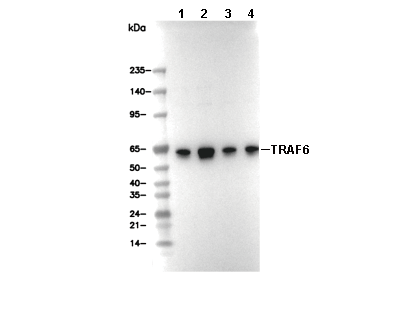 Lane 1: K562, Lane 2: Hela, Lane 3: 293T, Lane 4: COS-7