
Technische Daten
| Formel | C21H22Cl2N4O2 |
||||||
| Molekulargewicht | 433.33 | CAS-Nr. | 869886-67-9 | ||||
| Löslichkeit (25°C)* | In vitro | DMSO | 86 mg/mL (198.46 mM) | ||||
| Ethanol | 43 mg/mL (99.23 mM) | ||||||
| Water | Insoluble | ||||||
| In vivo (Lösungsmittel einzeln und der Reihe nach zum Produkt hinzufügen.) |
|
||||||
|
* <1 mg/ml bedeutet schwer löslich oder unlöslich. * Bitte beachten Sie, dass Selleck die Löslichkeit aller Verbindungen intern testet und die tatsächliche Löslichkeit geringfügig von veröffentlichten Werten abweichen kann. Dies ist normal und ist auf geringfügige Batch-zu-Batch-Variationen zurückzuführen. * Versand bei Raumtemperatur (Stabilitätstests zeigen, dass dieses Produkt ohne Kühlmaßnahmen versendet werden kann.) |
|||||||
Vorbereitung von Stammlösungen
Biologische Aktivität
| Beschreibung | Ulixertinib (BVD-523, VRT752271) ist ein potenter und reversibler ERK1/ERK2-Inhibitor mit einer IC50 von <0,3 nM für ERK2. Diese Verbindung befindet sich in Phase 1. | ||||
|---|---|---|---|---|---|
| Ziele |
|
||||
| In vitro | In einer A375-Melanomzelllinie, die eine b-RAFV600E-Mutation enthält, reduziert Ulixertinib (BVD-523) die Spiegel des phosphorylierten ERK2 (pERK) und der Phosphorylierung der nachgeschalteten Kinase RSK (pRSK) mit einer IC50 von 4,1/0,14 μM. Es hemmt auch die Proliferation von A375-Zellen mit einer IC50 von 180 nM. |
Protokoll (aus Referenz)
| Kinase-Assay:[1] |
|
|---|---|
| Zell-Assay:[1] |
|
Referenzen
|
Kundenproduktvalidierung
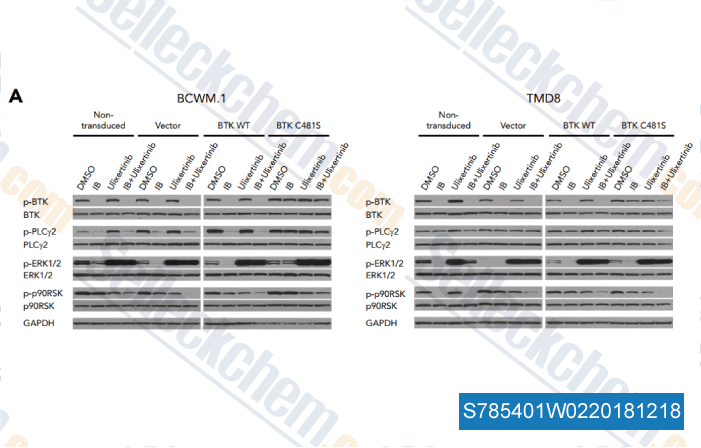
-
Daten von [ , , Blood, 2018, 131(18):2047-2059 ]

-
Daten von [ , , Haematologica, 2018, doi:10.3324/haematol.2018.196931 ]
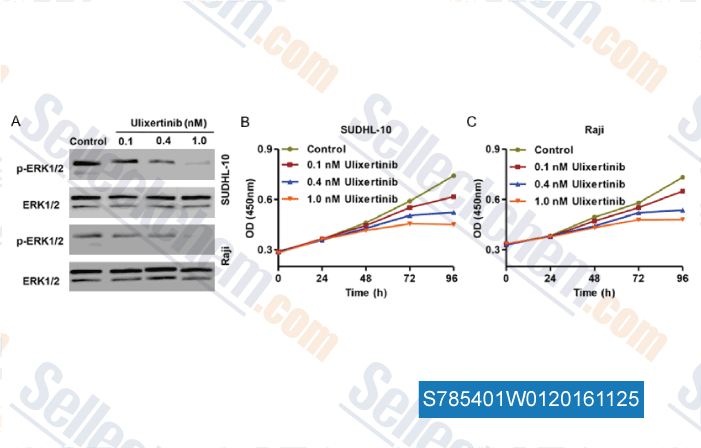
-
Daten von [ , , Int J Clin Exp Med, 2016, 9(6):10955-10962. ]
Sellecks Ulixertinib (BVD-523) Wurde zitiert von 72 Publikationen
| RAF-independent MEK mutations drive refractory histiocytic neoplasms but respond to ERK inhibition [ Cancer Cell, 2025, S1535-6108(25)00406-4] | PubMed: 41135521 |
| DUSP8 as a regulator of glioblastoma stem-like cell contribution to tumor vascularization [ J Exp Clin Cancer Res, 2025, 44(1):269] | PubMed: 41029387 |
| A bedside-to-bench translational analysis of NF1 alterations and CDK4/6 inhibitor resistance in hormone receptor-positive metastatic breast cancer [ EBioMedicine, 2025, 118:105828] | PubMed: 40578027 |
| Genes driving three-dimensional growth of immortalized cells and cancer [ Cell Death Dis, 2025, 16(1):442] | PubMed: 40494869 |
| PRDX1 knockdown promotes erastin-induced ferroptosis and impedes diffuse large B-cell lymphoma development by inhibiting the MAPK/ERK pathway [ BMC Cancer, 2025, 25(1):806] | PubMed: 40307771 |
| Independent and synergistic roles of MEK-ERK1/2 and PKC pathways in regulating functional changes in vascular tissue following flow cessation [ J Mol Cell Cardiol Plus, 2025, 12:100300] | PubMed: 40395439 |
| Multi-selective RAS(ON) Inhibition Targets Oncogenic RAS Mutations and Overcomes RAS/MAPK-Mediated Resistance to FLT3 and BCL2 Inhibitors in Acute Myeloid Leukemia [ bioRxiv, 2025, 2025.06.10.658786] | PubMed: 40661530 |
| Tumour-selective activity of RAS-GTP inhibition in pancreatic cancer [ Nature, 2024, 629(8013):927-936] | PubMed: 38588697 |
| EHMT2 promotes tumorigenesis in GNAQ/11-mutant uveal melanoma via ARHGAP29-mediated RhoA pathway [ Acta Pharm Sin B, 2024, 14(3):1187-1203] | PubMed: 38486999 |
| Inhibition of oxidative stress-induced epithelial-mesenchymal transition in retinal pigment epithelial cells of age-related macular degeneration model by suppressing ERK activation [ J Adv Res, 2024, 60:141-157] | PubMed: 37328058 |
RÜCKGABERICHTLINIE
Die bedingungslose Rückgaberichtlinie von Selleck Chemical gewährleistet unseren Kunden ein reibungsloses Online-Einkaufserlebnis. Wenn Sie in irgendeiner Weise mit Ihrem Kauf unzufrieden sind, können Sie jeden Artikel innerhalb von 7 Tagen nach Erhalt zurückgeben. Im Falle von Produktqualitätsproblemen, sei es protokollbezogene oder produktbezogene Probleme, können Sie jeden Artikel innerhalb von 365 Tagen ab dem ursprünglichen Kaufdatum zurückgeben. Bitte befolgen Sie die nachstehenden Anweisungen, wenn Sie Produkte zurücksenden.
VERSAND UND LAGERUNG
Selleck-Produkte werden bei Raumtemperatur transportiert. Wenn Sie das Produkt bei Raumtemperatur erhalten, seien Sie versichert, dass die Qualitätskontrollabteilung von Selleck Experimente durchgeführt hat, um zu überprüfen, dass die normale Temperaturplatzierung von einem Monat die biologische Aktivität von Pulverprodukten nicht beeinträchtigt. Nach dem Sammeln lagern Sie das Produkt bitte gemäß den in der Datenblatt beschriebenen Anforderungen. Die meisten Selleck-Produkte sind unter den empfohlenen Bedingungen stabil.
NICHT FÜR DIE ANWENDUNG AM MENSCHEN, FÜR VETERINÄRMEDIZINISCHE DIAGNOSTIK ODER THERAPEUTISCHE ZWECKE.