
Technische Daten
| Formel | C18H14BrNO5S2 |
||||||
| Molekulargewicht | 468.34 | CAS-Nr. | 518303-20-3 | ||||
| Löslichkeit (25°C)* | In vitro | DMSO | 93 mg/mL (198.57 mM) | ||||
| Ethanol | 93 mg/mL (198.57 mM) | ||||||
| Water | Insoluble | ||||||
| In vivo (Lösungsmittel einzeln und der Reihe nach zum Produkt hinzufügen.) |
|
||||||
|
* <1 mg/ml bedeutet schwer löslich oder unlöslich. * Bitte beachten Sie, dass Selleck die Löslichkeit aller Verbindungen intern testet und die tatsächliche Löslichkeit geringfügig von veröffentlichten Werten abweichen kann. Dies ist normal und ist auf geringfügige Batch-zu-Batch-Variationen zurückzuführen. * Versand bei Raumtemperatur (Stabilitätstests zeigen, dass dieses Produkt ohne Kühlmaßnahmen versendet werden kann.) |
|||||||
Vorbereitung von Stammlösungen
Biologische Aktivität
| Beschreibung | UMI-77 ist ein selektiver Mcl-1-Inhibitor mit einem Ki-Wert von 490 nM, der gegenüber anderen Mitgliedern der Bcl-2-Familie selektiv wirkt. | ||
|---|---|---|---|
| Ziele |
|
||
| In vitro | UMI-77 unterbricht wirksam die Wechselwirkungen zwischen BL-Noxa und zellulärem Mcl-1 sowie die Protein-Protein-Wechselwirkungen zwischen Mcl-1 und Bax. Diese Verbindung hemmt das Wachstum von Bauchspeicheldrüsenkrebszellen mit einer IC50 von 3,4, 4,4, 12,5, 16,1 und 5,5 μM für BxPC-3-, Panc-1-, MiaPaCa-2-, AsPC-1- und Capan-2-Zellen. Es induzierte Apoptose in Bauchspeicheldrüsenkrebszellen durch Aktivierung des intrinsischen Apoptosewegs und/oder eine Bax-Konformationsänderung. | ||
| In vivo | In einem BxPC-3-Xenotransplantat-Mausmodell zeigt UMI-77 (60 mg/kg i.v.) eine Antitumoraktivität als Monotherapie, ohne normales Gewebe zu schädigen. |
Protokoll (aus Referenz)
| Kinase-Assay: |
|
|---|---|
| Zell-Assay: |
|
| Tierstudie: |
|
Referenzen
|
Kundenproduktvalidierung
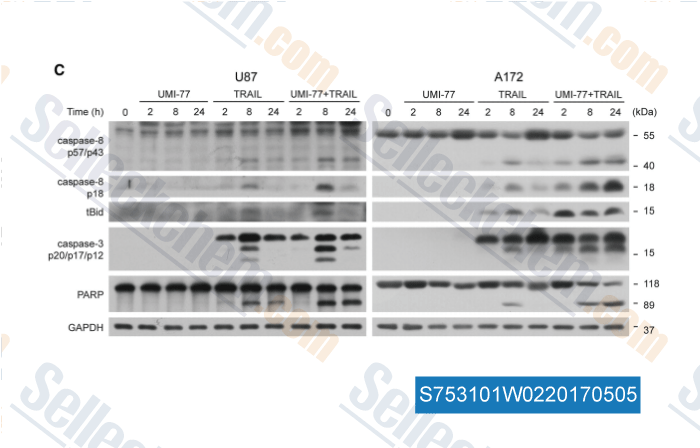
-
, , Mol Cell Biochem, 2017, 432(1-2):55-65
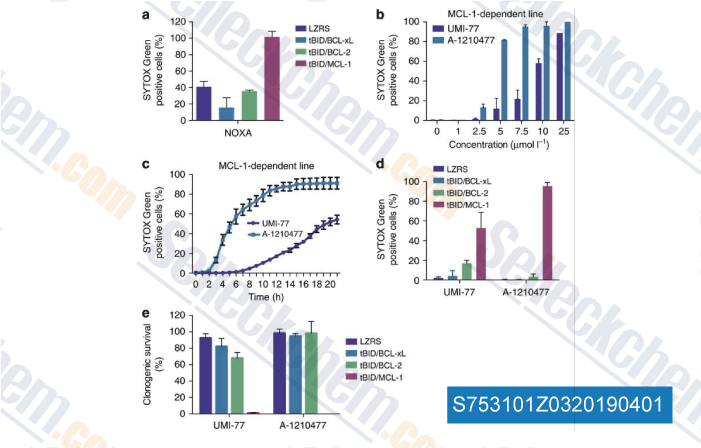
-
Daten von [ , , Nat Commun, 2016, 7:10538 ]
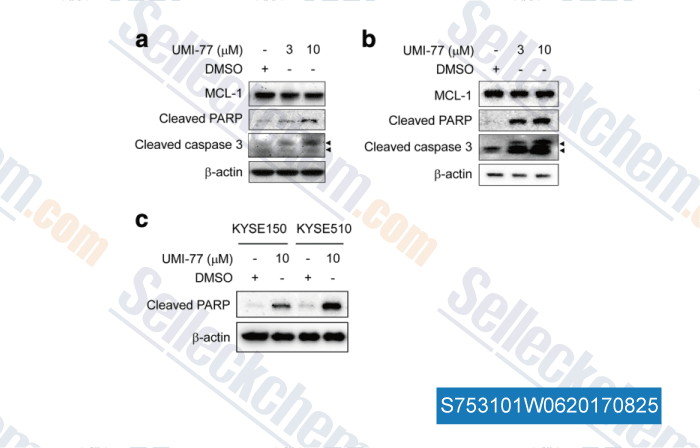
-
Daten von [ , , BMC Cancer, 2017, 17(1):449 ]
Sellecks UMI-77 Wurde zitiert von 21 Publikationen
| Therapy-induced normal tissue damage promotes breast cancer metastasis [ iScience, 2024, 27(1):108503] | PubMed: 38161426 |
| Deregulation and epigenetic modification of BCL2-family genes cause resistance to venetoclax in hematologic malignancies [ Blood, 2022, blood.2021014304] | PubMed: 35704690 |
| Proteogenomics refines the molecular classification of chronic lymphocytic leukemia [ Nat Commun, 2022, 13(1):6226] | PubMed: 36266272 |
| AXL/MERTK inhibitor ONO-7475 potently synergizes with venetoclax and overcomes venetoclax resistance to kill FLT3-ITD acute myeloid leukemia [ Haematologica, 2021, 10.3324/haematol.2021.278369] | PubMed: 34732043 |
| Development of potent and selective inhibitors targeting the papain-like protease of SARS-CoV-2 [ Cell Chem Biol, 2021, S2451-9456(21)00213-0] | PubMed: 33979649 |
| Mesothelioma Cells Depend on the Antiapoptotic Protein Bcl-xL for Survival and Are Sensitized to Ionizing Radiation by BH3-Mimetics. [ Int J Radiat Oncol Biol Phys, 2020, 15;106(4):867-877] | PubMed: 31786278 |
| Targeting the Synthetic Vulnerability of PTEN-Deficient Glioblastoma Cells with MCL1 Inhibitors [ Mol Cancer Ther, 2020, 19(10):2001-2011] | PubMed: 32737157 |
| AT101 [(-)-Gossypol] Selectively Inhibits MCL1 and Sensitizes Carcinoma to BH3 Mimetics by Inducing and Stabilizing NOXA [ Cancers (Basel), 2020, 12(8):E2298] | PubMed: 32824203 |
| Alveolar Macrophage Apoptosis-associated Bacterial Killing Helps Prevent Murine Pneumonia. [ Am J Respir Crit Care Med, 2019, 200(1):84-97] | PubMed: 30649895 |
| Confounding off-target effects of BH3 mimetics at commonly used concentrations: MIM1, UMI-77, and A-1210477 [ Cell Death Dis, 2019, 10(3):185] | PubMed: 30796196 |
RÜCKGABERICHTLINIE
Die bedingungslose Rückgaberichtlinie von Selleck Chemical gewährleistet unseren Kunden ein reibungsloses Online-Einkaufserlebnis. Wenn Sie in irgendeiner Weise mit Ihrem Kauf unzufrieden sind, können Sie jeden Artikel innerhalb von 7 Tagen nach Erhalt zurückgeben. Im Falle von Produktqualitätsproblemen, sei es protokollbezogene oder produktbezogene Probleme, können Sie jeden Artikel innerhalb von 365 Tagen ab dem ursprünglichen Kaufdatum zurückgeben. Bitte befolgen Sie die nachstehenden Anweisungen, wenn Sie Produkte zurücksenden.
VERSAND UND LAGERUNG
Selleck-Produkte werden bei Raumtemperatur transportiert. Wenn Sie das Produkt bei Raumtemperatur erhalten, seien Sie versichert, dass die Qualitätskontrollabteilung von Selleck Experimente durchgeführt hat, um zu überprüfen, dass die normale Temperaturplatzierung von einem Monat die biologische Aktivität von Pulverprodukten nicht beeinträchtigt. Nach dem Sammeln lagern Sie das Produkt bitte gemäß den in der Datenblatt beschriebenen Anforderungen. Die meisten Selleck-Produkte sind unter den empfohlenen Bedingungen stabil.
NICHT FÜR DIE ANWENDUNG AM MENSCHEN, FÜR VETERINÄRMEDIZINISCHE DIAGNOSTIK ODER THERAPEUTISCHE ZWECKE.