
Technische Daten
| Formel | C45H50ClN7O7S |
||||||
| Molekulargewicht | 868.44 | CAS-Nr. | 1257044-40-8 | ||||
| Löslichkeit (25°C)* | In vitro | DMSO | 100 mg/mL (115.14 mM) | ||||
| Water | Insoluble | ||||||
| Ethanol | Insoluble | ||||||
| In vivo (Lösungsmittel einzeln und der Reihe nach zum Produkt hinzufügen.) |
|
||||||
|
* <1 mg/ml bedeutet schwer löslich oder unlöslich. * Bitte beachten Sie, dass Selleck die Löslichkeit aller Verbindungen intern testet und die tatsächliche Löslichkeit geringfügig von veröffentlichten Werten abweichen kann. Dies ist normal und ist auf geringfügige Batch-zu-Batch-Variationen zurückzuführen. * Versand bei Raumtemperatur (Stabilitätstests zeigen, dass dieses Produkt ohne Kühlmaßnahmen versendet werden kann.) |
|||||||
Vorbereitung von Stammlösungen
Biologische Aktivität
| Beschreibung | Venetoclax (ABT-199, GDC-0199) ist ein Bcl-2-selektiver Inhibitor mit einem Ki von <0,01 nM in zellfreien Assays, über 4800-fach selektiver gegenüber Bcl-xL und Bcl-w und keiner Aktivität gegenüber Mcl-1. Venetoclax induziert Berichten zufolge Zellwachstumshemmung, Apoptose, Zellzyklusarrest und Autophagie in dreifach negativen Brustkrebs-MDA-MB-231-Zellen. Phase 3. | ||
|---|---|---|---|
| Ziele |
|
||
| In vitro | Venetoclax (ABT-199) zeigt eine geringere Empfindlichkeit gegenüber Bcl-xL, Mcl-1 und Bcl-w mit Ki von 48 nM, > 444 nM bzw. 245 nM. Es hemmt potent FL5.12-Bcl-2-Zellen, RS4;11-Zellen mit EC50 von 4 nM und 8 nM, während es eine geringe Aktivität gegen FL5.12-Bcl-xL-Zellen mit EC50 von 261 nM zeigt. Diese Verbindung induziert eine schnelle Apoptose in RS4;11-Zellen mit Cytochrom c-Freisetzung, Caspase-Aktivierung, der Externalisierung von Phosphatidylserin und der Akkumulation von Sub-G0/G1-DNA. Quantitative Immunoblot-Analysen zeigen, dass die Empfindlichkeit stark mit der Expression von Bcl-2 korreliert, einschließlich NHL-, DLBCL-, MCL-, AML- und ALL-Zelllinien. Es induziert auch Apoptose in CLL mit einem durchschnittlichen EC50 von 3,0 nM. | ||
| In vivo | Venetoclax (ABT-199) bewirkt eine maximale Tumorwachstumshemmung von 95 % und eine Tumorwachstumsverzögerung von 152 % in RS4;11-Xenotransplantaten. Es hemmt auch das Xenotransplantatwachstum (DoHH2, Granta-519) als Einzelwirkstoff oder in Kombination mit SDX-105 und anderen Wirkstoffen. | ||
| Merkmale | Neu entwickelte Version von ABT-263 (Navitoclax). |
Protokoll (aus Referenz)
| Kinase-Assay:[1] |
|
|---|---|
| Zell-Assay:[1] |
|
| Tierstudie:[1] |
|
Referenzen
|
Kundenproduktvalidierung
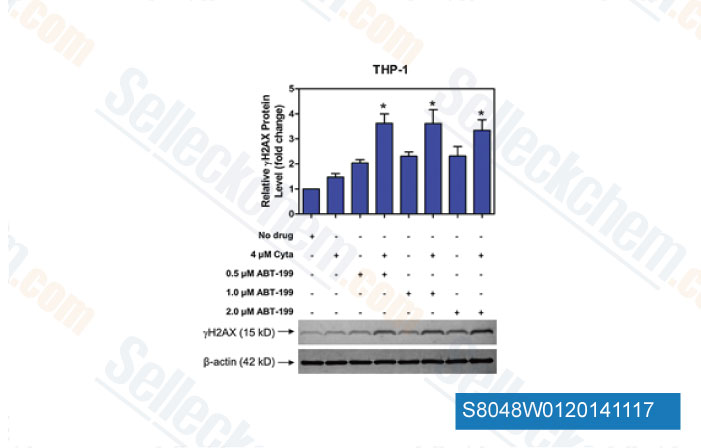
-
Daten von [ Mol Oncol , 2014 , 10.1016/j.molonc.2014.09.008 ]
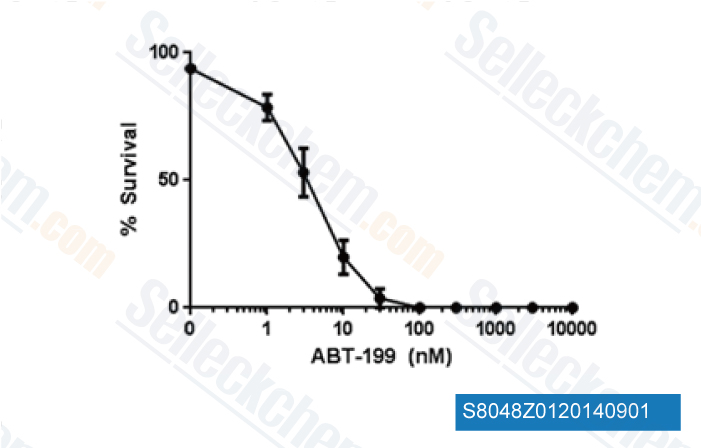
-
Daten von [ J Biol Chem , 2014 , 289(23), 16190-9 ]
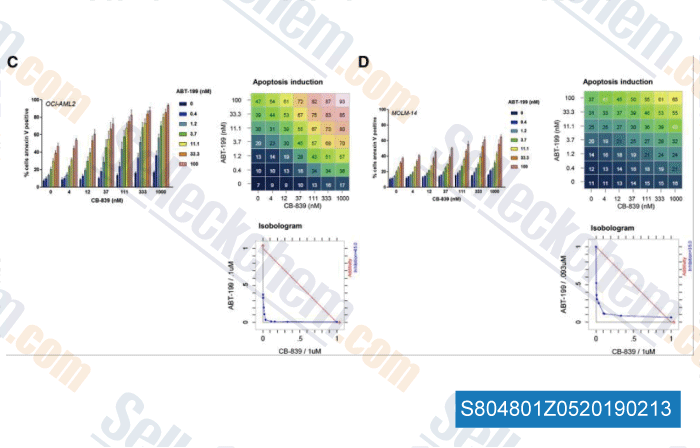
-
Daten von [ , , Blood, 2015, 126(11):1346-56 ]
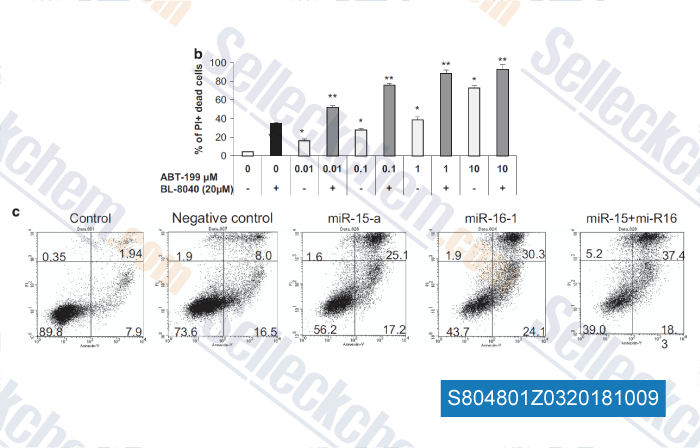
-
Daten von [ , , Leukemia, 2017, 31(11):2336-2346 ]
Sellecks ABT-199 (Venetoclax) Wurde zitiert von 650 Publikationen
| Combination antiretroviral therapy and MCL-1 inhibition mitigate HTLV-1 infection in vivo [ Cell, 2025, S0092-8674(25)00689-0] | PubMed: 40645177 |
| Inhibition of heme biosynthesis triggers cuproptosis in acute myeloid leukemia [ Cell, 2025, S0092-8674(25)01233-4] | PubMed: 41265435 |
| Anti-BCL2 therapy eliminates giant congenital melanocytic nevus by senolytic and immune induction [ Signal Transduct Target Ther, 2025, 10(1):161] | PubMed: 40374605 |
| High mtDNA content identifies oxidative phosphorylation-driven acute myeloid leukemias and represents a therapeutic vulnerability [ Signal Transduct Target Ther, 2025, 10(1):222] | PubMed: 40653487 |
| Co-targeting of epigenetic regulators and BCL-XL improves efficacy of immune checkpoint blockade therapy in multiple solid tumors [ Mol Cancer, 2025, 24(1):154] | PubMed: 40442785 |
| Tonic type I interferon signaling optimizes the antiviral function of plasmacytoid dendritic cells [ Nat Immunol, 2025, 26(11):1946-1961] | PubMed: 41087726 |
| Pathway coessentiality mapping reveals complex II is required for de novo purine biosynthesis in acute myeloid leukaemia [ Nat Metab, 2025, 7(12):2474-2488.] | PubMed: 41350470 |
| PIM2 inhibition promotes MCL1 dependency in plasma cells involving integrated stress response-driven NOXA expression [ Nat Commun, 2025, 16(1):256] | PubMed: 39747141 |
| CREBBP inactivation sensitizes B cell acute lymphoblastic leukemia to ferroptotic cell death upon BCL2 inhibition [ Nat Commun, 2025, 16(1):4274] | PubMed: 40393984 |
| Oncogenic role of RARG rearrangements in acute myeloid leukemia resembling acute promyelocytic leukemia [ Nat Commun, 2025, 16(1):617] | PubMed: 39805831 |
RÜCKGABERICHTLINIE
Die bedingungslose Rückgaberichtlinie von Selleck Chemical gewährleistet unseren Kunden ein reibungsloses Online-Einkaufserlebnis. Wenn Sie in irgendeiner Weise mit Ihrem Kauf unzufrieden sind, können Sie jeden Artikel innerhalb von 7 Tagen nach Erhalt zurückgeben. Im Falle von Produktqualitätsproblemen, sei es protokollbezogene oder produktbezogene Probleme, können Sie jeden Artikel innerhalb von 365 Tagen ab dem ursprünglichen Kaufdatum zurückgeben. Bitte befolgen Sie die nachstehenden Anweisungen, wenn Sie Produkte zurücksenden.
VERSAND UND LAGERUNG
Selleck-Produkte werden bei Raumtemperatur transportiert. Wenn Sie das Produkt bei Raumtemperatur erhalten, seien Sie versichert, dass die Qualitätskontrollabteilung von Selleck Experimente durchgeführt hat, um zu überprüfen, dass die normale Temperaturplatzierung von einem Monat die biologische Aktivität von Pulverprodukten nicht beeinträchtigt. Nach dem Sammeln lagern Sie das Produkt bitte gemäß den in der Datenblatt beschriebenen Anforderungen. Die meisten Selleck-Produkte sind unter den empfohlenen Bedingungen stabil.
NICHT FÜR DIE ANWENDUNG AM MENSCHEN, FÜR VETERINÄRMEDIZINISCHE DIAGNOSTIK ODER THERAPEUTISCHE ZWECKE.