
Technische Daten
| Formel | C14H20N2O3 |
||||||
| Molekulargewicht | 264.3 | CAS-Nr. | 149647-78-9 | ||||
| Löslichkeit (25°C)* | In vitro | DMSO | 53 mg/mL (200.52 mM) | ||||
| Ethanol | 2 mg/mL (7.56 mM) | ||||||
| Water | Insoluble | ||||||
| In vivo (Lösungsmittel einzeln und der Reihe nach zum Produkt hinzufügen.) |
|
||||||
|
* <1 mg/ml bedeutet schwer löslich oder unlöslich. * Bitte beachten Sie, dass Selleck die Löslichkeit aller Verbindungen intern testet und die tatsächliche Löslichkeit geringfügig von veröffentlichten Werten abweichen kann. Dies ist normal und ist auf geringfügige Batch-zu-Batch-Variationen zurückzuführen. * Versand bei Raumtemperatur (Stabilitätstests zeigen, dass dieses Produkt ohne Kühlmaßnahmen versendet werden kann.) |
|||||||
Vorbereitung von Stammlösungen
Biologische Aktivität
| Beschreibung | Vorinostat (SAHA) ist ein HDAC-Inhibitor mit einem IC50 von ~10 nM in einem zellfreien Assay und hebt die produktive HPV-18-DNA-Amplifikation auf. | ||
|---|---|---|---|
| Ziele |
|
||
| In vitro | Vorinostat (SAHA) hemmt die Aktivitäten von HDAC1 und HDAC3 mit IC50-Werten von 10 nM bzw. 20 nM und führt auch zu einer deutlichen Hyperacetylierung von Histon H4. Diese Verbindung hemmt das Wachstum von drei Prostatakrebszelllinien LNCaP, PC-3 und TSU-Pr1 in mikromolaren Konzentrationen (2,5-7,5 μM) und induziert einen dosisabhängigen Zelltod in LNCaP-Zellen. Die Behandlung in MCF-7-Zellen hemmt die Zellproliferation bei einem IC50 von 0,75 μM, was zur Akkumulation von Zellen in der G1- und G2-M-Phase des Zellzyklus führt. Es induziert auch die Differenzierung in der Östrogenrezeptor-negativen Zelllinie SKBr-3 und der Retinoblastom-negativen Zelllinie MDA-468. Eine Behandlung mit dieser Verbindung bei 1 μM für 8 Stunden oder länger ist ausreichend, um die Apoptose menschlicher Multiples Myelom (MM)-Zellen irreversibel zu induzieren. Die Genexpressionsprofile von Vorinostat-behandelten MM-Zellen sind nicht durch globale transkriptionelle Aktivierung gekennzeichnet, sondern durch koordinierte transkriptionelle Veränderungen spezifischer funktioneller Gengruppen wie Zytokin-induzierte proliferative/Überlebens-Signalkaskaden, Onkogene-Tumorsuppressorgene, Regulatoren der Apoptose, DNA-Synthese-Reparatur und Zellzyklus sowie Proteasom-Ubiquitin-Funktion. |
||
| In vivo | Die Verabreichung von Vorinostat (SAHA) (~100 mg/kg/Tag) hemmt signifikant das Wachstum menschlicher Prostatakarzinom-Xenotransplantate CWR22 in Nacktmäusen mit Tumorreduktionen von 78%, 97% und 97% bei Dosen von 25 mg/kg/Tag, 50 mg/kg/Tag bzw. 100 mg/kg/Tag im Vergleich zur Kontrolle. Diese Verbindung induziert die Akkumulation von acetylierten Kernhistonen und die mRNA-Expression des prostataspezifischen Antigens in CWR22-Zellen, was zu höheren Serumspiegeln des prostataspezifischen Antigens führt, als allein aus dem Tumorvolumen vorhergesagt. Die orale Verabreichung davon (0,67 g/L) überwindet die Blut-Hirn-Schranke, erhöht die Histonacetylierung im Gehirn und verbessert dramatisch die motorische Beeinträchtigung im R6/2-Mausmodell der Huntington-Krankheit. |
Protokoll (aus Referenz)
| Kinase-Assay: |
|
|---|---|
| Zell-Assay: |
|
| Tierstudie: |
|
Referenzen
|
Kundenproduktvalidierung
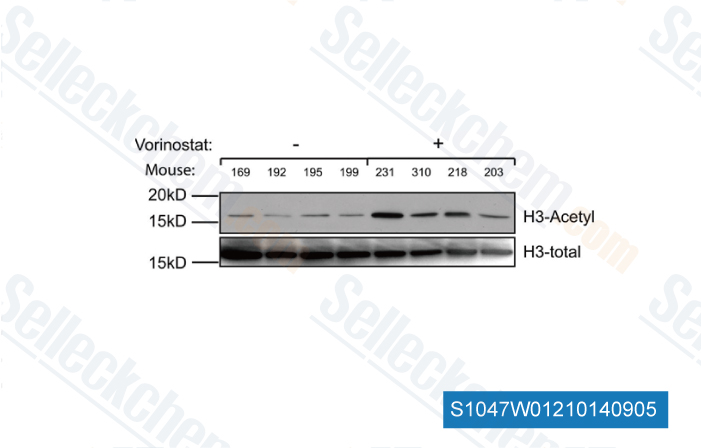
-
Daten von [ J Exp Med , 2012 , 209, 35-50 ]
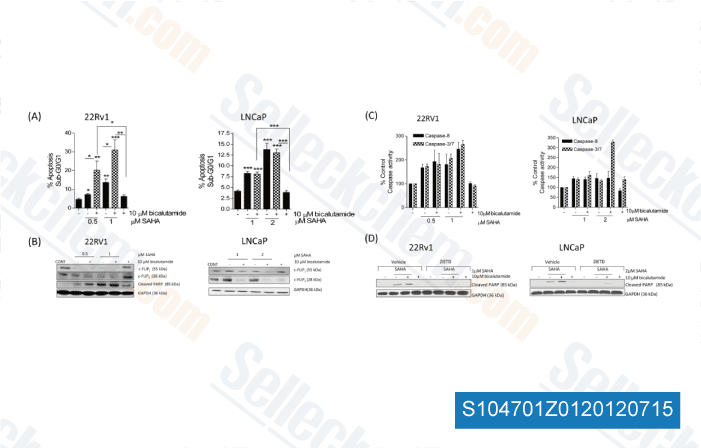
-
Daten von [ Clin Cancer Res , 2012 , 18, 3822-33 ]
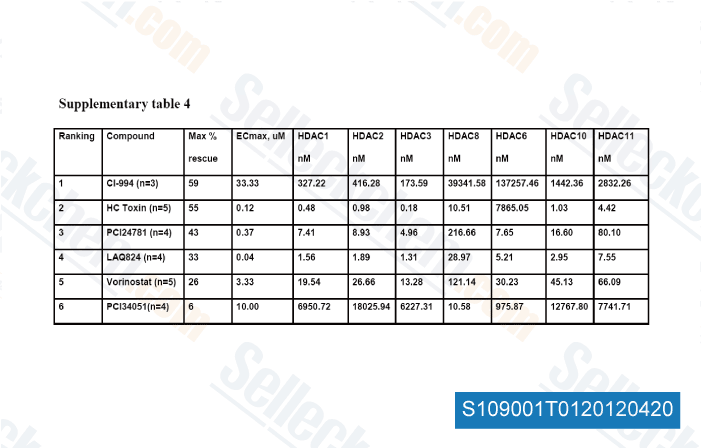
-
Daten von [ Diabetologia , 2012 , 55, 2421-2431 ]
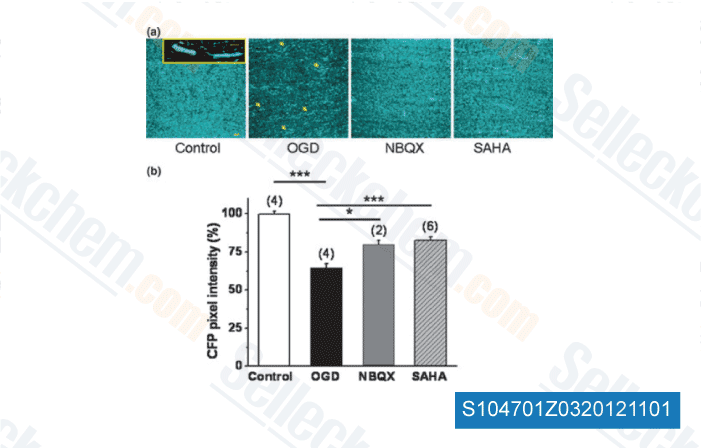
-
Daten von [ J Neurochem , 2012 , 123 Suppl 2, 108-15 ]
Sellecks Vorinostat (SAHA) Wurde zitiert von 614 Publikationen
| Co-targeting of epigenetic regulators and BCL-XL improves efficacy of immune checkpoint blockade therapy in multiple solid tumors [ Mol Cancer, 2025, 24(1):154] | PubMed: 40442785 |
| Intratumor heterogeneity of EGFR expression mediates targeted therapy resistance and formation of drug tolerant microenvironment [ Nat Commun, 2025, 16(1):28] | PubMed: 39747003 |
| The harmonized activities of HER2-HER3 heterodimer and deacetylated FOXA1 evade hormone response by regulating FOXA1 chromatin binding [ Nucleic Acids Res, 2025, 53(20)gkaf1086] | PubMed: 41224124 |
| Dual targeting of CDK6 and LSD1 is synergistic and overcomes differentiation blockade in AML [ EMBO Mol Med, 2025, 10.1038/s44321-025-00296-2] | PubMed: 40883610 |
| Heterozygous Kmt2d loss diminishes enhancers to render medulloblastoma cells vulnerable to combinatory inhibition of LSD1 and OXPHOS [ Cell Rep, 2025, 44(5):115619] | PubMed: 40286267 |
| A STAT3/integrin axis accelerates pancreatic cancer initiation and progression [ Cell Rep, 2025, S2211-1247(25)00781-8] | PubMed: 40701148 |
| DNMT inhibition epigenetically restores the cGAS-STING pathway and activates RIG-I/MDA5-MAVS to enhance antitumor immunity [ Acta Pharmacol Sin, 2025, 10.1038/s41401-025-01639-y] | PubMed: 40830678 |
| Integrator complex subunit 12 knockout overcomes a transcriptional block to HIV latency reversal [ Elife, 2025, 13RP103064] | PubMed: 40207620 |
| The integrative genomic and functional immunological analyses of colorectal cancer initiating cells to modulate stemness properties and the susceptibility to immune responses [ J Transl Med, 2025, 23(1):193] | PubMed: 39962504 |
| Targeting hypoxia-inducible factor-1 in a hypoxidative stress model protects retinal pigment epithelium cells from cell death and metabolic dysregulation [ Cell Death Discov, 2025, 11(1):380] | PubMed: 40813365 |
RÜCKGABERICHTLINIE
Die bedingungslose Rückgaberichtlinie von Selleck Chemical gewährleistet unseren Kunden ein reibungsloses Online-Einkaufserlebnis. Wenn Sie in irgendeiner Weise mit Ihrem Kauf unzufrieden sind, können Sie jeden Artikel innerhalb von 7 Tagen nach Erhalt zurückgeben. Im Falle von Produktqualitätsproblemen, sei es protokollbezogene oder produktbezogene Probleme, können Sie jeden Artikel innerhalb von 365 Tagen ab dem ursprünglichen Kaufdatum zurückgeben. Bitte befolgen Sie die nachstehenden Anweisungen, wenn Sie Produkte zurücksenden.
VERSAND UND LAGERUNG
Selleck-Produkte werden bei Raumtemperatur transportiert. Wenn Sie das Produkt bei Raumtemperatur erhalten, seien Sie versichert, dass die Qualitätskontrollabteilung von Selleck Experimente durchgeführt hat, um zu überprüfen, dass die normale Temperaturplatzierung von einem Monat die biologische Aktivität von Pulverprodukten nicht beeinträchtigt. Nach dem Sammeln lagern Sie das Produkt bitte gemäß den in der Datenblatt beschriebenen Anforderungen. Die meisten Selleck-Produkte sind unter den empfohlenen Bedingungen stabil.
NICHT FÜR DIE ANWENDUNG AM MENSCHEN, FÜR VETERINÄRMEDIZINISCHE DIAGNOSTIK ODER THERAPEUTISCHE ZWECKE.