
Technische Daten
| Formel | C16H14BrN3O3 |
||||||||||
| Molekulargewicht | 376.2 | CAS-Nr. | 211555-04-3 | ||||||||
| Löslichkeit (25°C)* | In vitro | DMSO | 75 mg/mL (199.36 mM) | ||||||||
| Water | Insoluble | ||||||||||
| Ethanol | Insoluble | ||||||||||
| In vivo (Lösungsmittel einzeln und der Reihe nach zum Produkt hinzufügen.) |
|
||||||||||
|
* <1 mg/ml bedeutet schwer löslich oder unlöslich. * Bitte beachten Sie, dass Selleck die Löslichkeit aller Verbindungen intern testet und die tatsächliche Löslichkeit geringfügig von veröffentlichten Werten abweichen kann. Dies ist normal und ist auf geringfügige Batch-zu-Batch-Variationen zurückzuführen. * Versand bei Raumtemperatur (Stabilitätstests zeigen, dass dieses Produkt ohne Kühlmaßnahmen versendet werden kann.) |
|||||||||||
Vorbereitung von Stammlösungen
Biologische Aktivität
| Beschreibung | WHI-P154 ist ein potenter JAK3-Inhibitor mit einer IC50 von 1,8 μM, ohne Aktivität gegen JAK1 oder JAK2. Es hemmt auch EGFR, Src, Abl, VEGFR und MAPK und verhindert die Phosphorylierung von Stat3, aber nicht von Stat5. | ||||||||
|---|---|---|---|---|---|---|---|---|---|
| Ziele |
|
||||||||
| In vitro | WHI-P154 wird erstmals als JAK3-Inhibitor beschrieben, der keine Aktivität bei JAK1 oder JAK2 zeigt. Diese Verbindung hemmt die STAT1-Aktivierung, iNOS-Expression und NO-Produktion in Makrophagen in vitro. Es ist jedoch erwiesen, dass diese Chemikalie auch andere gängige Kinasen wie EGFR, Src, Abl, VEGFR, MAPK und PI3-K hemmt und Apoptose in menschlichen Glioblastom-Zelllinien induziert. Es hemmt die Adhäsion und Migration von Glioblastomzellen im Kontext der ECM. Diese Verbindung zeigt eine signifikante Zytotoxizität gegen U373- und U87-menschliche Glioblastom-Zelllinien, die bei mikromolaren Konzentrationen zum apoptotischen Zelltod führt. Die In-vitro-Antiglobalaktivität dieser Chemikalie wird > 200-fach verstärkt und durch Konjugation an rekombinanten humanen epidermalen Wachstumsfaktor (EGF) selektiv gemacht. Die In-vitro-Behandlung mit EGF-P154 führt zum Abtöten von Glioblastomzellen bei nanomolaren Konzentrationen mit einer IC50 von 813 nM, während keine Zytotoxizität gegen EGF-R-negative Leukämiezellen beobachtet wird, selbst bei Konzentrationen von bis zu 100 mM. | ||||||||
| In vivo | Die In-vivo-Verabreichung von EGF-P154 führt zu einer verzögerten Tumorprogression und einem verbesserten tumorfreien Überleben in einem Glioblastom-Xenograft-Modell mit SCID-Mäusen. Während keines der Kontrollmäuse länger als 33 Tage tumorfrei überlebt (medianes tumorfreies Überleben, 19 Tage) und alle Kontrollmäuse Tumoren aufweisen, die schnell auf eine durchschnittliche Größe von > 500 mm3 bis zum 58. Tag anwachsen, bleiben 40% der Mäuse, die 10 aufeinanderfolgende Tage mit 1 mg/kg/Tag dieser Verbindung behandelt wurden, länger als 58 Tage am Leben und frei von nachweisbaren Tumoren, mit einem medianen tumorfreien Überleben von 40 Tagen. Die sich entwickelnden Tumoren in den restlichen 60% der Mäuse erreichen nie eine Größe von > 50 mm3. |
Protokoll (aus Referenz)
| Kinase-Assay:[1] |
|
|---|---|
| Zell-Assay:[3] |
|
| Tierstudie:[3] |
|
Referenzen
|
Kundenproduktvalidierung
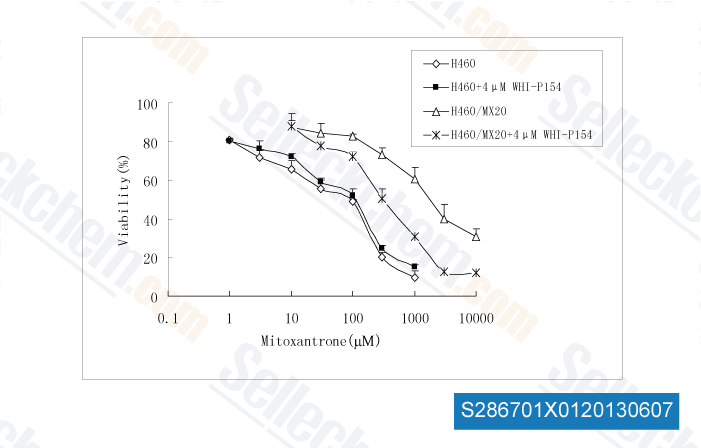
-
,
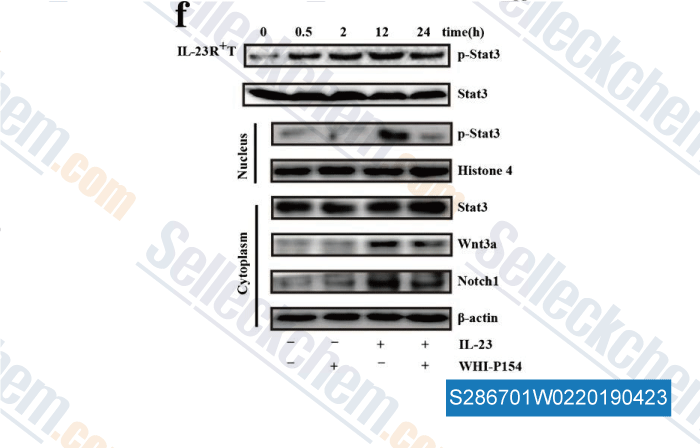
-
Daten von [ , , J Mol Med, 2018, doi:10.1007/s00109-018-1724-8 ]
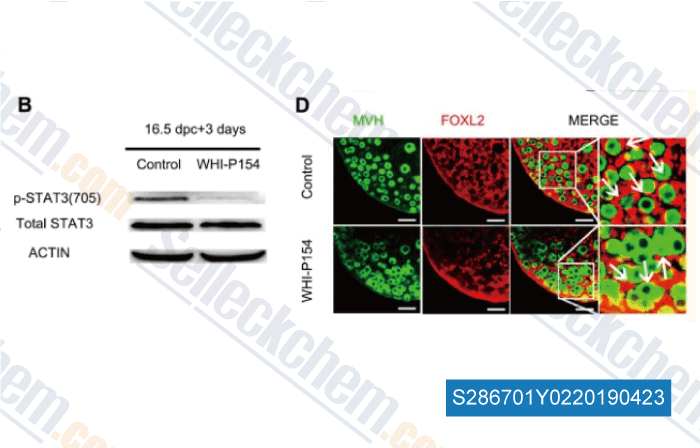
-
Daten von [ , , Biol Open, 2018, 7(1) ]
Sellecks WHI-P154 Wurde zitiert von 12 Publikationen
| Farnesoid X receptor activation by bile acids suppresses lipid peroxidation and ferroptosis [ Nat Commun, 2023, 14(1):6908] | PubMed: 37903763 |
| Tyrosine Kinase Inhibitor Profiling Using Multiple Forskolin-Responsive Reporter Cells [ Int J Mol Sci, 2023, 10.3390/ijms241813863] | PubMed: 37762164 |
| Tyrosine Kinase Inhibitor Profiling Using Multiple Forskolin-Responsive Reporter Cells [ Int J Mol Sci, 2023, 24(18)13863] | PubMed: 37762164 |
| Establishment and characterization of immortalized sweat gland myoepithelial cells [ Sci Rep, 2022, 12(1):7] | PubMed: 34997030 |
| Interleukin 6 trans-signaling is a critical driver of lung allograft fibrosis [ Am J Transplant, 2021, 21(7):2360-2371] | PubMed: 33249747 |
| Revisiting Aldehyde Oxidase Mediated Metabolism in Drug-like Molecules: An Improved Computational Model [ J Med Chem, 2020, 31] | PubMed: 32191458 |
| A novel human colon signet-ring cell carcinoma organoid line: establishment, characterization and application [ Carcinogenesis, 2020, 41(7):993-1004] | PubMed: 31740922 |
| IL-21 promotes osteoblastic differentiation of human valvular interstitial cells through the JAK3/STAT3 pathway [ Int J Med Sci, 2020, 17(18):3065-3072] | PubMed: 33173427 |
| Interleukin-23 receptor signaling mediates cancer dormancy and radioresistance in human esophageal squamous carcinoma cells via the Wnt/Notch pathway [Zhou Y, et al. J Mol Med, 2018, 10.1007/s00109-018-1724-8] | PubMed: 30483821 |
| JAK signaling regulates germline cyst breakdown and primordial follicle formation in mice [Huang K, et al. Biol Open, 2018, 7(1)] | PubMed: 29242197 |
RÜCKGABERICHTLINIE
Die bedingungslose Rückgaberichtlinie von Selleck Chemical gewährleistet unseren Kunden ein reibungsloses Online-Einkaufserlebnis. Wenn Sie in irgendeiner Weise mit Ihrem Kauf unzufrieden sind, können Sie jeden Artikel innerhalb von 7 Tagen nach Erhalt zurückgeben. Im Falle von Produktqualitätsproblemen, sei es protokollbezogene oder produktbezogene Probleme, können Sie jeden Artikel innerhalb von 365 Tagen ab dem ursprünglichen Kaufdatum zurückgeben. Bitte befolgen Sie die nachstehenden Anweisungen, wenn Sie Produkte zurücksenden.
VERSAND UND LAGERUNG
Selleck-Produkte werden bei Raumtemperatur transportiert. Wenn Sie das Produkt bei Raumtemperatur erhalten, seien Sie versichert, dass die Qualitätskontrollabteilung von Selleck Experimente durchgeführt hat, um zu überprüfen, dass die normale Temperaturplatzierung von einem Monat die biologische Aktivität von Pulverprodukten nicht beeinträchtigt. Nach dem Sammeln lagern Sie das Produkt bitte gemäß den in der Datenblatt beschriebenen Anforderungen. Die meisten Selleck-Produkte sind unter den empfohlenen Bedingungen stabil.
NICHT FÜR DIE ANWENDUNG AM MENSCHEN, FÜR VETERINÄRMEDIZINISCHE DIAGNOSTIK ODER THERAPEUTISCHE ZWECKE.