
Technische Daten
| Formel | C17H14BrN3O |
||||||||||||||
| Molekulargewicht | 356.22 | CAS-Nr. | 857064-38-1 | ||||||||||||
| Löslichkeit (25°C)* | In vitro | DMSO | 71 mg/mL (199.31 mM) | ||||||||||||
| Water | Insoluble | ||||||||||||||
| Ethanol | Insoluble | ||||||||||||||
| In vivo (Lösungsmittel einzeln und der Reihe nach zum Produkt hinzufügen.) |
|
||||||||||||||
|
* <1 mg/ml bedeutet schwer löslich oder unlöslich. * Bitte beachten Sie, dass Selleck die Löslichkeit aller Verbindungen intern testet und die tatsächliche Löslichkeit geringfügig von veröffentlichten Werten abweichen kann. Dies ist normal und ist auf geringfügige Batch-zu-Batch-Variationen zurückzuführen. * Versand bei Raumtemperatur (Stabilitätstests zeigen, dass dieses Produkt ohne Kühlmaßnahmen versendet werden kann.) |
|||||||||||||||
Vorbereitung von Stammlösungen
Biologische Aktivität
| Beschreibung | WP1066 ist ein neuartiger Inhibitor von JAK2 und STAT3 mit einem IC50 von 2,30 μM und 2,43 μM in HEL-Zellen; zeigt Aktivität gegenüber JAK2, STAT3, STAT5 und ERK1/2, aber nicht JAK1 und JAK3. WP1066 induziert Apoptose. Phase 1. | ||||
|---|---|---|---|---|---|
| Ziele |
|
||||
| In vitro | WP1066 hemmt das Wachstum von HEL-Zellen, die die JAK2 V617F-Mutantenisoform tragen, dosisabhängig mit IC20, IC50 und IC80 von 0,8, 2,3 und 3,8 μM. Diese Verbindung hemmt bei Konzentrationen von 0,5, 1,0, 2,0, 3,0 oder 4,0 μM die Phosphorylierung von JAK2, STAT3, STAT5 und ERK1/2, ohne die Phosphorylierung von JAK1 und JAK3 in erythroiden Leukämie-HEL-Zellen zu beeinflussen, die die JAK2 V617F-Isoform exprimieren. Bei Konzentrationen von 0,5 bis 3,0 μM hemmt es dosisabhängig die Proliferation von AML-koloniebildenden Zellen, die von Patienten gewonnen wurden, sowie die der AML-Zelllinien OCIM2 und K562. Diese Chemikalie verringert bei Konzentrationen von 0,5, 1,0, 2,0, 3,0 oder 4,0 μM dosisabhängig die JAK2- und pJAK2-Proteinspiegel sowie die nachgeschalteten Phosphorylierungsgrade von STAT3, STAT5 und AKT in OCIM2- und K562-Zellen. Bei Konzentrationen von 2 μM hemmt es die OCIM2-Zellvermehrung, indem es die Akkumulation von Zellen in der G0-G1-Phase des Zellzyklus induziert. Diese Verbindung induziert bei Konzentrationen von 1, 2 oder 3 μM Apoptose in sowohl OCIM2- als auch K562-Zellen dosisabhängig durch Aktivierung von Procaspase-3 und Spaltung von PARP. Bei Konzentrationen von 5 μM verhindert es die Phosphorylierung von STAT3, und bei Konzentrationen von 2,5 μM hemmt es signifikant die Zellüberlebensfähigkeit und Proliferation in Caki-1- und 786-O-Nierenkrebszellen. Diese Chemikalie unterdrückt bei Konzentrationen von 5 μM die HIF1α- und HIF2α-Expression sowie die VEGF-Produktion in Caki-1- und 786-O-Nierenkrebszellen. | ||||
| In vivo | WP1066, oral in einer Dosis von 40 mg/kg einmal täglich über 19 Tage verabreicht, hemmt signifikant das Tumorwachstum bei Caki-1-Xenograft-Mäusen, mit verminderter Immunfärbung von phosphoryliertem STAT3 und reduzierter Länge von CD34-positiven Gefäßen. | ||||
| Merkmale | Ähnlich wie seine Stammverbindung AG490 hemmt WP1066 die Phosphorylierung von JAK2, aber im Gegensatz zu AG490 degradierte WP1066 auch das JAK2-Protein. |
Protokoll (aus Referenz)
| Zell-Assay:[1] |
|
|---|---|
| Tierstudie:[4] |
|
Referenzen
|
Kundenproduktvalidierung
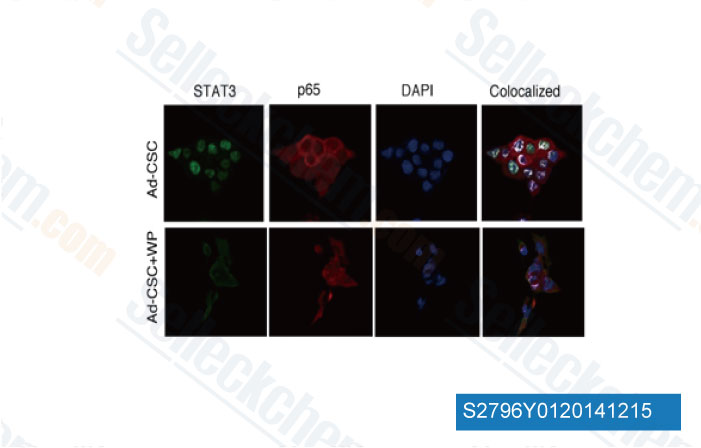
-
Daten von [ J Biol Chem , 2013 , 288(36), 26167-76 ]
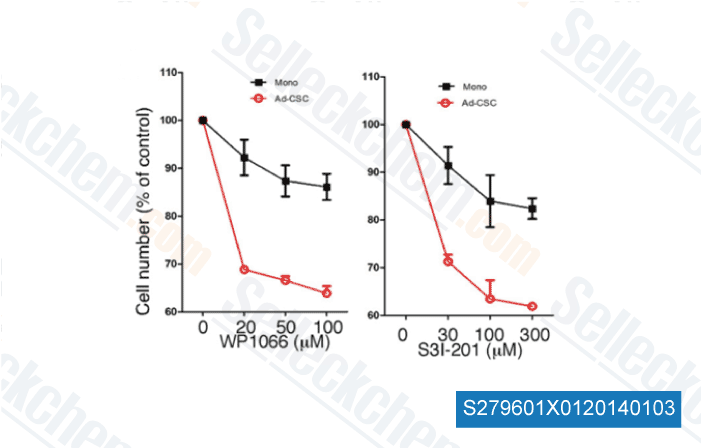
-
,
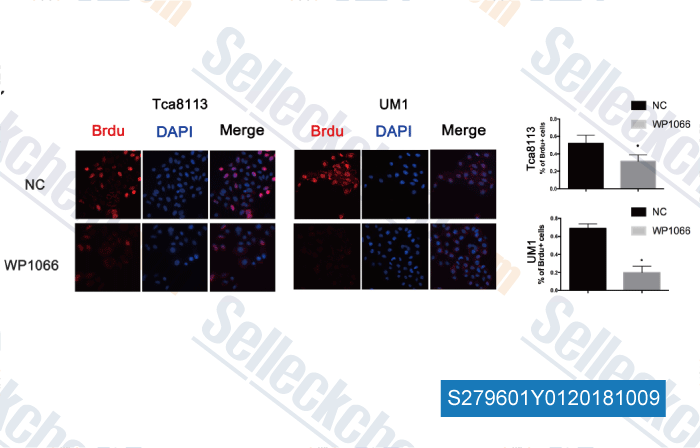
-
Daten von [ , , Clin Cancer Res, 2018, 24(11):2665-2677 ]
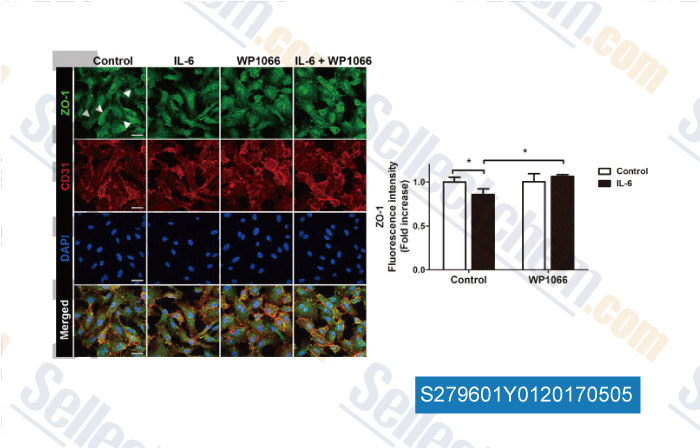
-
Daten von [ , , J Cell Physiol, 2017, 232(5):1123-1134 ]
Sellecks WP1066 Wurde zitiert von 76 Publikationen
| NIBAN2 Stimulates Glioma Growth by Regulating the JAK2/STAT3/c-Myc Pathway [ Cancer Med, 2025, 14(18):e71239] | PubMed: 40944417 |
| Lactate dehydrogenase A regulates tumor-macrophage symbiosis to promote glioblastoma progression [ Nat Commun, 2024, 15(1):1987] | PubMed: 38443336 |
| IGFBP3 induces PD-L1 expression to promote glioblastoma immune evasion [ Cancer Cell Int, 2024, 24(1):60] | PubMed: 38326861 |
| RNF122 promotes glioblastoma growth via the JAK2/STAT3/c-Myc signaling Axis [ CNS Neurosci Ther, 2024, 30(9):e70017] | PubMed: 39218810 |
| Investigation of cuproptosis regulator-mediated modification patterns and SLC30A7 function in GBM [ Aging (Albany NY), 2024, 16(4):3554-3582] | PubMed: 38393693 |
| P. gingivalis Infection Upregulates PD-L1 Expression on Dendritic Cells, Suppresses CD8+ T-cell Responses, and Aggravates Oral Cancer [ Cancer Immunol Res, 2023, 11(3):290-305] | PubMed: 36633576 |
| Tumor-associated astrocytes promote tumor progression of Sonic Hedgehog medulloblastoma by secreting lipocalin-2 [ Brain Pathol, 2023, 10.1111/bpa.13212] | PubMed: 37721122 |
| oHSV-P10 reduces glioma stem cell enrichment after oncolytic HSV therapy [ Mol Ther Oncolytics, 2023, 29:30-41] | PubMed: 37114074 |
| Triptolide reduces PD-L1 through the EGFR and IFN-γ/IRF1 dual signaling pathways [ Int Immunopharmacol, 2023, 118:109993] | PubMed: 36931170 |
| Triptolide reduces PD-L1 through the EGFR and IFN-γ/IRF1 dual signaling pathways [ International Immunopharmacology, 2023, Volume 118] | PubMed: None |
RÜCKGABERICHTLINIE
Die bedingungslose Rückgaberichtlinie von Selleck Chemical gewährleistet unseren Kunden ein reibungsloses Online-Einkaufserlebnis. Wenn Sie in irgendeiner Weise mit Ihrem Kauf unzufrieden sind, können Sie jeden Artikel innerhalb von 7 Tagen nach Erhalt zurückgeben. Im Falle von Produktqualitätsproblemen, sei es protokollbezogene oder produktbezogene Probleme, können Sie jeden Artikel innerhalb von 365 Tagen ab dem ursprünglichen Kaufdatum zurückgeben. Bitte befolgen Sie die nachstehenden Anweisungen, wenn Sie Produkte zurücksenden.
VERSAND UND LAGERUNG
Selleck-Produkte werden bei Raumtemperatur transportiert. Wenn Sie das Produkt bei Raumtemperatur erhalten, seien Sie versichert, dass die Qualitätskontrollabteilung von Selleck Experimente durchgeführt hat, um zu überprüfen, dass die normale Temperaturplatzierung von einem Monat die biologische Aktivität von Pulverprodukten nicht beeinträchtigt. Nach dem Sammeln lagern Sie das Produkt bitte gemäß den in der Datenblatt beschriebenen Anforderungen. Die meisten Selleck-Produkte sind unter den empfohlenen Bedingungen stabil.
NICHT FÜR DIE ANWENDUNG AM MENSCHEN, FÜR VETERINÄRMEDIZINISCHE DIAGNOSTIK ODER THERAPEUTISCHE ZWECKE.