
Technische Daten
| Formel |
C18H18N4
|
||||||||||
| Molekulargewicht | 290.36 | CAS-Nr. | 55778-02-4 | ||||||||
| Löslichkeit (25°C)* | In vitro | DMSO | 30 mg/mL (103.32 mM) | ||||||||
| Water | Insoluble | ||||||||||
| Ethanol | Insoluble | ||||||||||
| In vivo (Lösungsmittel einzeln und der Reihe nach zum Produkt hinzufügen.) |
|
||||||||||
|
* <1 mg/ml bedeutet schwer löslich oder unlöslich. * Bitte beachten Sie, dass Selleck die Löslichkeit aller Verbindungen intern testet und die tatsächliche Löslichkeit geringfügig von veröffentlichten Werten abweichen kann. Dies ist normal und ist auf geringfügige Batch-zu-Batch-Variationen zurückzuführen. * Versand bei Raumtemperatur (Stabilitätstests zeigen, dass dieses Produkt ohne Kühlmaßnahmen versendet werden kann.) |
|||||||||||
Vorbereitung von Stammlösungen
Biologische Aktivität
| Beschreibung | WZ811 ist ein hochwirksamer kompetitiver CXCR4-Antagonist mit einer EC50 von 0,3 nM. | ||
|---|---|---|---|
| Ziele |
|
||
| In vitro | WZ811 ist ein hochwirksamer kompetitiver Antagonist von CXCR4. Diese Verbindung ist wirksam bei der Neutralisierung von SDF-1 auf die cAMP-Reduktion in Dosen von nur wenigen Nanomol. Es blockiert die SDF-1-vermittelte Invasion mit einer EC50 von 5,2 nM. |
Protokoll (aus Referenz)
Referenzen
|
Kundenproduktvalidierung
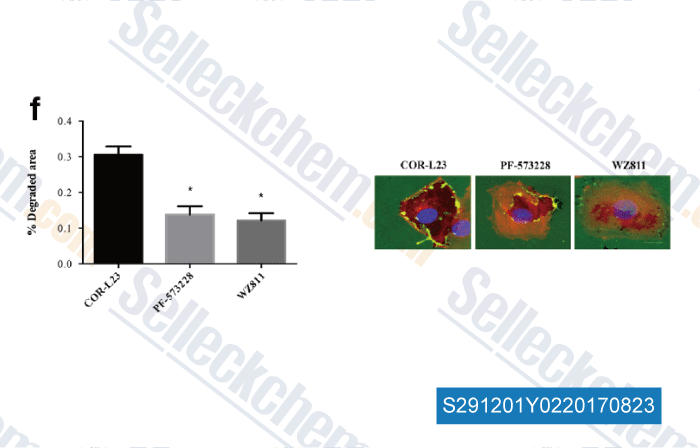
-
, , Invest New Drugs, 2017, 35(6):718-732
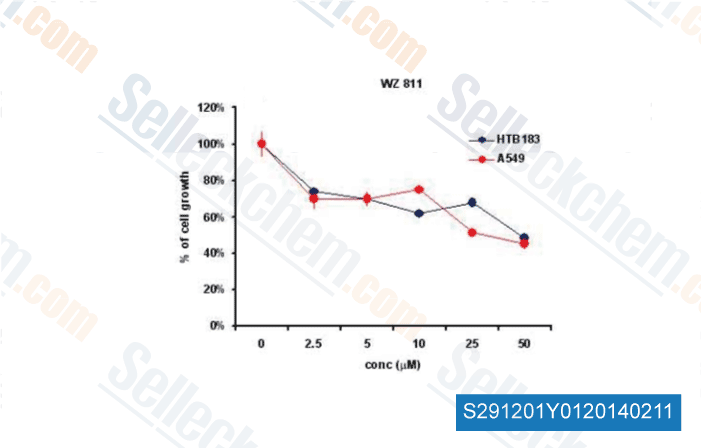
-
, , Dr.Milica Pesic from Institute for Biological Research
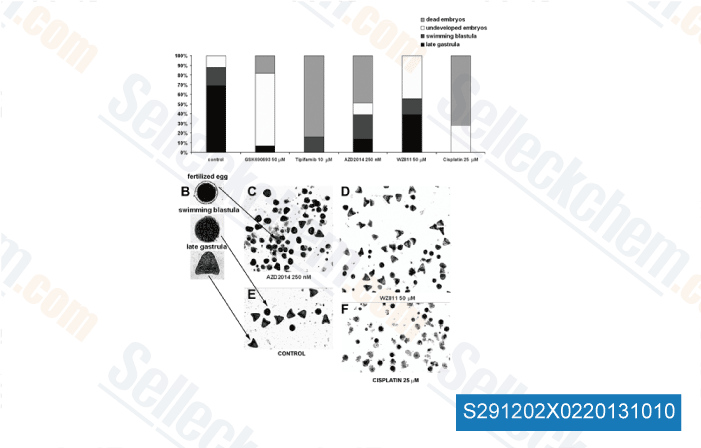
-
, , Dr. Milica Pesic from Institute for Biological Research
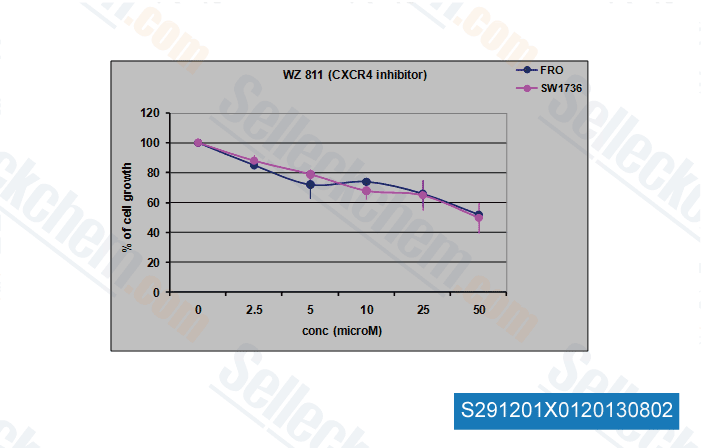
-
,
Sellecks WZ811 Wurde zitiert von 20 Publikationen
| Immunoglobulin-like transcript 2 as an impaired anti-tumor cytotoxicity marker of natural killer cells in patients with hepatocellular carcinoma [ Front Immunol, 2024, 15:1389411] | PubMed: 38638429 |
| MicroRNA-301a knockout attenuates peripheral nerve regeneration by delaying Wallerian degeneration [ Neural Regen Res, 2024, 10.4103/NRR.NRR-D-24-00081] | PubMed: 39101651 |
| Exploring the Interplay of RUNX2 and CXCR4 in Melanoma Progression [ Cells, 2024, 13(5)408] | PubMed: 38474372 |
| Modeling the SDF-1/CXCR4 protein using advanced artificial intelligence and antagonist screening for Japanese anchovy [ Front Physiol, 2024, 15:1349119] | PubMed: 38370015 |
| Metformin potentiates nephrotoxicity by promoting NETosis in response to renal ferroptosis [ Cell Discov, 2023, 9(1):104] | PubMed: 37848438 |
| Berbamine targets cancer stem cells and reverses cabazitaxel resistance via inhibiting IGF2BP1 and p-STAT3 in prostate cancer [ Prostate, 2023, 10.1002/pros.24632] | PubMed: 37828768 |
| The CXCR4-CXCL12 axis promotes T-cell reconstitution via efficient hematopoietic immigration [ J Genet Genomics, 2022, S1673-8527(22)00125-4] | PubMed: 35483564 |
| Single-cell transcriptomic reveals molecular diversity and developmental heterogeneity of human stem cell-derived oligodendrocyte lineage cells [ Nat Commun, 2021, 12(1):652] | PubMed: 33510160 |
| TGFβR-SMAD3 Signaling Induces Resistance to PARP Inhibitors in the Bone Marrow Microenvironment [ Cell Rep, 2020, 33(1):108221] | PubMed: 33027668 |
| Megakaryocytes participate in the occurrence of bleomycin-induced pulmonary fibrosis [ Cell Death Dis, 2019, 10(9):648] | PubMed: 31501415 |
RÜCKGABERICHTLINIE
Die bedingungslose Rückgaberichtlinie von Selleck Chemical gewährleistet unseren Kunden ein reibungsloses Online-Einkaufserlebnis. Wenn Sie in irgendeiner Weise mit Ihrem Kauf unzufrieden sind, können Sie jeden Artikel innerhalb von 7 Tagen nach Erhalt zurückgeben. Im Falle von Produktqualitätsproblemen, sei es protokollbezogene oder produktbezogene Probleme, können Sie jeden Artikel innerhalb von 365 Tagen ab dem ursprünglichen Kaufdatum zurückgeben. Bitte befolgen Sie die nachstehenden Anweisungen, wenn Sie Produkte zurücksenden.
VERSAND UND LAGERUNG
Selleck-Produkte werden bei Raumtemperatur transportiert. Wenn Sie das Produkt bei Raumtemperatur erhalten, seien Sie versichert, dass die Qualitätskontrollabteilung von Selleck Experimente durchgeführt hat, um zu überprüfen, dass die normale Temperaturplatzierung von einem Monat die biologische Aktivität von Pulverprodukten nicht beeinträchtigt. Nach dem Sammeln lagern Sie das Produkt bitte gemäß den in der Datenblatt beschriebenen Anforderungen. Die meisten Selleck-Produkte sind unter den empfohlenen Bedingungen stabil.
NICHT FÜR DIE ANWENDUNG AM MENSCHEN, FÜR VETERINÄRMEDIZINISCHE DIAGNOSTIK ODER THERAPEUTISCHE ZWECKE.