
Technische Daten
| Formel | C26H23F2N3O3 |
||||||
| Molekulargewicht | 463.48 | CAS-Nr. | 209984-56-5 | ||||
| Löslichkeit (25°C)* | In vitro | DMSO | 93 mg/mL (200.65 mM) | ||||
| Water | Insoluble | ||||||
| Ethanol | Insoluble | ||||||
| In vivo (Lösungsmittel einzeln und der Reihe nach zum Produkt hinzufügen.) |
|
||||||
|
* <1 mg/ml bedeutet schwer löslich oder unlöslich. * Bitte beachten Sie, dass Selleck die Löslichkeit aller Verbindungen intern testet und die tatsächliche Löslichkeit geringfügig von veröffentlichten Werten abweichen kann. Dies ist normal und ist auf geringfügige Batch-zu-Batch-Variationen zurückzuführen. * Versand bei Raumtemperatur (Stabilitätstests zeigen, dass dieses Produkt ohne Kühlmaßnahmen versendet werden kann.) |
|||||||
Vorbereitung von Stammlösungen
Biologische Aktivität
| Beschreibung | DBZ (Dibenzazepin) ist ein dipeptidischer γ-Secretase-Inhibitor mit einem IC50-Wert von 2,6 nM bzw. 2,9 nM in zellfreien Assays für APPL- und Notch-Spaltung. | ||||
|---|---|---|---|---|---|
| Ziele |
|
||||
| In vitro | YO-01027 interagiert direkt mit dem γ-secretase-Komplex und zielt auf das N-terminale Presenilin-Fragment ab. Steigende Konzentrationen von YO-01027, die APPL- oder Notch-exprimierenden Zellen verabreicht werden, führen zu einer progressiven Akkumulation von APPL CTF-Fragmenten und einer Abnahme der NICD-Produktion auf streng dosisabhängige Weise. 10 μM YO-01027 reduziert die Anzahl und Aktivität von Brustkrebs-Stammzellen (BCSC). Eine aktuelle Untersuchung zeigt, dass YO-01027 die Biosynthese des Muzinproteins MUC16 in undifferenzierten Zellen sowohl in präkonfluenten als auch in konfluenten Stadien durch Notch-Hemmung, aber nicht in postmitotischen geschichteten Zellen, konzentrationsabhängig beeinträchtigt. | ||||
| In vivo | YO-01027, das am Tag der Zellinjektion und alle 3 folgenden Tage als 1 mg/mL i.p.-Injektion verabreicht wird, verringert signifikant MCF7-, aber nicht MDA-MB-231-Tumoren und erhöht die Latenz im Vergleich zu Kontrollmäusen (18-28 Tage). Die mit YO-01027 behandelten MCF7-Tumoren, die sich bildeten, hatten deutlich reduzierte Tumorvolumina. Die Behandlung von C57BL/6-Mäusen mit YO-01027 hemmt die Proliferation von Epithelzellen und induziert die Becherzellendifferenzierung in intestinalen Adenomen dosisabhängig. |
Protokoll (aus Referenz)
| Kinase-Assay: |
|
|---|---|
| Zell-Assay: |
|
| Tierstudie: |
|
Referenzen
|
Kundenproduktvalidierung
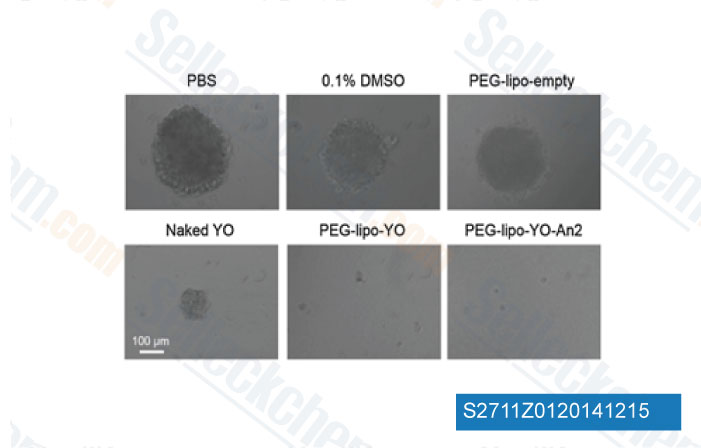
-
Daten von [ Journal of Pharmaceutical Investigation , 2014 , 10.1007/s40005-014-0151-2 ]
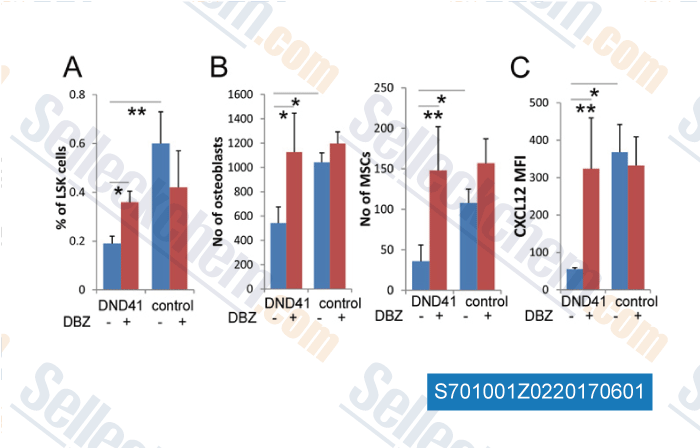
-
Daten von [ , , Cancer Res, 2016, 76(6):1641-52 ]
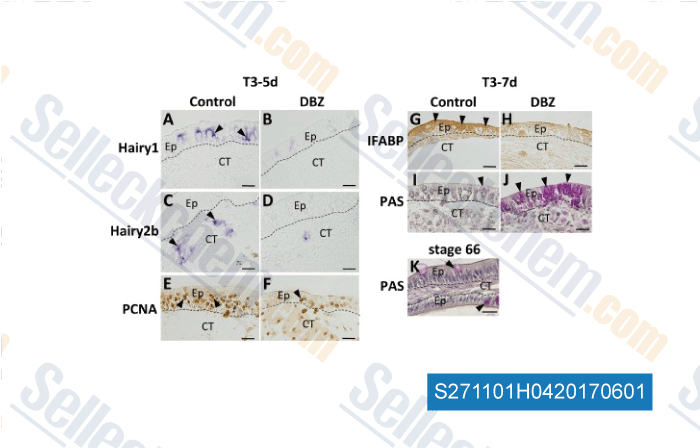
-
Daten von [ , , Stem Cells, 2017, 35(4):1028-1039 ]
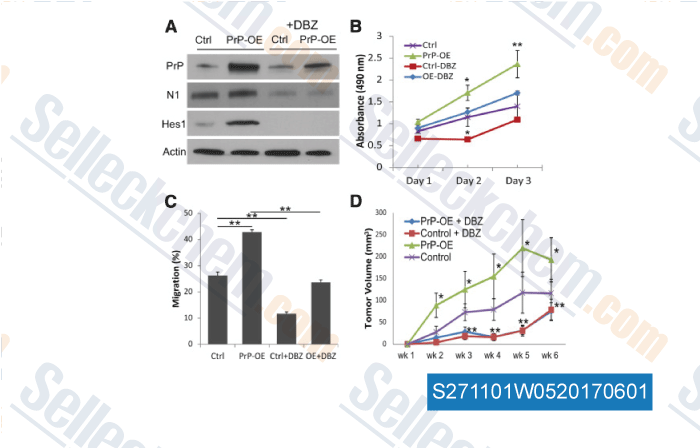
-
Daten von [ , , Am J Pathol, 2016, 186(11):2945-2956 ]
Sellecks Dibenzazepine (YO-01027) Wurde zitiert von 40 Publikationen
| GSK3 acts as a switch for transcriptional programs in a model of low-grade gliomagenesis [ Acta Neuropathol Commun, 2025, 13(1):87] | PubMed: 40307935 |
| Activation of notch signaling pathway is a potential mechanism for mucin2 reduction and intestinal mucosal barrier dysfunction in high-altitude hypoxia [ Sci Rep, 2025, 15(1):12154] | PubMed: 40204779 |
| A noncoding variant confers pancreatic differentiation defect and contributes to diabetes susceptibility by recruiting RXRA [ Nat Commun, 2024, 15(1):9771] | PubMed: 39532884 |
| Notch1 blockade by a novel, selective anti-Notch1 neutralizing antibody improves immunotherapy efficacy in melanoma by promoting an inflamed TME [ J Exp Clin Cancer Res, 2024, 43(1):295] | PubMed: 39491031 |
| GPA33 expression in colorectal cancer can be induced by WNT inhibition and targeted by cellular therapy [ Oncogene, 2024, ] | PubMed: 39472498 |
| Patient-Induced Pluripotent Stem Cell-Derived Hepatostellate Organoids Establish a Basis for Liver Pathologies in Telomeropathies [ Cell Mol Gastroenterol Hepatol, 2023, 16(3):451-472] | PubMed: 37302654 |
| HDAC6 and ERK/ADAM17 Regulate VEGF-Induced NOTCH Signaling in Lung Endothelial Cells [ Cells, 2023, 12(18)2231] | PubMed: 37759454 |
| Incongruence between transcriptional and vascular pathophysiological cell states [ Nat Cardiovasc Res, 2023, 2:2023530-549] | PubMed: 37745941 |
| Inhibition of LSD1 with bomedemstat sensitizes small cell lung cancer to immune checkpoint blockade and T cell killing [ Clin Cancer Res, 2022, CCR-22-1128] | PubMed: 35920742 |
| Notch signaling functions in noncanonical juxtacrine manner in platelets to amplify thrombogenicity [ Elife, 2022, 11e79590] | PubMed: 36190110 |
RÜCKGABERICHTLINIE
Die bedingungslose Rückgaberichtlinie von Selleck Chemical gewährleistet unseren Kunden ein reibungsloses Online-Einkaufserlebnis. Wenn Sie in irgendeiner Weise mit Ihrem Kauf unzufrieden sind, können Sie jeden Artikel innerhalb von 7 Tagen nach Erhalt zurückgeben. Im Falle von Produktqualitätsproblemen, sei es protokollbezogene oder produktbezogene Probleme, können Sie jeden Artikel innerhalb von 365 Tagen ab dem ursprünglichen Kaufdatum zurückgeben. Bitte befolgen Sie die nachstehenden Anweisungen, wenn Sie Produkte zurücksenden.
VERSAND UND LAGERUNG
Selleck-Produkte werden bei Raumtemperatur transportiert. Wenn Sie das Produkt bei Raumtemperatur erhalten, seien Sie versichert, dass die Qualitätskontrollabteilung von Selleck Experimente durchgeführt hat, um zu überprüfen, dass die normale Temperaturplatzierung von einem Monat die biologische Aktivität von Pulverprodukten nicht beeinträchtigt. Nach dem Sammeln lagern Sie das Produkt bitte gemäß den in der Datenblatt beschriebenen Anforderungen. Die meisten Selleck-Produkte sind unter den empfohlenen Bedingungen stabil.
NICHT FÜR DIE ANWENDUNG AM MENSCHEN, FÜR VETERINÄRMEDIZINISCHE DIAGNOSTIK ODER THERAPEUTISCHE ZWECKE.