
Technische Daten
| Formel | C16H13ClFN3O2 |
||||||
| Molekulargewicht | 333.74 | CAS-Nr. | 690206-97-4 | ||||
| Löslichkeit (25°C)* | In vitro | DMSO | 67 mg/mL (200.75 mM) | ||||
| Water | Insoluble | ||||||
| Ethanol | Insoluble | ||||||
| In vivo (Lösungsmittel einzeln und der Reihe nach zum Produkt hinzufügen.) |
|
||||||
|
* <1 mg/ml bedeutet schwer löslich oder unlöslich. * Bitte beachten Sie, dass Selleck die Löslichkeit aller Verbindungen intern testet und die tatsächliche Löslichkeit geringfügig von veröffentlichten Werten abweichen kann. Dies ist normal und ist auf geringfügige Batch-zu-Batch-Variationen zurückzuführen. * Versand bei Raumtemperatur (Stabilitätstests zeigen, dass dieses Produkt ohne Kühlmaßnahmen versendet werden kann.) |
|||||||
Vorbereitung von Stammlösungen
Biologische Aktivität
| Beschreibung | ZM 306416 (CB 676475) ist ein VEGFR (Flt und KDR)-Inhibitor für VEGFR1 mit einer IC50 von 0,33 μM, hemmt aber auch EGFR mit einer IC50 von <10 nM. | ||||||
|---|---|---|---|---|---|---|---|
| Ziele |
|
||||||
| In vitro | ZM-306416 induziert einen selektiven antiproliferativen Effekt auf die EGFR-abhängigen NSCLC-Zelllinien H3255 und HCC4011 mit einer IC50 von 0,09 µM bzw. 0,072 µM. ZM-306416 hemmt die Granulabildung mit einer IC50 von 0,67 μM. ZM-306416 hemmt signifikant den ERRα-Assay mit einer IC50 von 7,3 μM in der GeneBLAzer T-Rex RORγ-UAS-bla HEK293T-Zelllinie. ZM306416 (300 nM) hemmt vollständig die PAA-Sekretion und stimuliert die [125]I-Aufnahme in menschlichen Schilddrüsenfollikelzellen. ZM306416 (300 nM) eliminiert die pVEGFR2 (Y1214)-Expression in menschlichen Schilddrüsenfollikelzellen. ZM306416 (< 10 μM) hat ausgeprägte hemmende Wirkungen auf die steady-state Phosphorylierung von p42/44 MAPK, beeinflusst aber nicht die Expression der unphosphorylierten Form. ZM306416 (3 μM) erhöht signifikant den Zelltod in menschlichen Schilddrüsenfollikelzellen. ZM306416 (3 μM) erhöht signifikant den Zelltod in menschlichen Schilddrüsenfollikelzellen. ZM306416 hemmt schwach die Sekretion von VEGF und erhöht die Produktion von PlGF. ZM306416 (1 μM) verstärkt die Follikelbildung und verringert die nukleäre Verteilung in menschlichen Schilddrüsenfollikelzellen. |
Protokoll (aus Referenz)
Referenzen
|
Kundenproduktvalidierung
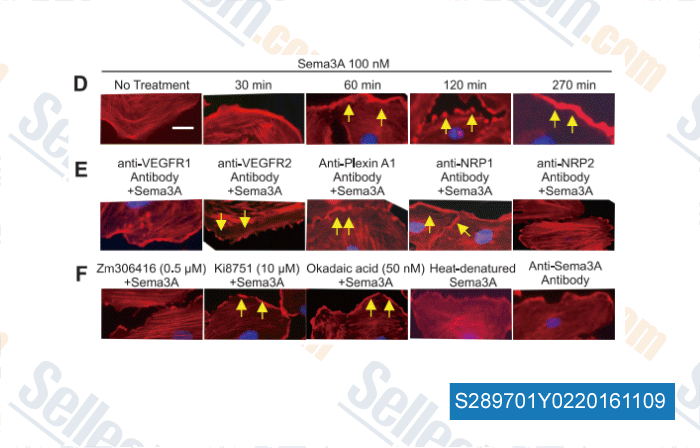
-
, , Sci Rep, 2015, 5:7890.

-
, , Cell Signal, 2016, 28(6):652-62.
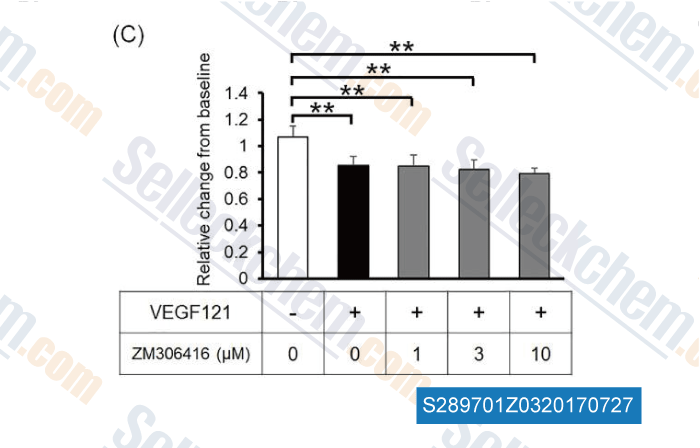
-
Daten von [ , , PLoS One, 2016, 11(9):e0161332 ]
Sellecks ZM 306416 Wurde zitiert von 13 Publikationen
| Gliovascular transcriptional perturbations in Alzheimer's disease reveal molecular mechanisms of blood brain barrier dysfunction [ Nat Commun, 2024, 15(1):4758] | PubMed: 38902234 |
| Regulation of Cell Cycle Progression through RB Phosphorylation by Nilotinib and AT-9283 in Human Melanoma A375P Cells [ Int J Mol Sci, 2024, 25(5)2956] | PubMed: 38474202 |
| Histamine promotes angiogenesis through a histamine H1 receptor-PKC-VEGF-mediated pathway in human endothelial cells [ J Pharmacol Sci, 2023, 151(4):177-186] | PubMed: 36925216 |
| Establishment of an oral squamous cell carcinoma cell line expressing vascular endothelial growth factor a and its two receptors [ J Dent Sci, 2022, 17(4):1471-1479] | PubMed: 36299342 |
| Vascular endothelial growth factor B exerts lipid-lowering effect by activating AMPK via VEGFR1 [ Life Sci, 2021, 276:119401] | PubMed: 33785341 |
| Crizotinib and Doxorubicin Cooperatively Reduces Drug Resistance by Mitigating MDR1 to Increase Hepatocellular Carcinoma Cells Death [ Front Oncol, 2021, 11:650052] | PubMed: 34094940 |
| The in vitro effect of VEGF receptor inhibition on primary alveolar osteoblast nodule formation. [ Aust Dent J, 2020, 10.1111/adj.12752] | PubMed: 32072641 |
| Central VEGF-A pathway plays a key role in the development of trigeminal neuropathic pain in rats. [ Mol Pain, 2019, 15:1744806919872602] | PubMed: 31397622 |
| Activated T cells induce proliferation of oligodendrocyte progenitor cells via release of vascular endothelial cell growth factor-A. [ Glia, 2018, 66(11):2503-2513] | PubMed: 30500113 |
| Vasculogenic and angiogenic potential of adipose stromal vascular fraction cell populations in vitro [Zakhari JS In Vitro Cell Dev Biol Anim, 2018, 54(1):32-40] | PubMed: 29197029 |
RÜCKGABERICHTLINIE
Die bedingungslose Rückgaberichtlinie von Selleck Chemical gewährleistet unseren Kunden ein reibungsloses Online-Einkaufserlebnis. Wenn Sie in irgendeiner Weise mit Ihrem Kauf unzufrieden sind, können Sie jeden Artikel innerhalb von 7 Tagen nach Erhalt zurückgeben. Im Falle von Produktqualitätsproblemen, sei es protokollbezogene oder produktbezogene Probleme, können Sie jeden Artikel innerhalb von 365 Tagen ab dem ursprünglichen Kaufdatum zurückgeben. Bitte befolgen Sie die nachstehenden Anweisungen, wenn Sie Produkte zurücksenden.
VERSAND UND LAGERUNG
Selleck-Produkte werden bei Raumtemperatur transportiert. Wenn Sie das Produkt bei Raumtemperatur erhalten, seien Sie versichert, dass die Qualitätskontrollabteilung von Selleck Experimente durchgeführt hat, um zu überprüfen, dass die normale Temperaturplatzierung von einem Monat die biologische Aktivität von Pulverprodukten nicht beeinträchtigt. Nach dem Sammeln lagern Sie das Produkt bitte gemäß den in der Datenblatt beschriebenen Anforderungen. Die meisten Selleck-Produkte sind unter den empfohlenen Bedingungen stabil.
NICHT FÜR DIE ANWENDUNG AM MENSCHEN, FÜR VETERINÄRMEDIZINISCHE DIAGNOSTIK ODER THERAPEUTISCHE ZWECKE.