
uitsluitend voor onderzoeksdoeleinden
Vinblastine sulfate Antineoplastic and Immunosuppressive Antibiotics remmer
Cat.Nr.S4505
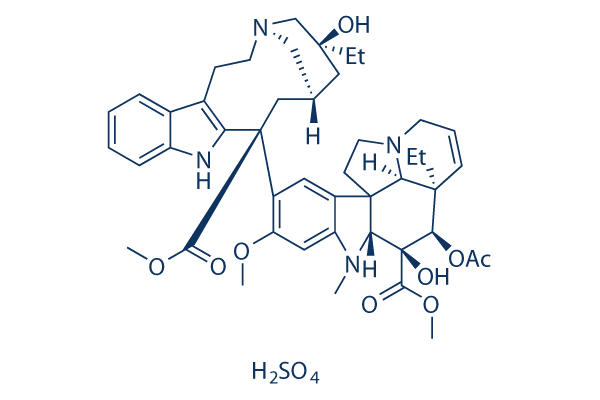
Chemische structuur
Moleculair gewicht: 909.05
Kwaliteitscontrole
| Gerelateerde doelwitten | Akt Wnt/beta-catenin PKC HSP ROCK Microtubule Associated Integrin Bcr-Abl Actin FAK |
|---|---|
| Overige Antineoplastic and Immunosuppressive Antibiotics Inhibitoren | Staurosporine (STS) Cyclosporin A Oligomycin A (MCH 32) Puromycin Dihydrochloride Nigericin sodium salt Geldanamycin (NSC 122750) Honokiol Streptozotocin (STZ) Sodium Monensin (NSC 343257) Cephalomannine |
Celkweek, behandeling & werkconcentratie
| Cellijnen | Assaytype | Concentratie | Incubatietijd | Formulering | Activiteitsbeschrijving | PMID |
|---|---|---|---|---|---|---|
| COLO 320 human colorectal carcinoma cell line | Function assay | In vitro concentration required to kill 50% of COLO 320 human colorectal carcinoma cell line, EC50=0.08 μM | ||||
| LNCaP human prostate cancer cell line | Function assay | In vitro concentration required to kill 50% of LNCaP human prostate cancer cell line, EC50=0.5 μM | ||||
| K562 cell | Growth inhibition assay | In vitro inhibitory concentration against human chronic myelogenous leukemia K562 cell growth, IC50=0.001 μM | ||||
| T47D cells | Function assay | In vitro concentration required to kill 50% of T47D human breast ductal carcinoma cell line, EC50=0.08 μM | ||||
| K562 cell | Proliferation assay | 48 h | Antiproliferative activity against human K562 cells after 48 hrs, IC50=0.001 μM | |||
| ACHN cells | Cytotoxicity assay | 48 h | Cytotoxicity against human ACHN cells after 48 hrs by SRB assay, IC50=22.7 μM | |||
| A375 cells | Cytotoxicity assay | 48 h | Cytotoxicity against human A375 cells after 48 hrs by SRB assay, IC50=7.2 μM | |||
| C32 cells | Cytotoxicity assay | 48 h | Cytotoxicity against human C32 cells after 48 hrs by SRB assay, IC50=3 μM | |||
| LNCAP cells | Cytotoxicity assay | 48 h | Cytotoxicity against human LNCAP cells after 48 hrs by SRB assay, IC50=29.3 μM | |||
| Huh-7D12 cells | Cytotoxicity assay | 48 h | Cytotoxicity against human Huh-7D12 cells after 48 hrs by SRB assay, IC50=45.6 μM | |||
| COR-L23 cells | Cytotoxicity assay | 48 h | Cytotoxicity against human COR-L23 cells after 48 hrs by SRB assay, IC50=45.5 μM | |||
| 142BR cells | Cytotoxicity assay | 48 h | Cytotoxicity against human 142BR cells after 48 hrs by SRB assay, IC50=37.6 μM | |||
| HT-29 cells | Cytotoxicity assay | 48 h | Cytotoxicity against human HT-29 cells after 48 hrs by MTS assay, IC50=0.55 μM | |||
| A549 cells | Proliferation assay | 48 h | Antiproliferative activity against human A549 cells after 48 hrs by MTS assay, IC50=2.36 μM | |||
| DU145 cells | Proliferation assay | 48 h | Antiproliferative activity against human DU145 cells after 48 hrs by MTS assay, IC50=4.25 μM | |||
| SK-MEL-5 cells | Proliferation assay | 48 h | Antiproliferative activity against human SK-MEL-5 cells after 48 hrs by MTS assay, IC50=1.74 μM | |||
| HepG2 cells | Proliferation assay | 48 h | Antiproliferative activity against human HepG2 cells after 48 hrs by MTS assay, IC50=0.16 μM | |||
| HT-29 cells | Proliferation assay | 48 h | Antiproliferative activity against human HT-29 cells after 48 hrs by MTS assay, IC50=11.18 μM | |||
| MCF7 cells | Proliferation assay | 48 h | Antiproliferative activity against human MCF7 cells after 48 hrs by MTS assay, IC50=24.08 μM | |||
| MDA-MB-231 cells | Proliferation assay | 48 h | Antiproliferative activity against human MDA-MB-231 cells after 48 hrs by MTS assay, IC50=31.52 μM | |||
| rat REF52 cells | Function assay | 0.1 μM | 30 mins | Induction of microtubule depolymerization in rat REF52 cells at 0.1 uM after 30 mins by fluorescence assay | ||
| HepG2 cells | Cytotoxicity assay | 72 h | Cytotoxicity against adriamycin-resistant human HepG2 cells assessed as growth inhibition after 72 hrs by MTT assay, IC50=0.056 μM | |||
| HepG2 cells | Cytotoxicity assay | 72 h | Cytotoxicity against human HepG2 cells assessed as growth inhibition after 72 hrs by MTT assay, IC50=0.019 μM | |||
| K562 cells | Cytotoxicity assay | 72 h | Cytotoxicity against human K562 cells assessed as growth inhibition after 72 hrs by MTT assay, IC50=0.016 μM | |||
| MDA-MB-231 cells | Cytotoxicity assay | 72 h | Cytotoxicity against human MDA-MB-231 cells assessed as growth inhibition after 72 hrs by MTT assay, IC50=0.0083 μM | |||
| MCF7 cells | Cytotoxicity assay | 72 h | Cytotoxicity against human MCF7 cells assessed as growth inhibition after 72 hrs by MTT assay, IC50=0.007 μM | |||
| SCL6 cells | Cytotoxicity assay | Cytotoxicity against human SCL6 cells by MTT assay, ED50=6.1 Μm | ||||
| SCL9 | Cytotoxicity assay | Cytotoxicity against human SCL9 cells by MTT assay, ED=5.3 μM | ||||
| KATO III cells | Cytotoxicity assay | Cytotoxicity against human KATO III cells by MTT assay, ED50=6.1 μM | ||||
| NUGC4 cells | Cytotoxicity assay | Cytotoxicity against human NUGC4 cells by MTT assay, ED50=5.3 μM | ||||
| UACC903 cells | Cytotoxicity assay | 48 h | Cytotoxicity against human UACC903 cells after 48 hrs by MTS assay, IC50=1.65 μM | |||
| K562 cells | Function assay | Inhibition of tubulin polymerization in human K562 cells, IC50=0.13 μM | ||||
| BxPC3 cells | Proliferation assay | 48 h | Antiproliferative activity against human BxPC3 cells after 48 hrs by MTS assay, IC50=1.13 μM | |||
| Klik om meer experimentele gegevens over de cellijn te bekijken | ||||||
Chemische informatie, Opslag en Stabiliteit
| Moleculair gewicht | 909.05 | Formule | C46H58N4O9.H2SO4 |
Opslag (Vanaf de ontvangstdatum) | |
|---|---|---|---|---|---|
| CAS-nr. | 143-67-9 | SDF downloaden | Opslag van stamoplossingen |
|
|
| Synoniemen | NSC-49842, Vincaleukoblastine, 29060-LE | Smiles | CCC1(CC2CC(C3=C(CCN(C2)C1)C4=CC=CC=C4N3)(C5=C(C=C6C(=C5)C78CCN9C7C(C=CC9)(C(C(C8N6C)(C(=O)OC)O)OC(=O)C)CC)OC)C(=O)OC)O.OS(=O)(=O)O | ||
Oplosbaarheid
|
In vitro |
DMSO
: 100 mg/mL
(110.0 mM)
Water : 50 mg/mL Ethanol : Insoluble |
Molariteitscalculator
|
In vivo |
|||||
In vivo Formuleringscalculator (Heldere oplossing)
Stap 1: Voer de onderstaande informatie in (Aanbevolen: Een extra dier voor het geval van verlies tijdens het experiment)
Stap 2: Voer de in vivo formulering in (Dit is alleen de calculator, geen formulering. Neem eerst contact met ons op als er geen in vivo formulering is in het gedeelte Oplosbaarheid.)
Berekeningsresultaten:
Werkconcentratie: mg/ml;
Methode voor het bereiden van DMSO-mastervloeistof: mg geneesmiddel vooraf opgelost in μL DMSO ( Concentratie mastervloeistof mg/mL, Neem eerst contact met ons op als de concentratie de DMSO-oplosbaarheid van de partij geneesmiddel overschrijdt. )
Methode voor het bereiden van in vivo formulering: Neem μL DMSO mastervloeistof, voeg vervolgens toeμL PEG300, mengen en helder maken, voeg vervolgens toeμL Tween 80, mengen en helder maken, voeg vervolgens toe μL ddH2O, mengen en helder maken.
Methode voor het bereiden van in vivo formulering: Neem μL DMSO mastervloeistof, voeg vervolgens toe μL Maïsolie, mengen en helder maken.
Opmerking: 1. Zorg ervoor dat de vloeistof helder is voordat u het volgende oplosmiddel toevoegt.
2. Zorg ervoor dat u het/de oplosmiddel(en) in de juiste volgorde toevoegt. U moet ervoor zorgen dat de verkregen oplossing, bij de vorige toevoeging, een heldere oplossing is voordat u verdergaat met het toevoegen van het volgende oplosmiddel. Fysische methoden zoals vortexen, echografie of een warmwaterbad kunnen worden gebruikt om het oplossen te bevorderen.
Werkingsmechanisme
| Targets/IC50/Ki |
nAChR
(Adrenal Chromaffin Cells) 8.9 μM
|
|---|---|
| In vitro |
De gemiddelde terminale halfwaardetijd van Vinblastine sulfate is 14,3 uur. Bij incubatie in vers geïsoleerde rattenhepatocyten dringt deze verbinding snel en intensief in de cellen, waarschijnlijk via een passief diffusiemechanisme gevolgd door strakke cellulaire binding. Het remt de angiogene respons geïnduceerd door adrenomedulline en is ook positief voor mitotische slip, waardoor micronuclei ontstaan in mononucleaire cellen met cytokinesisblokkade. Deze chemische stof geeft een significante toename van gemicronucleerde mononucleaire cellen bij concentraties die ongeveer 50% celdood en cytostase of minder veroorzaakten, berekend met RPD, RICC en RCC.
|
| In vivo |
Vinblastine is een veelgebruikt kankerbestrijdend medicijn met ongewenste bijwerkingen. Een combinatie van deze verbinding en RAP in zeer lage doses tegen menselijke HCC krijgt een bevredigend anti-angiogeen effect in vivo. De klinisch relevante dosis van deze chemische stof remt de palmitoylering van tubuline in vivo in CEM-cellen (effect op de depalmitoylering van tubuline).
|
Referenties |
|
Toepassingen
| Methoden | Biomarkers | Afbeeldingen | PMID |
|---|---|---|---|
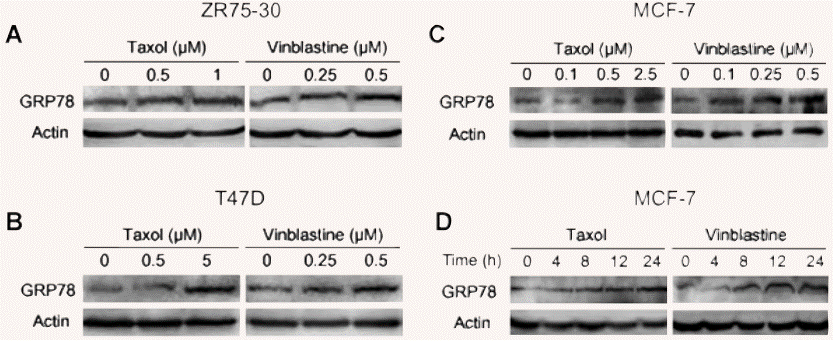
| Western blot | GRP78 p-eIF2 p-JNK / c-Caspase-7 / c-PARP ERK / p-ERK / Mcl-1 / Bad / Bid / Noxa |
|
19674193 |
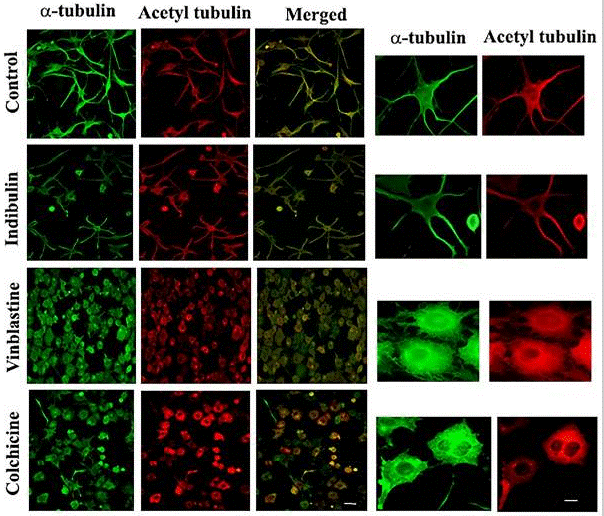
| Immunofluorescence | α-tubulin / Acetyl tubulin |
|
30120268 |
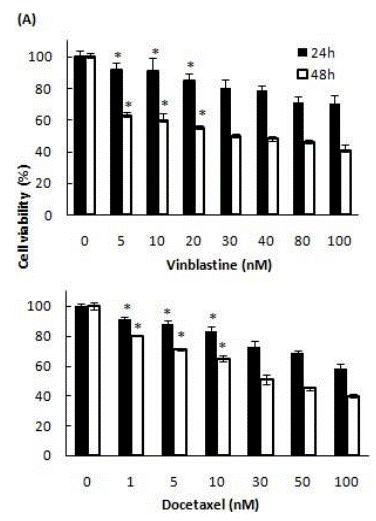
| Growth inhibition assay | Cell viability |
|
27114800 |
Informatie klinische proef
(gegevens van https://clinicaltrials.gov, bijgewerkt op 2024-05-22)
| NCT-nummer | Rekrutering | Aandoeningen | Sponsor/Medewerkers | Startdatum | Fasen |
|---|---|---|---|---|---|
| NCT06381570 | Recruiting | Low-grade Glioma |
Daniel Morgenstern|The Hospital for Sick Children |
March 21 2024 | Early Phase 1 |
Technische ondersteuning
Tel: +1-832-582-8158 Ext:3
Als u nog andere vragen heeft, kunt u een bericht achterlaten.

Producten zijn uitsluitend voor onderzoeksdoeleinden. Niet voor menselijk gebruik. Wij verkopen niet aan patiënten.
©Copyright 2013 Selleck Chemicals. Alle rechten voorbehouden.