Mammalian target of rapamycin (mTOR), also known as FKBP12-rapamycin-associated protein (FRAP), is a 280 kDa serine/threonine kinase which plays a key role in regulating critical cellular processes such as growth, proliferation, cytoskeletal organization, transcription, protein synthesis and ribosomal biogenesis by integrating three major inputs-nutrients (amino acids), growth factors (insulin), and cellular energy status. [show the full text]

mTOR inhibiteurs/activateurs (mTOR Inhibitors/Activators)
| N° de cat. | Nom du produit | Informations | Citations dutilisation du produit | Validations de produit |
|---|---|---|---|---|
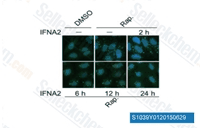
| S1039 | Rapamycin (Sirolimus) | Rapamycin ist ein spezifischer mTOR-Inhibitor mit einer IC50 von ~0,1 nM in HEK293-Zellen. Diese Verbindung bindet an FKBP12 und wirkt spezifisch als allosterischer Inhibitor von mTORC1. Es ist ein Autophagy-Aktivator und ein Immunsuppressivum. |
|
|
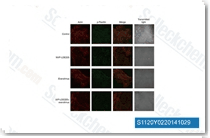
| S1120 | RAD001 (Everolimus) | Everolimus ist ein mTOR Inhibitor von FKBP12 mit einer IC50 von 1,6-2,4 nM in einem zellfreien Assay. Everolimus induziert Zell-Apoptose und Autophagy und hemmt die Proliferation von Tumorzellen. |
|
|
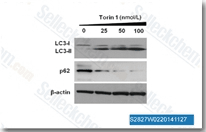
| S2827 | Torin 1 | Torin 1 ist ein potenter Inhibitor von mTORC1/2 mit einer IC50 von 2 nM/10 nM in zellfreien Assays; zeigt eine 1000-fache Selektivität für mTOR im Vergleich zu PI3K. |
|
|
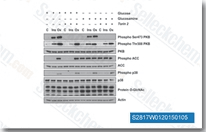
| S2817 | Torin 2 | Torin 2 ist ein potenter und selektiver mTOR-Inhibitor mit einer IC50 von 0,25 nM in p53 / - MEF-Zelllinien; 800-fach höhere Selektivität für mTOR als PI3K und verbesserte pharmakokinetische Eigenschaften. Diese Verbindung hemmt ATM/ATR/DNA-PK mit einer EC50 von 28 nM/35 nM/118 nM,in PC3-Zelllinien. Es verringert die Zellviabilität und induziert Autophagy und Apoptosis. |
|
|
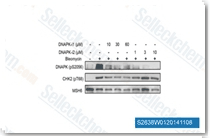
| S2638 | NU7441 (KU-57788) | NU7441 (KU-57788) ist ein hochwirksamer und selektiver DNA-PK-Inhibitor mit einer IC50 von 14 nM. Er hemmt auch mTOR und PI3K mit einer IC50 von 1,7 μM bzw. 5 μM in zellfreien Assays und reduziert die Häufigkeit von NHEJ, während die Rate der HDR nach Cas9-vermittelter DNA-Spaltung erhöht wird. |
|
|
| S9736 | ME-344 | ME-344 ist ein synthetischer Metabolit von NV-128, einem potenten Inhibitor des mitochondrialen oxidativen Phosphorylierung (OXPHOS) Komplex I, der die ATP-Generierung und den Sauerstoffverbrauch stört. Es hemmt auch mTOR durch Herunterregulierung des AKT/mTOR-Signalwegs und zeigt Antikrebsaktivität durch Hemmung des Zellwachstums und der Lebensfähigkeit in Leukämiezelllinien mit IC50-Werten von 70–260 nM. | ||
| S8163 | Paxalisib (GDC-0084) | Paxalisib (GDC-0084, RG7666) ist ein hirngängiger Inhibitor von PI3K und mTOR mit Kiapp-Werten von 2 nM, 46 nM, 3 nM, 10 nM und 70 nM für PI3Kα, PI3Kβ, PI3Kδ, PI3Kγ und mTOR. |
|
|
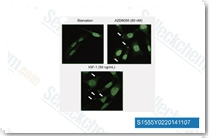
| S1555 | AZD8055 | AZD8055 ist ein neuartiger ATP-kompetitiver mTOR-Inhibitor mit einer IC50 von 0,8 nM in MDA-MB-468-Zellen mit ausgezeichneter Selektivität (ca. 1.000-fach) gegenüber PI3K-Isoformen und ATM/DNA-PK. Diese Verbindung induziert Caspase-abhängige Apoptose und induziert auch Autophagy. Phase 1. |
|
|
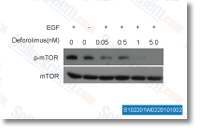
| S1022 | Ridaforolimus (Deforolimus, MK-8669) | Ridaforolimus (Deforolimus, MK-8669, AP23573) ist ein selektiver mTOR-Inhibitor mit einer IC50 von 0,2 nM in der HT-1080-Zelllinie; obwohl nicht als Prodrug klassifiziert, ähneln die mTOR-Hemmung und FKBP12-Bindung der von Rapamycin. Phase 3. |
|
|
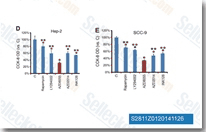
| S2811 | Sapanisertib (MLN0128, INK-128) | Sapanisertib (MLN0128, INK 128, TAK-228) ist ein potenter und selektiver mTOR-Inhibitor mit einer IC50 von 1 nM in zellfreien Assays; >200-fach weniger potent gegenüber Klasse-I-PI3K-Isoformen, überlegen bei der Blockierung von mTORC1/2 und empfindlich gegenüber Pro-Invasions-Genen (vs. Rapamycin). Phase 1. |
|
|
Mammalian target of Rapamycin (mTOR), also known as FKBP12-rapamycin-associated protein (FRAP), is a 280 kDa serine/threonine kinase [1-3]. mTOR kinase activity could be promoted by various extra- and intracellular stimulus like trophic factors, mitogens, hormones, amino acids and cellular stress [4-8]. In response to increased availability of stimuli, mTOR modulates numerous of important cellular processes, e.g. protein translation and autophagy, by phosphorylating its downstream molecules [9]. mTOR is the nuclear catalytic subunit of two complexes: mTORC1 and mTORC2 [1]. mTORC1 is comprised of mTOR, Raptor, mLST8, and PRAS40 (a mTOR inhibitor). This complex presented classic features of mTOR as a nutrient or energy sensor and protein synthesis conditioner [5, 10]. Low level of nutrient levels, growth factor and cellular stress inhibits the activity of mTORC1 [9, 10]. p70-S6 Kinase 1 (S6K1) and the eukaryotic initiation factor 4E (eIF4E) binding protein 1 (4E-BP1) are the best investigated targets of mTORC1 [5]. The activated mTORC1 showed a negative feedback inhibition on PI3K signaling [11]. mTORC1 could be specifically suppressed by rapamycin, as well as its allosteric ramifications. mTORC2 contains mTOR, Rictor, mLST8, and mSIN1 [12, 13]. Different from mTORC1, activated mTORC2 could induce the phosphorylation of Akt at serine 473 and serving as a positive feedback on PI3K signaling cascade [14]. Although mTORC2 was identified as a rapamycin-insensitive complex previously [14], an inhibition effect of rapamycin on free mTOR was observed in some cell lines [15]. Recent studies revealed that disordered activity of mTOR is related to some malignant and resistant cancer. The specific inhibitors, such as rapamycin and Temsirolimus(CCI-779), have been developed and trialed as novel anti-cancer agents [16, 17].

Les produits sont destinés à la recherche uniquement. Non destinés à lusage humain. Nous ne vendons pas aux patients.
©Copyright 2013 Selleck Chemicals. Tous droits réservés.