Phosphatidylinositol 3-kinase (PI 3-kinase or PI3K) is a famous target which is the upstream of akt because PI3K can activate Akt when PI3K is activated by growth factors including EGF, IGF, TGF-α and so on. The activation Class IA PI3Ks by growth factors is receptor tyrosine kinase (RTK)-dependent activation. Class IB PI3K is primarily regulated by small G-proteins such as Ras. PI3K is a key enzyme involved in cell processes, apoptosis and cancer. PI3K with mTOR, akt and MEK plays a key role in cancer. [show the full text]

PI3K Inhibitoren/Aktivatoren (PI3K Inhibitors/Activators)
| Kat.-Nr. | Produktname | Informationen | Publikationen | Validierung |
|---|---|---|---|---|
| S8668 | GDC-0077 (Inavolisib) | Inavolisib (GDC-0077, RG6114, RO-7113755) ist ein potenter selektiver Inhibitor von PI3K alpha (PI3Kα) mit einer IC50 von 0,038 nM. GDC-0077 ist >300-fach selektiver für PI3K alpha gegenüber den anderen Klasse-I-PI3K-Isoformen (beta, delta und gamma) und >2000-fach selektiver gegenüber PIK-Familienmitgliedern. GDC-0077 bindet an die ATP-Bindungsstelle von PI3K und hemmt die Phosphorylierung von PIP2 zu PIP3. |
|
|
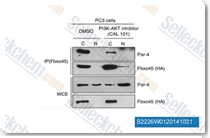
| S2226 | CAL-101 (Idelalisib) | Idelalisib (CAL-101) ist ein selektiver p110δ-Inhibitor mit einer IC50 von 2,5 nM in zellfreien Assays; es zeigte eine 40- bis 300-fach höhere Selektivität für p110δ als für p110α/β/γ und eine 400- bis 4000-fach höhere Selektivität für p110δ als für C2β, hVPS34, DNA-PK und mTOR. Idelalisib stimuliert auch die Autophagy. |
|
|
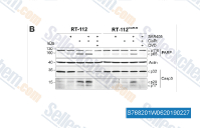
| S7682 | SAR405 | SAR405 ist ein niedermolekularer Kinaseinhibitor von PIK3C3/Vps34 (KD 1,5 nM), der eine hohe Selektivität aufweist und bis zu 10 μM an Klasse-I- und Klasse-II-PI3Ks sowie an mTOR nicht aktiv ist. SAR405 verhindert die Autophagie und wirkt in Tumorzellen synergistisch mit der MTOR (mechanistisches Target von Rapamycin)-Inhibition. |
|
|
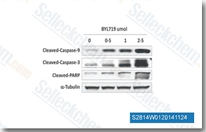
| S2814 | Alpelisib (BYL719) | Alpelisib (BYL719) ist ein potenter und selektiver PI3Kα-Inhibitor mit einer IC50 von 5 nM in einem zellfreien Assay und minimaler Wirkung auf PI3Kβ/γ/δ. Diese Verbindung befindet sich in Phase 2. |
|
|
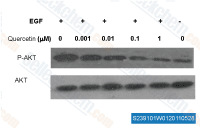
| S2391 | Quercetin (Sophoretin) | Quercetin, ein natürliches Flavonoid, das in Gemüse, Obst und Wein vorkommt, ist ein Stimulator von rekombinantem SIRT1 und auch ein PI3K-Inhibitor mit einer IC50 von 2,4-5,4 μM. Quercetin induziert Mitophagy, Apoptose und protektive Autophagy. Phase 4. |
|
|
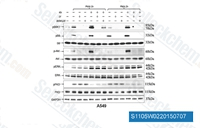
| S1105 | LY294002 | LY294002 (SF 1101, NSC 697286) ist das erste synthetische Molekül, das PI3Kα/δ/β mit einer IC50 von 0,5 μM/0,57 μM/0,97 μM hemmt; es ist in Lösung stabiler als Wortmannin und blockiert auch die Autophagosomenbildung. Es bindet nicht nur an Klasse-I-PI3Ks und andere PI3K-verwandte Kinasen, sondern auch an neuartige Ziele, die scheinbar nicht zur PI3K-Familie gehören. Diese Verbindung hemmt auch CK2 mit einer IC50 von 98 nM. Es ist ein nicht-spezifischer DNA-PKcs-Inhibitor und aktiviert Autophagy und Apoptosis. |
|
|
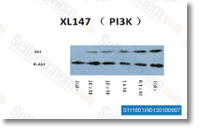
| S1118 | XL147 analogue | XL147 analogue (SAR245408) ist ein selektiver und reversibler PI3K-Hemmer der Klasse I für PI3Kα/δ/γ mit einer IC50 von 39 nM/36 nM/23 nM in zellfreien Assays, weniger potent gegenüber PI3Kβ. Diese Verbindung induziert Apoptosis. Phase 1/2. |
|
|
| E1815 | Tersolisib (STX-478) | Tersolisib (STX-478) ist ein hochwirksamer, mutationsselektiver, allosterischer Inhibitor von PI3Kα, der selektiv auf prävalente mutierte Formen von PI3Kα abzielt. Er zeigt eine starke Wirksamkeit gegen häufige PI3Kα-Helikal- und Kinase-Domänenmutationen, einschließlich der H1047R-Variante, mit einem IC50-Wert von 9,4 nmol/L. STX-478 weist eine 14-fach höhere Selektivität für mutierte PI3Kα gegenüber der Wildtypform auf. Er schont metabolische Dysfunktionen und verbessert die therapeutische Reaktion in PI3Kα-Mutanten-Xenotransplantaten. | ||
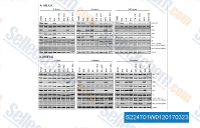
| S2247 | Buparlisib (BKM120) | Buparlisib (BKM120, NVP-BKM120) ist ein selektiver PI3K-Inhibitor von p110α/β/δ/γ mit einer IC50 von 52 nM/166 nM/116 nM/262 nM in zellfreien Assays. Reduzierte Wirksamkeit gegen VPS34, mTOR, DNAPK, mit geringer Aktivität gegenüber PI4Kβ. Buparlisib induziert Apoptose. Phase 2. |
|
|
| S7865 | 740 Y-P (PDGFR 740Y-P) | 740 Y-P (PDGFR 740Y-P, 740YPDGFR) ist ein zellgängiger Phosphopeptid-Aktivator von PI3K. |
|
|
Phosphatidylinositol 3-kinases (PI3Ks) are a family of lipid kinases whose biological function is to phosphorylate the 3-hydroxyl group of phosphoinositide. It is proved that PI3K-dependent signaling pathway contributes to many cellular processes such as cell growth, proliferation, differentiation, motility, survival and intracellular trafficking, which might be involved in oncogenesis under certain situation[1]. When a growth factor or ligand binds to the tyrosine kinase receptors (RTK), the PI3K is activated by G protein-coupled receptors[2]. PI3Ks family is generally divided into Class I, Class II, and Class III according to their primary structure, regulation, and in vitro lipid substrate specificity[2]. Class I PI3Ks are heterodimeric molecules composed of a regulatory subunit (p85) and a catalytic subunit (p110). The regulatory subunit of PI3K could be further divided in to six subtypes: p85-α, p85-β, p55-γ, p150,p101 and p87. P85α is the most highly expressed regulatory subunit than the others. And the catalytic subunit could also further divided into four subtypes: p110-α, p110-β, p110-γ and p110-δ. The α and β isoforms of p110 are expressed in all kinds of cells, whereas δ is only found in leukocytes. The regulatory subunit p101 and catalytic subunit p110γ comprise a complex which is classified as Class IB PI3K. Other collocations of regulatory and catalytic subunits are called Class IA PI3Ks. However, class II is structurally different from Class I. There are three catalytic isoforms of Class II PI3Ks: PI3K-C2α, -C2β, and -C2γ, but no regulatory subunit. Class III is structurally similar to Class I for the reason that it is composed of a catalytic (Vps34) and a regulatory subunit (p150). Functionally, class I PI3Ks catalyze the production of phosphatidylinositol 3-phosphate (PtdIns-3,4-P), phosphatidylinositol (3,4)-bisphosphate (PtdIns-3,4-P2), and phosphatidylinositol (3,4,5)-triphosphate (PtdIns-3,4,5-P3). Class II is related to the production of PtdIns-3-P and PtdIns-3,4-P2, while class III specifically catalyzes the production of PtdIns-3,4-P2 [3-5].

Produkte sind nur für Forschungszwecke bestimmt. Nicht für den menschlichen Gebrauch. Wir verkaufen nicht an Patienten.
©Copyright 2013 Selleck Chemicals. Alle Rechte vorbehalten.