The 70 kDa ribosomal protein S6 kinase (p70 S6K) is a serine/threonine kinase. Two members of S6K family are named as S6K1 and S6K2, respectively. As the downstream target of PI3K/Akt/mTOR signaling pateway, S6K could be activated in response to many stimulus such as growth factors, cytokines and nutrients. [show the full text]

S6 Kinase Inhibitoren (S6 Kinase Inhibitors)
| Kat.-Nr. | Produktname | Informationen | Publikationen | Validierung |
|---|---|---|---|---|
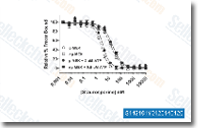
| S1421 | Staurosporine (STS) | Staurosporine (STS) ist ein potenter PKC-Inhibitor f R PKC R, PKC und PKC mit einer IC50 von 2 nM, 5 nM und 4 nM, weniger potent f R PKC (20 nM), PKC (73 nM) und wenig aktiv f R PKC (1086 nM) in zellfreien Assays. Diese Verbindung zeigt auch hemmende Aktivit ten auf andere Kinasen, wie PKA, PKG, S6K, CaMKII usw. Phase 3. |
|
|
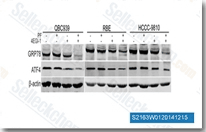
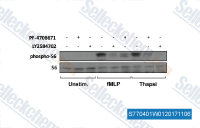
| S2163 | PF-4708671 | PF-4708671 ist ein zellgängiger Inhibitor der p70 ribosomalen S6 Kinase (S6K1-Isoform) mit einem Ki/IC50 von 20 nM/160 nM in zellfreien Assays, einer 400-fach höheren Selektivität für S6K1 als S6K2 und einer 4- bzw. >20-fach höheren Selektivität für S6K1 als MSK1 und RSK1/2. Diese Verbindung induziert Autophagy. Es ist der erste S6K1-spezifische Inhibitor, der berichtet wurde. |
|
|
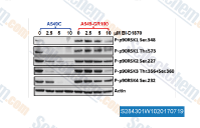
| S2843 | BI-D1870 | BI-D1870 ist ein ATP-kompetitiver Inhibitor der S6 ribosomale Proteine für RSK1/2/3/4 mit einer IC50 von 31 nM/24 nM/18 nM/15 nM in zellfreien Assays; 10- bis 100-fache Selektivität für RSK als MST2, GSK-3 D1870 zeigt Antikrebsattribute, einschließlich der Erzeugung von reaktiven Sauerstoffspezies (ROS) und einer Zunahme von ER-Stress und Autophagie. |
|
|
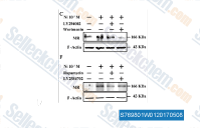
| S7698 | LY2584702 | LY2584702 ist ein selektiver, ATP-kompetitiver p70S6K-Inhibitor mit einer IC50 von 4 nM. |
|
|
| S7704 | LY2584702 Tosylate | LY2584702 Tosylate ist ein selektiver, ATP-kompetitiver p70S6K-Inhibitor mit einem IC50-Wert von 4 nM. Phase 1. |
|
|
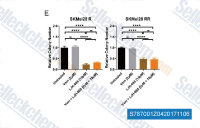
| S7870 | LJH685 | LJH685 ist ein potenter Pan-RSK-Inhibitor mit IC50 von 6 nM, 5 nM und 4 nM für RSK1, RSK2 bzw. RSK3. |
|
|
| S7871 | LJI308 | LJI308 ist ein potenter Pan-RSK (p90 ribosomale S6 Kinase)-Inhibitor mit einer IC50 von 6 nM, 4 nM und 13 nM für RSK1, RSK2 bzw. RSK3. |
|
|
| S0385 | S6K-18 | S6K-18 ist ein hochselektiver Inhibitor der ribosomalen Protein S6 Kinase Beta-1 (S6K1, p70S6K, p70-S6K). |
|
|
| S3940 | 3'-Hydroxypterostilbene | 3'-Hydroxypterostilbene (3'-HPT) ist ein aktiver Bestandteil von Sphaerophysa salsula und Pterocarpus marsupium, der bei der Behandlung verschiedener Arten hämatologischer Malignome nützlich sein könnte. Diese Verbindung, ein natürliches Pterostilben-Analogon, hemmt wirksam das Wachstum menschlicher Darmkrebszellen (IC50-Werte von 9,0, 40,2 bzw. 70,9 µM für COLO 205-, HCT-116- und HT-29-Zellen), indem es Apoptose und Autophagie induziert. Sie hemmt die PI3K/Akt/mTOR/p70S6K- und p38 MAPK-Signalwege und aktiviert die ERK1/2-, JNK1/2 MAPK-Signalwege. |
|
|
| E1754 | BRD7389 | BRD7389 ist ein Inhibitor der RSK-Familie von Kinasen mit IC50-Werten von 1,5 μM, 2,4 μM bzw. 1,2 μM für RSK1, RSK2 und RSK3. Diese Verbindung erhöht auch die β-Zell-spezifische Genexpression in primären menschlichen Inselzellen. | ||
The 70 kDa ribosomal protein S6 kinase (p70 S6K) is a serine/threonine kinase. There are two highly homologous members in S6K family, which are named as S6K1 and S6K2, respectively. Both S6Ks belong to the AGC family of serine/threonine kinases and they could be activated in response to many stimulus, like growth factors, insulin and cytokines. In turn, S6Ks phosphorylate its substrates including the ribosomal protein S6, elF4B, and SKAR. It was found that the activity of S6Ks could be controlled by mammalian target of rapamycin (mTOR) [2]. And then, direct phosphorylation of S6K1 by mTOR was confirmed [3; 4]. Therefore, the activity of S6K presented sensitive to rapamycin [8]. However, the sensitivity of S6Ks to rapamycin was found always changing. S6Ks became insensitive to rapamycin when the site T412 was phosphorylated [9]. Until recently, raptor has been proved to be responsible for T412 phosphorylation [6]. Besides, S6K−/− animals showed short-lived and were much smaller than wild type animals. A study suggested that this phenomenon was due to the control of S6K on cell growth rather than proliferation [5]. To date, S6Ks are also related to many serious diseases. For example, S6K1 showed overexpression in breast cancer patients [1]. With the understanding of the importance of S6K in human diseases, the demand for S6K-specific inhibitors increased rapidly. Fortunately, a novel inhibitor specific for S6K1, PF-4708671, was developed to facilitate the study of the functions of S6K1, at the same time, and S6K2 [7].

Produkte sind nur für Forschungszwecke bestimmt. Nicht für den menschlichen Gebrauch. Wir verkaufen nicht an Patienten.
©Copyright 2013 Selleck Chemicals. Alle Rechte vorbehalten.