
nur für Forschungszwecke
Chloramphenicol Antibiotics for Plant Cell Culture Hemmer
Kat.-Nr.S1677
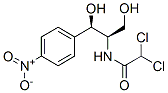
Chemische Struktur
Molekulargewicht: 323.13
Qualitätskontrolle
Chemische Informationen, Lagerung & Stabilität
| Molekulargewicht | 323.13 | Formel | C11H12Cl2N2O5 |
Lagerung (Ab dem Eingangsdatum) | |
|---|---|---|---|---|---|
| CAS-Nr. | 56-75-7 | SDF herunterladen | Lagerung von Stammlösungen |
|
|
| Synonyme | Chloromycetin | Smiles | C1=CC(=CC=C1C(C(CO)NC(=O)C(Cl)Cl)O)[N+](=O)[O-] | ||
Löslichkeit
|
In vitro |
DMSO
: 65 mg/mL
(201.15 mM)
Ethanol : 65 mg/mL Water : Insoluble |
Molaritätsrechner
|
In vivo |
|||||
In-vivo-Formulierungsrechner (Klare Lösung)
Schritt 1: Geben Sie die untenstehenden Informationen ein (Empfohlen: Ein zusätzliches Tier zur Berücksichtigung von Verlusten während des Experiments)
Schritt 2: Geben Sie die In-vivo-Formulierung ein (Dies ist nur der Rechner, keine Formulierung. Bitte kontaktieren Sie uns zuerst, wenn es im Abschnitt "Löslichkeit" keine In-vivo-Formulierung gibt.)
Berechnungsergebnisse:
Arbeitskonzentration: mg/ml;
Methode zur Herstellung der DMSO-Stammlösung: mg Wirkstoff vorgelöst in μL DMSO ( Konzentration der Stammlösung mg/mL, Bitte kontaktieren Sie uns zuerst, wenn die Konzentration die DMSO-Löslichkeit der Wirkstoffcharge überschreitet. )
Methode zur Herstellung der In-vivo-Formulierung: Nehmen Sie μL DMSO Stammlösung, dann hinzufügenμL PEG300, mischen und klären, dann hinzufügenμL Tween 80, mischen und klären, dann hinzufügen μL ddH2O, mischen und klären.
Methode zur Herstellung der In-vivo-Formulierung: Nehmen Sie μL DMSO Stammlösung, dann hinzufügen μL Maisöl, mischen und klären.
Hinweis: 1. Bitte stellen Sie sicher, dass die Flüssigkeit klar ist, bevor Sie das nächste Lösungsmittel hinzufügen.
2. Achten Sie darauf, das/die Lösungsmittel der Reihe nach hinzuzufügen. Sie müssen sicherstellen, dass die bei der vorherigen Zugabe erhaltene Lösung eine klare Lösung ist, bevor Sie mit der Zugabe des nächsten Lösungsmittels fortfahren. Physikalische Methoden wie Vortex, Ultraschall oder ein heißes Wasserbad können zur Unterstützung des Lösens verwendet werden.
Wirkmechanismus
| In vitro |
Chloramphenicol führt zu einem konstitutiven Anstieg des cspA-Transkriptspiegels und einer konstitutiven Produktion von CS7.4. Diese Verbindung reguliert das mitochondrial-DNA-kodierte Cox I-Protein herunter, aber nicht die nukleär kodierten Proteine. Es erhöht die zellulären Spiegel des p21(waf1/cip1)-Proteins und der p21(waf1/cip1)-mRNA über einen p53-unabhängigen Signalweg. Diese Chemikalie hemmt bei Konzentrationen von mehr als 0,1 g/L (0,3 mM) die Denitrifikationsenzymaktivität (DEA) von Gülle aus Humisol- und sandigen Lehmböden, indem sie die Aktivität bestehender Nitratreduktase-Enzyme stört. Bei Konzentrationen von 5 mM bis 2 mM leitet es die Apoptose in sich teilenden Zellen einer von Affennieren stammenden Zelllinie und in hämatopoetischen Vorläuferzellen aus menschlichem Nabelschnurblut ein. Diese Verbindung unterdrückt das Wachstum von Vorläuferzellen.
|
|---|---|
| In vivo |
Chloramphenicol führt bei Greyhounds zu einem erhöhten t1/2(beta) (um 209%), einem verringerten ClB (um 45%) und verlängerten Erholungsindizes (um 768 bis 946%). Diese Verbindung unterdrückt die Zunahme des Körpergewichts und des Lebergewichts von Versuchstieren und induzierte gleichzeitig einen bemerkenswerten Anstieg der Lipidperoxidation in der Leber während der Bildung von Megamitochondrien. Diese chemisch induzierte Bildung von Megamitochondrien ist nicht einfach auf die Unterdrückung des Teilungsprozesses der Mitochondrien aufgrund einer verminderten Proteinsynthese in Mitochondrien zurückzuführen, sondern steht in engem Zusammenhang mit oxidativem Stress.
|
Literatur |
|
Technischer Support
Tel: +1-832-582-8158 Ext:3
Wenn Sie weitere Fragen haben, hinterlassen Sie bitte eine Nachricht.

Produkte sind nur für Forschungszwecke bestimmt. Nicht für den menschlichen Gebrauch. Wir verkaufen nicht an Patienten.
©Copyright 2013 Selleck Chemicals. Alle Rechte vorbehalten.