
nur für Forschungszwecke
Busulfan Thioredoxin Reductase Inhibitor
Kat.-Nr.S1692
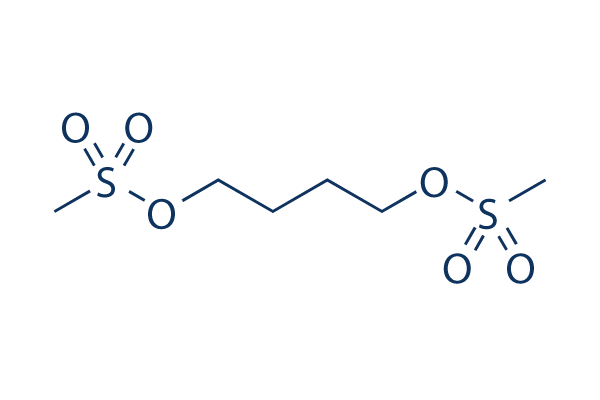
Chemische Struktur
Molekulargewicht: 246.3
Springe zu
Qualitätskontrolle
Charge:
Reinheit:
99.81%
99.81
Zellkultur, Behandlung & Arbeitskonzentration
| Zelllinien | Assay-Typ | Konzentration | Inkubationszeit | Formulierung | Aktivitätsbeschreibung | PMID |
|---|---|---|---|---|---|---|
| SK-N-SH cells | Proliferation assay | 10-100 μM | 72 h | Antiproliferative activity against human SK-N-SH cells at 10 to 100 uM after 72 hrs by MTT assay | 24814532 | |
| SiMa cells | Proliferation assay | 10-100 μM | 72 h | Antiproliferative activity against human SiMa cells at 10 to 100 uM after 72 hrs by MTT assay | 24814532 | |
| Kelly cells | Proliferation assay | 10-100 μM | 72 h | Antiproliferative activity against human Kelly cells at 10 to 100 uM after 72 hrs by MTT assay | 24814532 | |
| LS cells | Proliferation assay | 10-100 μM | 72 h | Antiproliferative activity against human LS cells at 10 to 100 uM after 72 hrs by MTT assay | 24814532 | |
| K562 | Apoptosis assay | 48 hrs | Induction of apoptosis in imatinib mesylate-resistant human K562 cells after 48 hrs | 18339455 | ||
| SK-N-MC | qHTS assay | qHTS of pediatric cancer cell lines to identify multiple opportunities for drug repurposing: Primary screen for SK-N-MC cells | 29435139 | |||
| NB-EBc1 | qHTS assay | qHTS of pediatric cancer cell lines to identify multiple opportunities for drug repurposing: Primary screen for NB-EBc1 cells | 29435139 | |||
| A673 | qHTS assay | qHTS of pediatric cancer cell lines to identify multiple opportunities for drug repurposing: Confirmatory screen for A673 cells) | 29435139 | |||
| Klicken Sie hier, um weitere experimentelle Daten zu Zelllinien anzuzeigen | ||||||
Chemische Informationen, Lagerung & Stabilität
| Molekulargewicht | 246.3 | Formel | C6H14O6S2 |
Lagerung (Ab dem Eingangsdatum) | |
|---|---|---|---|---|---|
| CAS-Nr. | 55-98-1 | SDF herunterladen | Lagerung von Stammlösungen |
|
|
| Synonyme | NSC-750 | Smiles | CS(=O)(=O)OCCCCOS(=O)(=O)C | ||
Löslichkeit
|
In vitro |
DMSO
: 49 mg/mL
(198.94 mM)
Water : Insoluble Ethanol : Insoluble |
Molaritätsrechner
Verdünnungsrechner
Molekulargewichtsrechner
|
In vivo |
|||||
In-vivo-Formulierungsrechner (Klare Lösung)
Schritt 1: Geben Sie die untenstehenden Informationen ein (Empfohlen: Ein zusätzliches Tier zur Berücksichtigung von Verlusten während des Experiments)
mg/kg
g
μL
Schritt 2: Geben Sie die In-vivo-Formulierung ein (Dies ist nur der Rechner, keine Formulierung. Bitte kontaktieren Sie uns zuerst, wenn es im Abschnitt "Löslichkeit" keine In-vivo-Formulierung gibt.)
% DMSO
%
% Tween 80
% ddH2O
%DMSO
%
Berechnungsergebnisse:
Arbeitskonzentration: mg/ml;
Methode zur Herstellung der DMSO-Stammlösung: mg Wirkstoff vorgelöst in μL DMSO ( Konzentration der Stammlösung mg/mL, Bitte kontaktieren Sie uns zuerst, wenn die Konzentration die DMSO-Löslichkeit der Wirkstoffcharge überschreitet. )
Methode zur Herstellung der In-vivo-Formulierung: Nehmen Sie μL DMSO Stammlösung, dann hinzufügenμL PEG300, mischen und klären, dann hinzufügenμL Tween 80, mischen und klären, dann hinzufügen μL ddH2O, mischen und klären.
Methode zur Herstellung der In-vivo-Formulierung: Nehmen Sie μL DMSO Stammlösung, dann hinzufügen μL Maisöl, mischen und klären.
Hinweis: 1. Bitte stellen Sie sicher, dass die Flüssigkeit klar ist, bevor Sie das nächste Lösungsmittel hinzufügen.
2. Achten Sie darauf, das/die Lösungsmittel der Reihe nach hinzuzufügen. Sie müssen sicherstellen, dass die bei der vorherigen Zugabe erhaltene Lösung eine klare Lösung ist, bevor Sie mit der Zugabe des nächsten Lösungsmittels fortfahren. Physikalische Methoden wie Vortex, Ultraschall oder ein heißes Wasserbad können zur Unterstützung des Lösens verwendet werden.
Wirkmechanismus
| In vitro |
Busulfan hemmt die Frequenz von „Cobblestone Area-Forming Cells“, führt aber nicht zu einem signifikanten Anstieg der Apoptosis in hämatopoetischen Stammzell-ähnlichen Zellen und Vorläufern. Diese Verbindung hemmt die hämatopoetische Funktion von HSC-ähnlichen Zellen und Vorläufern über einen Apoptosis-unabhängigen Mechanismus. Es induziert die Seneszenz hämatopoetischer Knochenmarkzellen, die mit einer erhöhten Expression von p16Ink4a und p19Arf in einer zeitabhängigen Weise verbunden ist. Diese Chemikalie, ein Alkylating Agent, das DNA Damage durch Quervernetzung von DNAs sowie DNA und Proteinen verursacht, induziert Seneszenz in normalen menschlichen diploiden WI38-Fibroblasten über die extrazelluläre Signal-regulierte Kinase (Erk) und p38-Mitogen-aktivierte Proteinkinase (p38 MAPK)-Kaskade, unabhängig vom p53-DNA Damage-Signalweg. Es induziert eine vorübergehende Reduktion von GSH, aber einen kontinuierlichen Anstieg der ROS-Produktion. Die durch diese Verbindung induzierte Hypophosphorylierung von Rb verhindert die Apoptosis von spermatogonialen Stammzellen, indem sie die PCNA-Expression in Hoden-Zellen hemmt. |
|---|---|
| In vivo |
Mit Busulfan behandelte Mäuse zeigen einen deutlichen Anstieg der Apoptosis und eine Abnahme des Hodengewichts. Diese Verbindung wird in einer Dosis von 40 mg/kg Körpergewicht verabreicht, um eine maximale Anzahl apoptotischer Zellen zu induzieren, während die Anzahl nekrotischer Zellen minimiert wird. Seine Konditionierung und Bestrahlung führen zu einer vergleichbaren Sensitivität der HSC-Detektion, bewertet durch eine Grenzverdünnungsanalyse bei NOD/SCID-Mäusen. Bei mit dieser Chemikalie transplantierten Mäusen kommt es zu einem langsamen und unvollständigen lymphoiden Engraftment. Es (20 mg/kg bis 100 mg/kg) bewirkt eine dosisabhängige kongenische lymphoide Rekonstitution bei Mäusen. |
Literatur |
|
Anwendungen
| Methoden | Biomarker | Bilder | PMID |
|---|---|---|---|
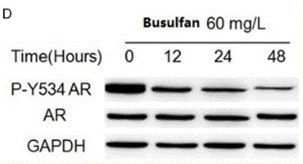
| Western blot | p-Y534 AR / AR Ack1 / Src |
|
27904688 |
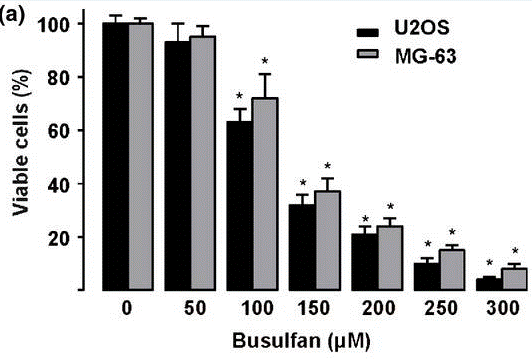
| Growth inhibition assay | Cell viability |
|
24815002 |
Klinische Studieninformationen
(Daten von https://clinicaltrials.gov, aktualisiert am 2024-05-22)
| NCT-Nummer | Rekrutierung | Erkrankungen | Sponsor/Kooperationspartner | Startdatum | Phasen |
|---|---|---|---|---|---|
| NCT04451200 | Not yet recruiting | Acute Leukemia|Mielodysplasic Syndrome|Myeloproliferative Neoplasm |
Institut Paoli-Calmettes |
November 2020 | Phase 2 |
| NCT03601286 | Recruiting | Severe Combined Immunodeficiency X-Linked |
Great Ormond Street Hospital for Children NHS Foundation Trust |
December 21 2018 | Phase 1 |
| NCT03235973 | Unknown status | Leukemia Myeloid Acute|Leukemia Lymphoblastic Acute |
Institut Paoli-Calmettes |
April 28 2018 | Phase 1 |
Technischer Support
Tel: +1-832-582-8158 Ext:3
Wenn Sie weitere Fragen haben, hinterlassen Sie bitte eine Nachricht.
Häufig gestellte Fragen
Frage 1:
How can I reconstitute it for in vivo studies?
Antwort:
This compound also can be dissolved in 2% DMSO+30% PEG 300+5% Tween 80+ddH2O at 5mg/ml as a clear solution. When preparing the solution, please dissolve it in DMSO clearly first. Then add PEG and Tween. After they mixed well, dilute with water. It in this formulation is not suitable for long-term storage. Please make the fresh solution each time before use.

Produkte sind nur für Forschungszwecke bestimmt. Nicht für den menschlichen Gebrauch. Wir verkaufen nicht an Patienten.
©Copyright 2013 Selleck Chemicals. Alle Rechte vorbehalten.